
The Iranian Navy's limited maneuvers raise concerns about its readiness following the recent US-Israel strike amid escalating tensions.
On February 28, tensions in the Middle East reached a peak just before the United States and Israel's preemptive strike against Iran. The signs of the impending attack manifested through unusual changes in military and civilian movements.
As the USS Gerald R. Ford (CVN-78) aircraft carrier strike group approached the Israeli coast, international airlines altered their routes passing through Iranian airspace a day in advance. However, it was observed that the Iranian regular navy, Nedaja, did not conduct a mass maneuver to set sail from its main ports until hours before the attack.
Critical Movements in Bandar Abbas
As of February 25, frigates belonging to Nedaja, namely IRINS Sabalan (F73), IRINS Sahand (F74), IRINS Jamaran (F76), and IRINS Zagros (H313), were anchored at Bandar Abbas Sea Port.
In the later hours of February 28, unverified reports suggested that IRINS Jamaran (F76) had been attacked.
The IRINS Taregh (S901), which was assessed to be semi-operational in the inner harbor, and IRINS Nooh (S902), undergoing extensive maintenance in a dry dock, were present. The whereabouts of the third Kilo-class submarine, IRINS Yunes (S903), remain unknown since it left the dry dock a few months ago.
Another noteworthy aspect was the absence of logistics vessels in the port. IRINS Kurdestan (K442) was located in the outer harbor on February 27, but the following day it changed position, replaced by the converted tanker IRINS Makran (K441).
The catamaran corvette IRIS Shahid Nazeri, belonging to the Iranian Revolutionary Guard Navy (Nedsa), was anchored in the western basin as usual, while the drone carrier IRIS Shahid Mahdavi (C110-3) and IRIS Shahid Bagheri (C110-4) were seen in their normal positions off the coast of Bandar Abbas on February 27.
Explosion and Sinking at Konarak Naval Base
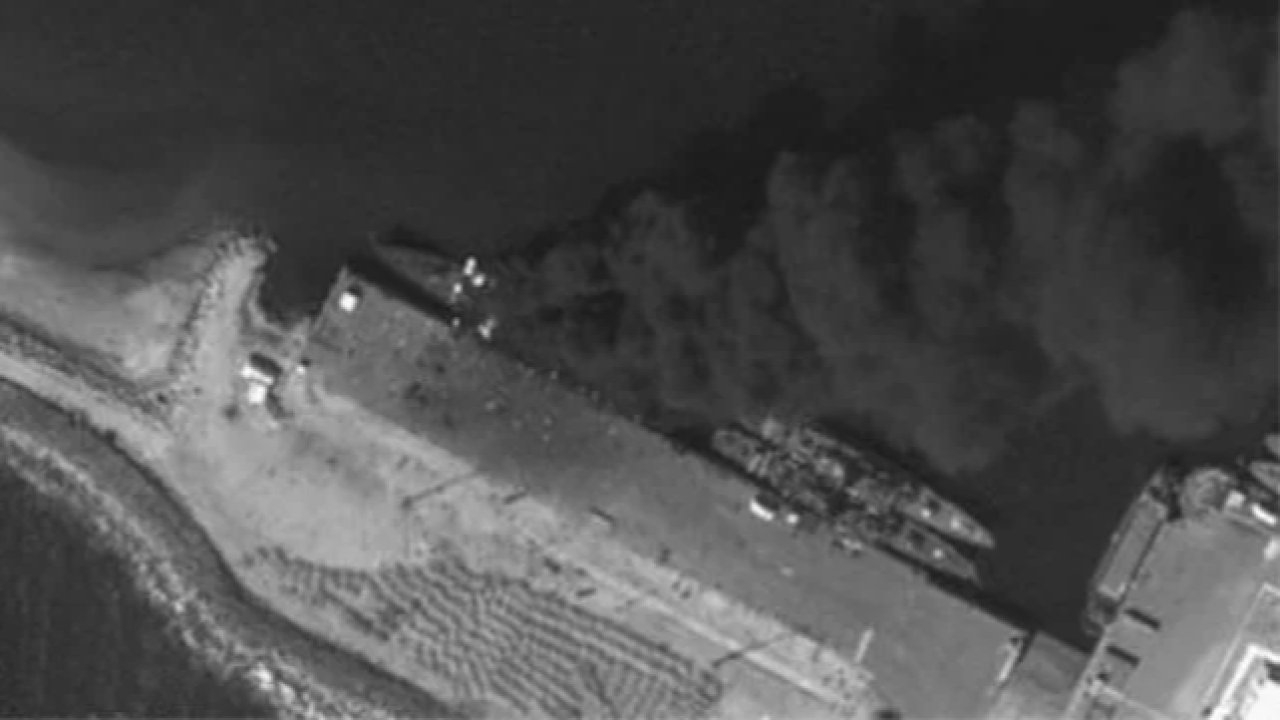
Satellite images dated February 28 revealed a striking scene at the Konarak Naval Base near Chah Bahar in eastern Iran. Smoke was seen rising from a dock likely occupied by a frigate, and a ship was observed sinking with debris scattered around.
The two fast attack boats, likely of the Kaman class, located side by side, were assessed to have sustained no damage.
On the same day, it was claimed that the 10TAB air base in Chah Bahar was also targeted, with fortified shelters storing anti-ship drones being struck.
Silence at Jask Naval Base
Images from February 27 at Jask Naval Base, the central hub of the Nedaja Naval Region, showed only one patrol boat. It appears that no vessels have been shifted from Bandar Abbas to this normally limited-use base.
This situation indicates that the Iranian navy did not conduct a large-scale preemptive deployment before the attack.
Trump: 'We Will Destroy Their Navies'
U.S. President Donald Trump, while announcing the attack, stated, 'We will destroy their navies' under the 'Epic Fury Operation.' However, it remains unclear whether he was referring to Iran's regular navy, Nedaja, or the Revolutionary Guard Navy, which is associated with threats in the Strait of Hormuz.
Initial reports indicate that both Nedaja and Nedsa elements were targeted.
Energy Facilities Also in the Crosshairs
According to initial attack reports, the oil loading terminal on Kharg Island was struck. If confirmed, it is believed that facilities such as the Single Point Mooring System off Jask and the under-construction Bushehr LNG Terminal may also have been targeted.
Previous attacks had not targeted refineries in the interior. This time, it is noted that the scope may expand.
Traffic in Hormuz Decreased
On the night of February 28, the eastern outbound channel of the Strait of Hormuz Traffic Separation Scheme was filled with vessels exiting the Gulf. However, traffic entering was quite limited. As of March 1, external traffic had dropped to a few vessels, with almost no passage inward.
While the UK-based MTO organization in Dubai did not publish an incident report, maritime circles indicate that the uncertainty in the region could significantly impact commercial traffic.
Houthis' Statement on the Red Sea
Before the attack, the Houthi forces in Yemen announced that the 'Humanitarian Operations Coordination Center' would resume attacks on Israel-linked vessels in the Red Sea and the Gulf of Aden.
This statement has raised concerns that tensions along the line extending from the Gulf to the Red Sea may escalate further.
As military activity continues in the region, it is considered that a critical period has begun for both energy markets and global maritime trade.
Source: SeaNews Türkiye


