
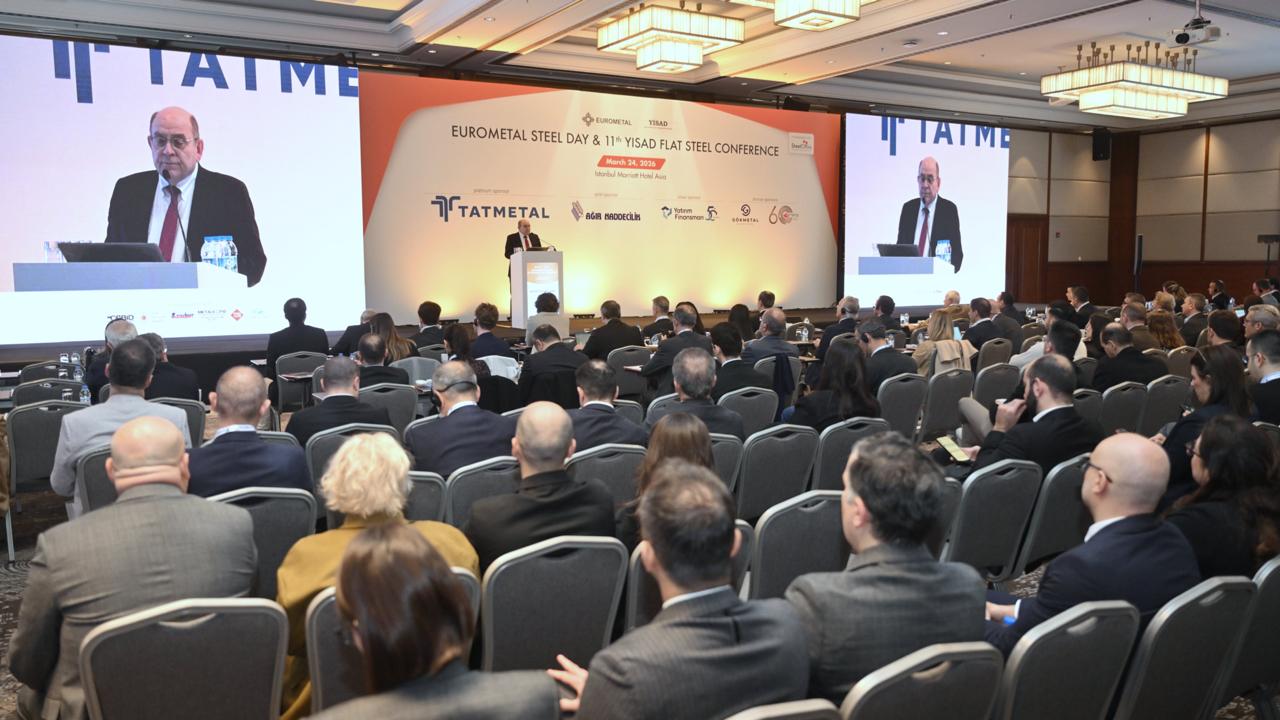
The Eurometal Steel Day in Istanbul highlighted cost pressures, protectionism, and evolving trade dynamics in the global steel market.
The global steel market is being shaped by protectionism, cost pressures, and changing competitive balances.
On Tuesday, March 24, the Eurometal Steel Day & 11th YISAD Flat Steel Conference took place at the Istanbul Marriott Hotel Asia with nearly 400 participants, sponsored by Tatmetal and in collaboration with SteelOrbis. Other sponsoring companies included Heavy Rolling, Investment Finance, Gökmetal, and Yametaş.
Global developments and sector evaluations
In his opening speech, YISAD Chairman Metin Tayfun İşeri emphasized the challenges faced by the steel sector in recent years, as well as the rising costs and strengthening tendencies of protectionism.
EUROMETAL President Alexander Julius stated in his presentation that the EU's new trade measures and the Carbon Border Adjustment Mechanism (CBAM) would exert upward pressure on prices and lead to a contraction on the supply side.
Following him, İş Bankası General Manager Hakan Aran remarked that despite economic and geopolitical risks, there is an opportunity window open for Turkey, suggesting that Turkey could increase its steel exports due to new demand that may arise in nearby geographies. Aran also pointed out that the demand in the iron and steel sector is highly sensitive to economic activities, stressing the importance of diversifying export markets and deepening in certain countries, especially as the EU's growth forecasts for 2026 are being revised downward. He highlighted the necessity for producers to take precautions against the volatility in raw material supply, freight, and energy prices during this process.
The final speaker of the opening session, Tatmetal CEO and Executive Board Chairman Tolga Yalgı, expressed that the rules of competition have fundamentally changed in a new order shaped more by state interventions than by free market dynamics, where strategic sectors are protected, indicating that competition now occurs not between companies, but between the industrial policies of countries.
CBAM, cost pressure, and trade order
In the first session, SteelOrbis General Manager Murat Eryılmaz stated that the effects of CBAM, import pressure, and rising energy and freight costs will continue to be decisive for the sector, noting that price increases are largely cost-driven rather than demand-driven.
Following Eryılmaz, Anıl Akalın, Head of Environmental Markets, Turkey, and Gulf Countries at Redshaw Advisors, emphasized that CBAM would significantly increase costs for companies exporting to the EU market and reshape trade flows. He also reminded that by 2034, all embedded emissions would be included in the scope.
European market and geopolitical risks
In the second session of the conference, Cosmin Bakai, Global Director of Raw Material Supply Chain Development at Autoliv, presented developments in the European automotive market, stating that the European automotive components sector is under pressure from competition originating from China, increasing imports, and geopolitical uncertainties. Bakai also added that he does not expect a clear recovery for the European steel industry in the short and medium term.
At the end of the second session, Lars Hillmann, Lawyer and Legal Advisor from Cattwyk, explained the legal framework of the steel trade measures that will be introduced when the EU's protection measures come to an end. He noted that the current protection measures in the EU would be replaced by permanent steel trade measures, indicating that the quota tonnage is planned to decrease by 47% compared to the current measures, and taxes applied in case of quota exceedance are expected to be raised to 50%, which would significantly tighten the EU's protection measures on steel imports.
Disruptions from the Strait of Hormuz
In the final session of the conference, Dr. Barış Esen, Corporate Communication Director at Investment Finance, and Şant Manukyan, Deputy General Manager at İş Investment, evaluated the impacts of Turkey and global economic conditions along with geopolitical developments, discussing the reflections of the recent situation in the Middle East and disruptions stemming from the Strait of Hormuz on oil prices, as well as the potential market reactions if the war prolongs.
Source: SeaNews Türkiye


