
Turkey's flat steel sector grapples with oversupply, CBAM, and financial pressures, as discussed at the SteelOrbis Market Talks on April 7.
How will the Turkish flat steel sector move under excess supply, CBAM, and financing pressure?
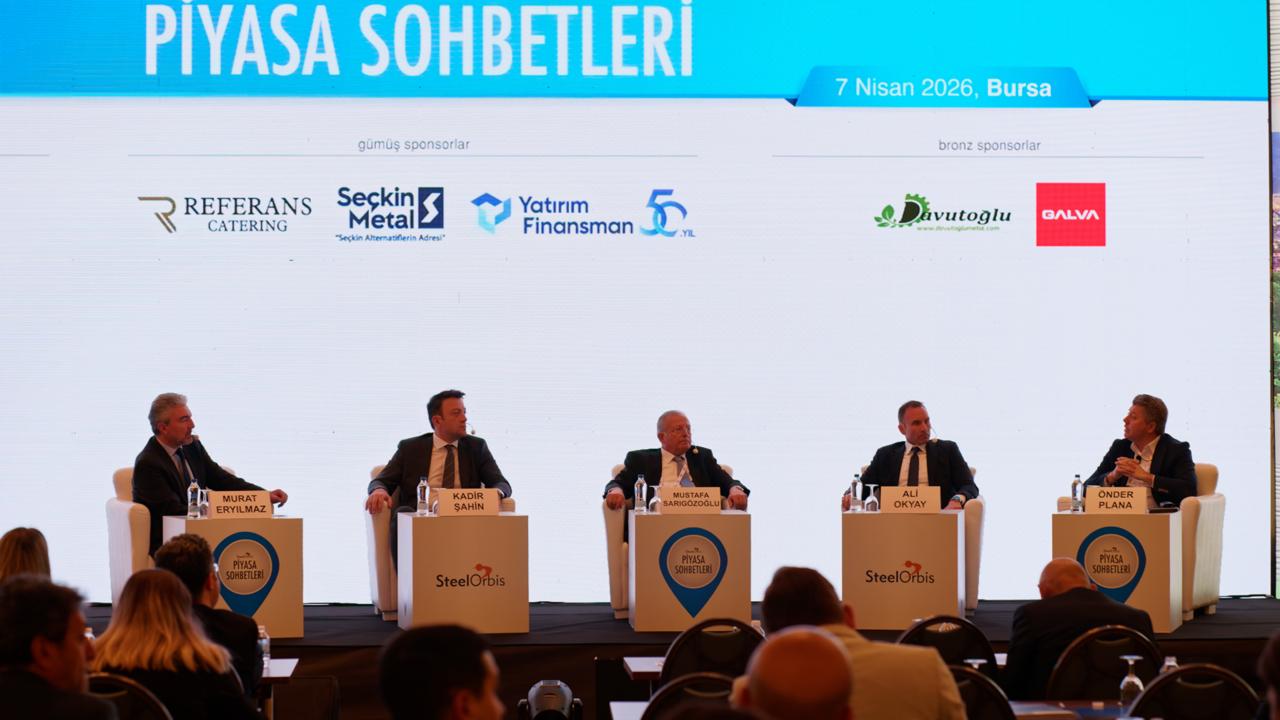
On Tuesday, April 7, at the Hilton Convention Center in Bursa, the SteelOrbis Market Talks took place with over 650 participants, where the current state of the Turkish flat steel sector and expectations for 2026 were comprehensively evaluated by leading representatives of the industry. The meeting, supported by Erdemir, was sponsored by Referans Catering, Seçkin Metal, Yatırım Finansman, Davutoğlu Metal, and Galva Metal.
In his opening speech, Erdemir-Isdemir Board Member and Executive Member Serdar Başoğlu emphasized that the sector has deviated from its usual cyclical structure since 2022, defining the current process as a 'paradigm shift.' Başoğlu stated, 'Since 2022, excess supply has entered our lives. This has led to aggressive export policies, and protectionist measures have tightened,' expressing that a permanent transformation is occurring in global markets.
Başoğlu also pointed out that the strategic importance of steel is increasing, reminding that despite Turkey's production capacity, it has a high dependency on imports. 'There is no other country among the top 10 that imports as much steel as we do. This shows us how strategic the steel sector is,' he indicated, highlighting the sector's vulnerabilities.
Steel and automotive: A transformation beyond cost
In the session titled 'Current Developments in the Steel Sector and Their Reflections on Automotive,' Erdemir Sales and Marketing Director Kadir Şahin noted that the demand structure has changed in recent years, particularly due to the impact of electric vehicles, stating, 'Steel has now moved beyond being a commercial product to becoming a product expected to provide technological contributions.' Şahin expressed that automotive manufacturers are shifting towards lighter, stronger, and lower-carbon products.
Mustafa Sarıgözoğlu, Chairman of the Board of Sarıgözoğlu A.Ş, stated that no material has yet been found that can completely replace steel, but alternatives are becoming increasingly visible. Sarıgözoğlu emphasized, 'We are in a process where lightweight yet strong steel is in demand, but alternative materials are also beginning to emerge,' highlighting the multifaceted transformation in the sector.
Ali Okyay, General Manager of Kalibre Boru, mentioned that the demand for special alloy lightweight steel has increased with electric vehicles, and they have observed a shift towards aluminum in some sheet products, indicating that alternative materials are coming to the forefront.
Önder Plana, Purchasing Director at Oyak Renault, approached the topic from the end-user perspective, stating that steel has now gained an 'identity.' Plana remarked, 'Steel is no longer just about sheets; it is shifting towards being a technological product,' drawing attention to the strategic dimension of the transformation in the sector.
Regarding the Border Carbon Adjustment Mechanism (CBAM), one of the important agenda items, the panelists emphasized the pressure this application will create on competition in the short term. Ali Okyay pointed out the protective aspect of the system by stating, 'It is called a carbon certificate, but in fact, it is a tax.' Önder Plana stressed that CBAM should not only be viewed as a cost factor, emphasizing that it is actually 'a long-term competitive regulation.' Kadir Şahin from Erdemir acknowledged that there may be challenges in the short term but expressed that this process could be overcome with new investments.
One of the most striking observations in the session was the assessment that the sub-industry is caught between the producer and the main industry. Ali Okyay summarized this situation by stating, 'As the automotive sub-industry, we are caught between the increasing expectations of the main industry and the constraints of steel producers,' emphasizing that the cost increases and delivery delays experienced, particularly in special quality products, are challenging competitiveness.
Recent developments will reshape global steel trade
In the second session titled '2026 Outlook for the Turkish Flat Steel Sector - Demand Dynamics, End-User Industries, and the Impact of EU Regulations,' discussions revolved around short-term trends in the sector, medium to long-term expectations, the effects of global geopolitical developments, and monetary policies on the real sector. It was emphasized that a cautious balancing process is anticipated rather than a strong recovery for 2026.
Erdemir Marketing Planning Director Mehmet Tahir Zazaoğlu reminded that the consumption of flat steel products in Turkey is approximately 19 million tons, stating that domestic demand remains strong, but production is under pressure due to high import rates. It was noted that developments in Iran affect not only energy costs but also other raw material and logistics costs, and the shutdown of steel facilities in Iran following attacks could reshape trade flows.
Bahar Parladı, a Board Member of Parladı Metal, stated that 2025 has been quite challenging for the sector, expressing that this period has been more about risk management and survival than growth. According to Parladı, demand in the domestic market has not completely disappeared but is significantly postponed.
Şebnem Güner, General Manager of Warmhaus, identified high financing costs as the most significant factor suppressing demand. Güner pointed out that the weakness in the housing and durable goods sectors directly affects steel demand, stating that companies are now inclined to operate with minimal stock and only purchase as much as needed.
Murat Urun, General Manager of RAM and Vice Chairman of the Board of TURKTRADE, indicated that the increasing trade wars, sanctions, and geopolitical developments in recent years point to a new world order, expressing that he believes the increase in steel demand in the automotive and white goods sectors will remain limited.
Following the sessions, Dr. Barış Esen, Corporate Communication Director of Yatırım Finansman, and Fatih Keresteci, founder and strategist of DNG Consulting, Research, and Education Ltd., delivered a presentation on the Turkish and global economy, sharing insights on the geopolitical crisis created by the Strait of Hormuz, recent expectations, and how current monetary policies will affect the steel sector.
Source: SeaNews Türkiye


