
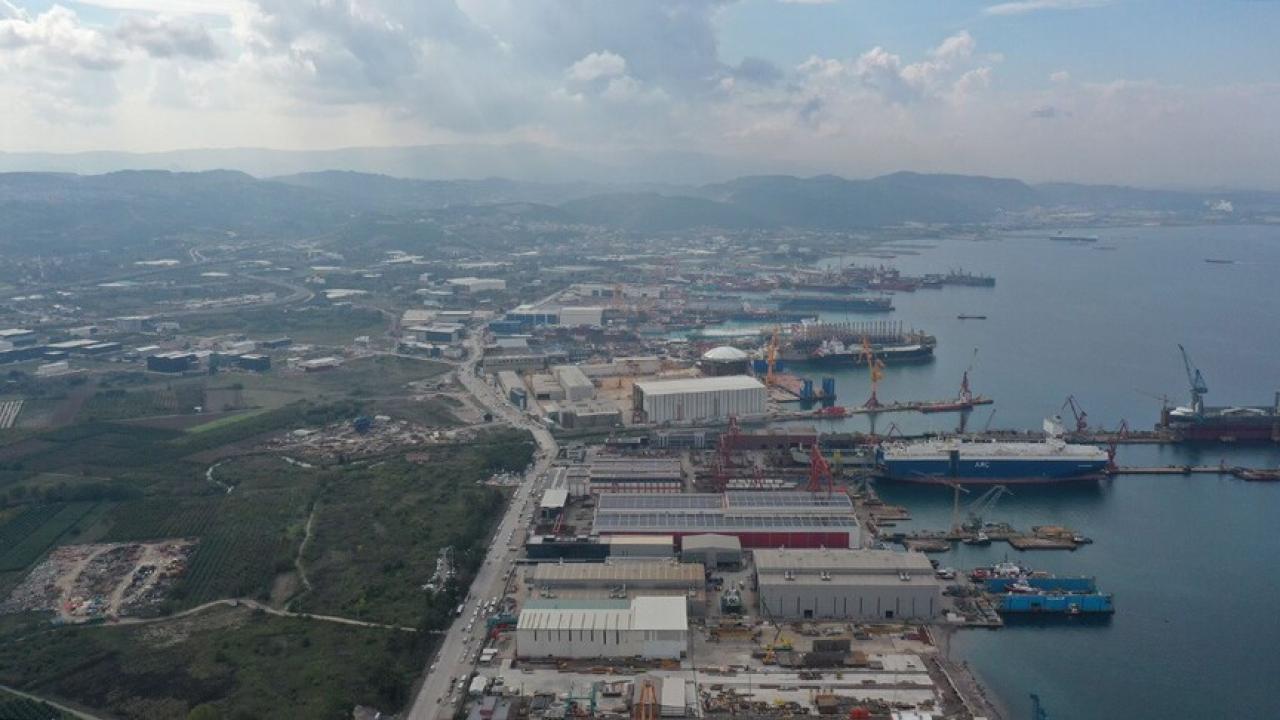
Türkiye's ship and yacht exports surged 78.6% to $585 million in Q1 2023, driven by strong demand and shifts in delivery schedules.
According to data compiled from the Turkish Exporters Assembly (TİM), the export of ships, yachts, and related services increased by 78.6% year-on-year in the January-March period, rising from $327.6 million to $585 million. Thus, the growth rate approached 80%.
Among the countries with the highest exports during this period, Norway led with $183.6 million, followed by Malta with $77.4 million, the United Kingdom and France with $68 million each, and the United Arab Emirates with $34.1 million.
The Marshall Islands, Panama, Tunisia, Greece, and Singapore also ranked among the top 10 countries for exports.
Cem Seven, President of the Ship, Yacht, and Services Exporters Association (GYHİB), stated regarding the sector's export performance in the first quarter that the increase during the January-March period was influenced by demand as well as shifts in delivery schedules. He explained that some yachts and ships scheduled for delivery in December 2025 were postponed to January and February of this year, and that such situations can occasionally occur in the sector.
Seven noted that global ship and yacht exports have reached a size of $120-140 billion, with China taking the lead in 2025 with $63 billion in exports, followed by South Korea with approximately $30 billion, and Japan in third place.
Emphasizing that these three countries account for more than half of global ship and yacht exports, Seven stated, 'Turkey ranks 12th with a volume of $1.9-2.2 billion. The definitive ranking for 2025 is expected to become clear in the summer months.'
'Our labor and reliability hold significant importance in their eyes.'
Cem Seven pointed out that among the leading countries in Turkey's exports are not only Norway but also Denmark and Finland, noting that France, the Netherlands, and Malta are important markets.
He reported that bulk carriers and tankers are primarily exported to Malta, while fishing vessels, ferries, and tugboats are exported to Norway. Continuing his remarks, he stated:
‘Factory fishing vessels and ferries exported to Norway always require high labor and high engineering. Especially alternative fuel products are at the forefront of exports. Northern European countries place great importance on innovative projects. Innovation, design, and sustainability are very important because they are indicators of reliability. For instance, factory fishing vessels, crab and krill catching vessels operate in the North Sea under extremely challenging sea and weather conditions and are exposed to significant stress and wave pressure, which is why our engineering, labor, and reliability hold significant importance in their eyes.’
'From Europe's perspective, we are seen as producing quality products.'
GYHİB President Seven emphasized that Turkey has been the world champion in fishing vessel exports for many years, stating, 'Let’s underline this. Our biggest competitor was the shipyards in Spain. Indicators suggest that Turkey will also be the export champion in fishing vessels this year.'
Discussing the reasons for the preference and advantages of factory-type fishing vessels, Seven highlighted that quality stands out in the production process of Turkish ship and yacht products.
Seven stated, 'From Europe's perspective, we are seen as producing quality products. Our labor is very good. We can deliver the products we produce on time. I am talking about sustainable labor. The ships and yachts we produce and export are high-quality products made with good engineering. Both this and after-sales service from Turkish shipyards are customer-oriented.'
Describing how Turkish companies promptly take action to resolve encountered problems, Seven remarked, 'Our ships and yachts are built according to international regulations and shipbuilding norms. Not only is quality and sustainability important, but also performance is better than other shipyards abroad, which is why Northern European countries prefer Turkish shipyards.'
'VAT exemption should continue.'
Cem Seven expressed that the green transformation process in line with the International Maritime Organization's 2030 goals has increased demand in the sector, noting that there has been a surge in orders from abroad for Turkish shipyards. However, sometimes difficulties arise in meeting this demand due to rising labor costs.
Seven indicated the need for incentives suitable for the dynamics of the sector, stating, 'Especially, the continuation of the VAT exemption applied during the construction of vessels under 24 meters is necessary. The expansion of this exemption, which was previously applied without size limitations, would contribute to the sector. Extending the foreign currency conversion support for ship and yacht construction from 6 months to 24 months will make the shipyards more competitive.'
Source: SeaNews Türkiye


