
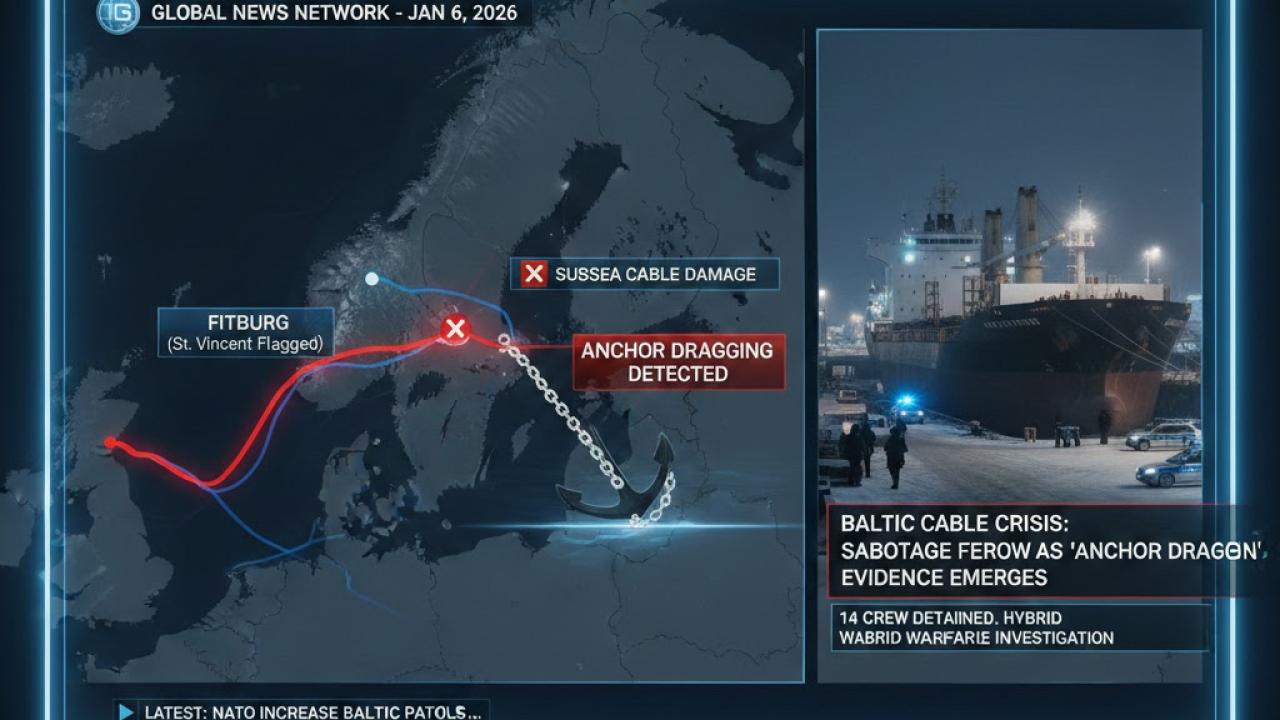
HELSINKI – A critical turning point has been reached today in the international investigation following the breaks in the underwater fiber optic cables facilitating data flow between Finland and Estonia in the Baltic Sea. The Finnish National Bureau of Investigation (NBI) and Latvian authorities are assessing the damage.
HELSINKI – A critical turning point was reached today in the international investigation following the breaks in the underwater fiber optic cables facilitating data flow between Finland and Estonia in the Baltic Sea. The Finnish National Bureau of Investigation (NBI) and Latvian authorities shared new technical findings related to the cargo ship believed to have caused the damage.
According to the latest reports shared today, it has been confirmed that the cargo ship named Fitburg, flagged under Saint Vincent and the Grenadines, slowed down at the coordinates where the cable damage occurred and deviated from its usual route. Sonar examinations conducted on the seabed revealed that the ship's massive anchor was dragged for kilometers, indicating that it was "sweeping the bottom." It was determined that these dragging traces cut the fiber optic cable line right in the middle.
The ship, which departed from St. Petersburg heading towards Haifa port in Israel, was stopped by the Finnish Coast Guard and towed to Kantvik Port. The 14 crew members, who are Russian, Georgian, and Kazakh nationals, were detained on suspicions of "causing serious damage to property" and "sabotage of critical infrastructure." The Finnish prosecutor's office seized the crew's digital records to determine whether the incident was merely a technical error or a planned hybrid attack.
The cargo on board, which consists of Russian steel subject to EU sanctions, has further escalated tensions in the region. The Latvian Ministry of Foreign Affairs emphasized that the occurrence of similar "accidents" in the underwater infrastructure of the Baltic Sea for the sixth time in the last two years cannot be a coincidence. Experts point out that the method of dragging anchors is increasingly being used as a sabotage technique disguised as an "accident" rather than a direct attack.
As NATO's "Baltic Sentinel" units increase their patrols in the region, it is estimated that the repair of the damaged lines will take weeks. With the deepening of the investigation, the question of whether the incident will escalate into a diplomatic crisis is being closely monitored by the global public.
Source: www.denizhaber.com


