28 new pilot candidates in İzmit Bay raise safety concerns; industry experts stress the need for supervised, practical training over rapid deployment.
It has been reported that 28 new candidate pilot captains have been sent to the authorized organization providing pilotage services in the Izmit Gulf in a short period. Industry representatives emphasize that deploying such a high number of candidates simultaneously poses risks to maritime safety; they stress that the internship should be conducted 'in practice' under the supervision of a master, rather than merely 'on paper.'
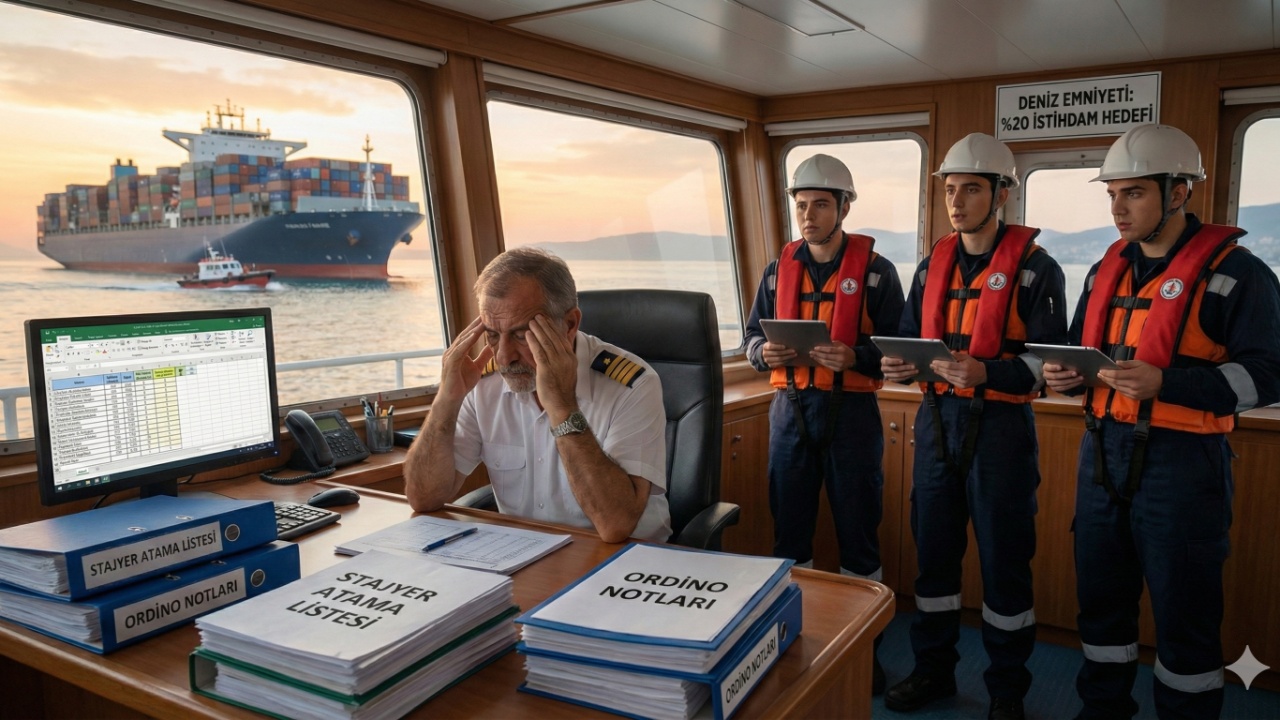
At the center of the debate is the question of who has the authority to plan and initiate the internship, along with the claim that interns are being sent to ships based on 'ordino' notes.
The regulations state '60 days'; the pressure to 'start immediately' is criticized.
Sources from the authorized organization indicate that the Regulation on Seafarers and Pilot Captains provides a clear upper limit for the start of internships; it is mandatory for the candidates reported by the administration to begin their internships within a maximum of 60 days, but this regulation cannot be interpreted as 'send everyone to the ship the next day.' This provision imposes an obligation on the pilotage organization and the candidate to start within 60 days.
According to the organization’s claim, conducting a gradual and safety-focused program within this timeframe is essential for both educational quality and operational safety.
Internship is not just 'watching the ship'; it requires master supervision, day-night balance, and practical training.
The regulations tie the internship of candidate pilot captains to concrete criteria that resemble the 'master-apprentice' concept: The candidate must undergo an internship under the supervision of an authorized pilot captain in the organization designated by the administration, on at least 30 ships, for a minimum of 30 days, and in a balanced manner between day and night, without interruptions.
Additionally, during the internship/assignment training, there are extra obligations such as 5 days of practical training on tugs belonging to the authorized tug organization and practical training regarding the structure/function of GTH (if it falls within the regional GTH scope).
This scenario strengthens the view that the approach of 'distributing a large group of interns to ships at once' contradicts the logic of training. The 'master-apprentice relationship' in pilotage is not a romantic slogan; it serves as the safety insurance of the profession, as the consequences of mistakes at sea are severe. (In short: This job is not learned by adding rows in Excel.)
Claim of 'sending interns via ordino': Is the organization being sidelined?
The organization and professional circles claim that notes regarding the intern are being included in the ordinances related to some ship movements, directing candidates to the ships in practice; this results in the internship being conducted outside the planning and approval of the organization.
At this point, the critical distinction is as follows: In the legislation, the concept of 'Administration' is defined as the General Directorate of Maritime Affairs of the Ministry of Transport and Infrastructure; the training responsibility of the authorized organization is carried out within this framework.
The approach of the authorized organization is clear: The internship does not exclude the administration's oversight and control authority; however, the actual organization of training is the responsibility of the pilotage organization.
Dimension of SGK and employment relations: Who bears the responsibility?
Another dimension of the internship debate is the aspect of labor and social security. The Regulation on Seafarers and Pilot Captains stipulates that the rights arising from labor and social security legislation during the internship and assignment training are the responsibility of the authorized pilotage organization.
This provision indicates that 'the intern boarding the ship' is a process that has not only operational but also labor law/social security consequences. On the organization’s side, concerns are raised that conducting practical dispatch without completing organizational and registration processes would make the oversight traces and responsibility chain debatable.
The role of the administration: There is an obligation to provide internships; what should the method be?
The Ministry of Transport and Infrastructure legislation imposes an obligation on those providing pilotage services to conduct assignment training for a certain number of candidates; the durations of this training are also determined with reference to the Regulation on Seafarers and Pilot Captains.
However, the same legislative system also indicates that the internship certificates to be issued at the end of the internship and the opinions regarding the candidate will be reported to the port authority by the pilotage organization; this shows that the documentation mechanism will operate through these notification processes.
Therefore, industry representatives argue that enforcing the internship 'by noting it in the ship movement document' could weaken the educational system.
The '20%' condition and the balance of human resources in the field.
The increase in the burden of internships also brings up tenders and human resource planning. In applications for pilotage service operation rights tenders, it is stipulated that the minimum number of pilot captains that must be employed before the contract is at least 20% of the required qualifications for the relevant service area must be demonstrated with an employment contract/SGK registration/commitment letter.
Professional circles warn that if such thresholds turn into pressure to 'rapidly train the remaining staff' in practice, the internship could become constrained by quantity.
The association emphasizes 'maritime safety'; legal avenues are being considered.
It is noted that the Turkish Pilot Captains Association is closely monitoring the process in terms of maritime safety and training standards; they are evaluating administrative and judicial options regarding claims that the internship is being conducted in violation of the regulations.
In summary, the debate is not centered on whether 'internships should be conducted or not'; it revolves around how the internship will be carried out, with what capacity, and what safety measures will be implemented. Because in pilotage, experience serves to prevent the most expensive thing at sea—an accident.
Source: SeaNews Türkiye