
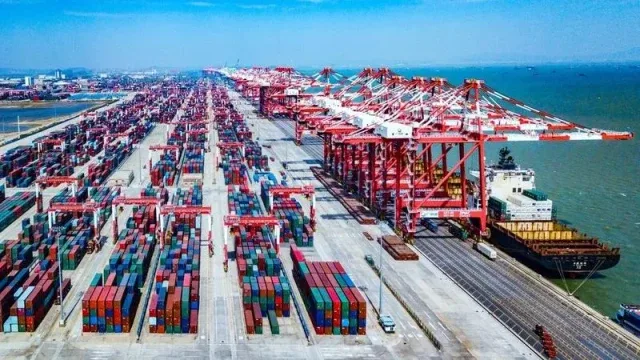
Qingdao Port International sees 3.2% cargo growth in nine months, but shares drop 5%, highlighting a disconnect between performance and market sentiment.
Qingdao Port International Co., Ltd. reported a 3.2% growth in cargo throughput for the first nine months of 2026, confirming continued operational expansion at one of northern China's principal maritime gateways. Despite this positive operational result, the company's shares have declined by 5%, separating the port's physical performance from its equity-market valuation.
Situated on the Shandong Peninsula, the Port of Qingdao serves as a primary maritime interface between northern China's industrial hinterland and international trade lanes. It consistently ranks among the world's largest container ports by volume. Qingdao Port International, which is listed on both the Hong Kong Stock Exchange and the Shanghai Stock Exchange, operates within the broader Shandong Port Group following the provincial consolidation of port assets in 2019.
The port handles a diversified portfolio of containerized freight, metal ore, coal, crude oil, and grain. This breadth of cargo classes makes it particularly relevant to manufacturers, retailers, and commodity traders whose supply chains depend on predictable berth availability and consistent vessel turnaround. The port's operational profile is further distinguished by the Qingdao Qianwan automated container terminal, which entered service in 2017 as Asia's first fully automated container terminal.
Compared with the same period last year, the 3.2% increase in nine-month cargo throughput indicates sustained, if moderate, growth in the volume of goods moving through the company's facilities. The figure was achieved during a period of variable global demand, shifting trade policies, and recurring route disruptions. In that context, the result points to a stable operational foundation rather than rapid acceleration.
Notwithstanding the throughput growth, the company's shares have declined by 5%. This movement reflects a divergence between the port's operational results and investor sentiment. No single cause for the decline has been established. Equity valuations in the port and logistics sector are routinely shaped by factors that extend beyond physical volumes, including expectations regarding revenue and margin performance, comparisons with prior-year growth rates and market forecasts, broader conditions affecting Chinese and Hong Kong equity markets, and prevailing assessments of global trade demand and tariff policy.
Accordingly, the share price movement should be understood as an indicator of market expectations rather than as evidence of operational deterioration. A throughput increase of 3.2%, while positive, may have been regarded by some market participants as modest relative to anticipated growth. That reading remains a matter of interpretation pending further financial disclosure from the company.
Nevertheless, prudent supply chain planning calls for continued monitoring. Subsequent financial disclosures, fourth-quarter volume data, and any announcements regarding capacity investment or tariff adjustments will provide a more complete basis for evaluating the port's medium-term trajectory. Diversified port strategies and contingency routing, therefore, remain advisable components of a comprehensive risk management framework.
Qingdao Port International's nine-month result demonstrates measured operational growth amid persistent uncertainty in global trade. The 5% share decline, by contrast, signals that investor expectations have not been fully satisfied by the throughput figure alone. For the shippers, forwarders, and importers whose cargo moves through the port, the operational data currently provides the more direct indication of service continuity. Further clarification on financial performance is expected to emerge as the company reports its full-year results.