
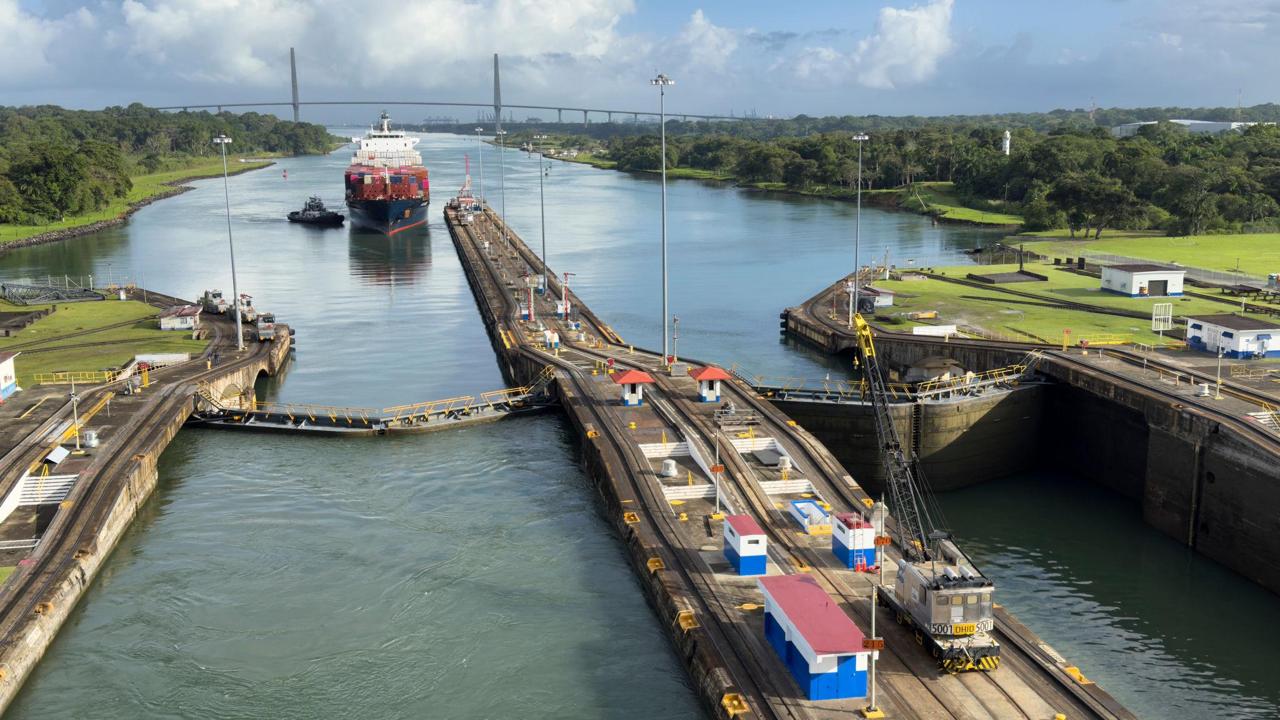
Panama Canal Authority reduces daily transit capacity, raising concerns over rerouting as alternatives remain impractical amid global security issues.
Effective 15 September, the Panama Canal Authority reduced daily transit capacity through the Panamax locks from 25 to 23 slots. The Neopanamax locks continue to operate at nine daily berths, with a maximum permitted draft of 48 feet. Meanwhile, the planned reduction of the Neopanamax draft limit to 47.5 feet, originally scheduled for implementation on 1 October, has been deferred.
For shipowners, the challenge has expanded beyond the matter of Panama Canal throughput. The more pressing question is whether viable alternative routing exists should the Panama passage become increasingly constrained.
Under normal circumstances, a restriction on one major trade route would prompt shipowners to consider the alternative intercontinental corridor. At present, however, security conditions along the Suez Canal and the Red Sea continue to affect vessel transits, while the evolving situation across the Middle East is reshaping routing decisions for fleets worldwide. A Member Alert issued by the Swedish Club on 14 September noted that, against the backdrop of water-related restrictions in the Panama Canal and security concerns along the Suez and Red Sea routes, the range of viable options available to shipowners is narrowing. This confluence of pressures has returned the southern tip of South America to active consideration.
A diversion around the southern extremity of South America involves two principal routes: the Drake Passage and the Strait of Magellan. The Drake Passage offers an open-ocean corridor that is relatively direct in alignment, but strong winds, heavy seas, and pronounced vessel motion introduce elevated risks of cargo shifting, equipment damage, and heightened mechanical load. The Strait of Magellan provides greater shelter but presents narrower channels and complex current patterns, placing greater demands on vessel maneuvering and passage planning. The Swedish Club advises that both routes require more thorough weather forecasting, detailed passage planning, and comprehensive crew preparation - and that pilotage arrangements may be required in certain segments.
The implications of a South American diversion extend well beyond navigational risk. Extended voyage distances translate directly into increased fuel consumption, longer transit times, and higher overall vessel operating costs. Pilotage through the Strait of Magellan may also give rise to cost-apportionment disputes. The Swedish Club notes that while pilotage is not mandatory for certain segments, shipowners may elect to engage pilots for safety reasons, potentially generating disagreements between shipowners and charterers over liability for those expenditures. Additionally, the low temperatures, remote operating environment, and limited emergency response infrastructure characteristic of the southern South American region must be incorporated into comprehensive voyage risk assessments.
The Swedish Club's assessment is that the current degree of restriction in the Panama Canal does not yet render South American rerouting a broadly viable alternative. Should waiting times increase further and draft limitations continue to tighten, however, the commercial calculus surrounding such diversions may shift. Shipowners and freight forwarders are advised to monitor not only slot availability and draft restrictions in the Panama Canal, but also whether routing adjustments introduce additional voyage distance, fuel cost, and operational expenditure. For the moment, South American rerouting is more accurately characterized as a contingency measure than as a direct substitute for the Panama Canal passage.


