
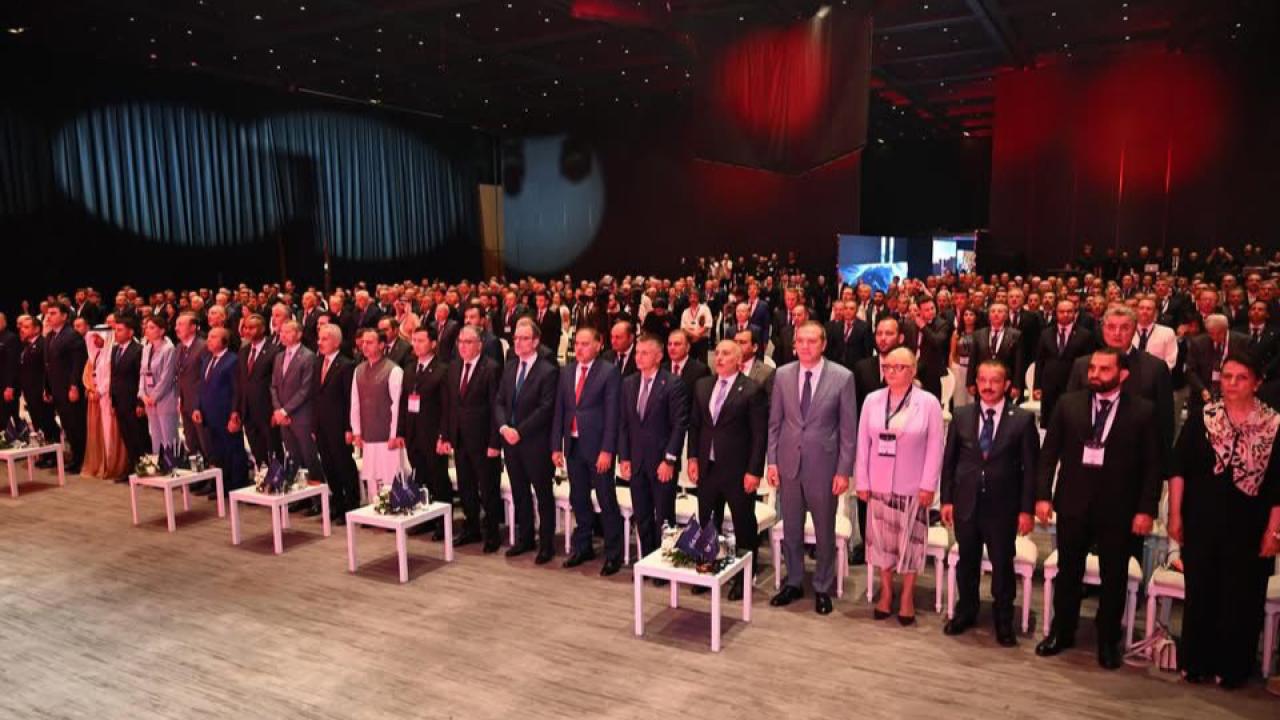
The 5th Turkey Maritime Summit, marking the 100th anniversary of the Cabotage Law, began in Istanbul, focusing on maritime collaboration and trade routes.
Maritime Summit Begins in Istanbul
The 5th Turkey Maritime Summit, organized under the leadership of the Ministry of Transport and Infrastructure, started in Istanbul on the 100th anniversary of the enactment of the Cabotage Law. In his opening speech, Minister of Transport and Infrastructure Abdulkadir Uraloğlu announced that a memorandum of understanding was signed with Saudi Arabia to revitalize the Hejaz Railway to create an alternative trade route to the Strait of Hormuz. IMO Secretary-General Arsenio Dominguez called for collective efforts to ensure that maritime activities and innocent seafarers do not become the ones paying the price in geopolitical conflicts.
ISTANBUL – The 5th Turkey Maritime Summit, which brings together representatives from the public sector, private sector, academia, and civil society in Turkish and global maritime, began on Thursday, July 2, 2026, in Istanbul. The summit, held in a historic venue established as a shipyard by Fatih Sultan Mehmet Han in 1455, is prepared in the context of the global maritime agenda to commemorate the 100th anniversary of the Cabotage Law, which came into effect on July 1, 1926.
The opening session began with the screening of a promotional film, followed by speeches from Tamer Kıran, Chairman of the Board of Directors of the IMEAK Chamber of Shipping (DTO), Ünal Baylan, General Director of Maritime Affairs at the Ministry of Transport and Infrastructure, Arsenio Dominguez, Secretary-General of the International Maritime Organization (IMO), and Minister Abdulkadir Uraloğlu. After the opening speeches, the 5th Maritime Summit Awards Ceremony was held to honor individuals and organizations that have contributed to Turkish maritime.
In addition to the IMO Secretary-General, the summit is attended by Egypt's Deputy Prime Minister and Minister of Transport and Industry Kamel Abdelhady Farag Elwazer, Somalia's Minister of Ports and Maritime Transport Abdulkadir Mohamed Nur, Pakistan's Federal Minister for Maritime Affairs Muhammad Junaid Anwar Chaudhry, Turkmenistan's Head of State Service for Maritime and River Transport Azat Shanazarov, Italy's Deputy Minister of Infrastructure and Transport Edoardo Rixi, and Georgia's Deputy Minister of Economy and Sustainable Development Tamar Ioseliani, along with senior representatives from UNCTAD, ICS, BIMCO, EMSA, and DP World.
Kıran: "Competition is possible by establishing a more environmentally friendly and resilient ecosystem"
In his opening remarks, Tamer Kıran, Chairman of the Board of IMEAK DTO, noted that the summit coincides with the 100th anniversary of the enactment of the Cabotage Law, one of the most significant turning points in Turkish maritime history. He stated that the law, which came into effect on July 1, 1926, granted the right to coastal transportation under the Turkish flag exclusively to Turkish citizens, laying the legal foundation for the development of Turkish maritime. Kıran emphasized that one of the most important complementary steps in this process was the signing of the Montreux Convention on July 20, 1936, which fully secured Turkey's sovereign rights over its seas and legally reinforced its independence at sea.
Kıran pointed out that countries advanced in maritime affairs reached this level only after processes spanning several centuries, while Turkey has risen to 11th place in the world maritime trade fleet by 2026, reaching an internationally competitive level in various fields from shipbuilding to port management and maritime education. According to Kıran, the development of maritime cannot be measured solely by fleet size; the production and export performance of shipyards, contributions to the defense industry, operational capacity of ports, international standards of maritime education, and the qualified workforce are also among the main indicators of the level a country has achieved.
Recalling that approximately 87% of global trade is conducted by sea, Kıran stated that the Russia-Ukraine war, conflicts in the Middle East, security risks in the Red Sea and the Strait of Hormuz, and disruptions in global supply chains have once again highlighted how strategic the maritime trade sector is. He noted that environmental regulations enacted to combat climate change, new obligations to reduce carbon emissions, and alternative fuel technologies are bringing about a historic transformation in the sector, stating:
"Now, competition in maritime will not only be about having more ships; it will be possible by creating a more environmentally friendly, more digital, safer, and more resilient maritime ecosystem. Achieving the net-zero emissions target by 2050, as outlined in the GHG Reduction Strategy adopted by the IMO in 2023, has become a common goal for the entire global maritime community. Reaching this goal requires coordinated action not only from ship operators but also from fuel producers, shipyards, equipment manufacturers, ports, and public authorities."
Kıran emphasized that Turkey possesses significant advantages to successfully realize this transformation, thanks to its strong geographical position, developed port infrastructure, modern shipyards, qualified workforce, and dynamic private sector. He stated that the strong cooperation between the public and private sectors is vital for the future of the industry. Kıran expressed gratitude on behalf of the maritime community to Minister Uraloğlu and his team for leading the organization of the summit.
Baylan: "We have reached the final stage in updating the Territorial Waters Law"
General Director of Maritime Affairs Ünal Baylan expressed his pleasure in welcoming guests in Istanbul, a meeting point of civilizations, and reminded that the venue of the summit was established as a shipyard by Fatih Sultan Mehmet Han in 1455. He noted that the Cabotage Law reserved passenger and cargo transportation between ports exclusively for Turkish citizens and legally secured sovereignty over the seas after the War of Independence, stating, "This law, which strengthens the awareness of protecting our seas, is an important symbol of our independence and national sovereignty, and one of the turning points in our maritime history."
Baylan emphasized that Turkey, which has some of the world's most strategic waterways such as the Istanbul and Çanakkale Straits, plays a key role in the sustainability of maritime trade for friendly and brotherly countries bordering the Black Sea. He stated that during the summit, the Cabotage Law, developments in global maritime trade, green and digital transformation, blue economy, and the transportation, foreign policy, defense, environmental, and educational dimensions of maritime will be evaluated in collaboration with national and international stakeholders. Baylan announced that the first day of the summit would be crowned with the attendance of the Vice President, and the second day would conclude with a special session featuring veterans who have served maritime for many years.
Baylan explained that Turkey has successfully fulfilled its responsibilities as a member of the IMO Council without interruption since 1999 and that the completion of the IMO Member State Audit (IMSAS) in 2024 has once again confirmed that Turkey has a maritime administration above international standards. He announced that they have reached the final stage in comprehensively updating the 1982 Territorial Waters Law to cover maritime jurisdiction areas to strongly protect rights and interests in the blue homeland, stating, "This regulation will allow us to define our rights and authorities in maritime jurisdiction areas more systematically. While strengthening our sovereign rights at sea, we will also lay a solid legal foundation for our blue homeland vision."
Baylan pointed out that maritime transportation, with its economic and environmentally friendly structure and high transport capacity, forms the backbone of global trade, but the sustainability of maritime is dependent on safe and stable routes. He expressed hope for the steps taken towards diplomacy and stability in the Gulf region, wishing that these developments contribute to lasting peace and that the safe navigation environment in critical sea routes, especially the Strait of Hormuz, is strengthened once again.
Baylan also delivered strong messages regarding the safety of seafarers, stating: "Seafarers serve at the forefront of geopolitical tensions without any fault of their own. Unfortunately, innocent seafarers have lost their lives due to attacks on civilian vessels in the Black Sea. The safety, welfare, and the ability to work in an environment free from threats for seafarers, who serve the global economy with great sacrifice, is a shared responsibility for all of us. We call for an immediate end to all attacks that threaten navigation safety and the security of seafarers."
Baylan, stating that "Ships are built for long journeys; our institutions must also prepare for the future with the same vision," added that the institutional capacity of the General Directorate of Maritime Affairs has been strengthened with this understanding, and efforts to implement structural reforms at the legislative level are being pursued with determination. He concluded his speech by honoring all martyrs, especially maritime martyrs, and congratulating the maritime community on the Maritime and Cabotage Day.
Dominguez: "Without maritime, there is no commerce"
IMO Secretary-General Arsenio Dominguez began his remarks by noting how the organization has gained international significance compared to the summit he attended two years ago. He stated that Turkey has historically strong ties to maritime and is a multimodal transport country that connects Europe with Asia and the Black Sea with the Mediterranean and the Middle East. He mentioned that just looking at the Bosphorus shows that maritime is a part of daily life in this country, celebrating the 100th anniversary of the Cabotage Law and the Maritime and Cabotage Day.
Dominguez emphasized that maritime has been continuously affected by geopolitical and geoeconomic developments over the past six years; during the COVID-19 pandemic in 2020, some seafarers were unable to leave their ships for almost two years and could not even access medical assistance. He explained that the conflicts in the Black Sea, attacks on vessels in the Red Sea, and the current situation around the Strait of Hormuz have impacted the sector. The Secretary-General noted that these developments have affected innocent seafarers who perform their duties daily for the benefit of everyone around the world and have made it difficult to attract young talent to the industry.
Dominguez stated that maritime is resilient, as new routes were found when ships were attacked in the Red Sea, and the same could be done for the Middle East. However, he pointed out that there is no substitute for trade passing through the region: "20% of oil, 19% of liquefied natural gas, and 13% of the chemicals and fertilizers necessary for global food supply cannot be replaced by any other mode of transport. Therefore, my message is very clear: We must work together to ensure that maritime and innocent seafarers do not become the ones paying the price in geopolitical conflicts. Maritime is resilient, and seafarers are resilient; but there are limits to what we can do."
According to the current workforce analysis by ICS and BIMCO, Dominguez indicated that there could be a shortage of over 100,000 officers needed by the sector by 2030, while maritime trade is projected to continue growing at an average of around 2% annually. He stated that Turkey, the 17th largest economy in the world, relies on maritime for more than 85% of its foreign trade, and with over 80 active shipyards from shipbuilding to ship recycling, Turkey is a concrete example of this picture.
Dominguez also provided information regarding the IMO agenda; he explained that the International Convention on Standards of Training, Certification and Watchkeeping for Seafarers (STCW) is being reviewed not only in terms of automation, new technologies, and new risks but also in social dimensions such as harassment, including sexual harassment, and mental health. He reiterated that the strategy adopted in 2023 aims for the sector to be carbon-free by around 2050, stating, "As a sector that carries more than 80% of global goods, our contribution to climate change is only around 3%. We are a clean sector, and despite all challenges, we continue to raise our targets. We are progressing towards the goal set for 2030 to reduce emissions by at least 20%."
Recalling that the voluntary Code for Autonomous Maritime Vessels (MASS) was accepted a few months ago, Dominguez stated, "Transitioning to automation does not mean abandoning people or seafarers. Our goal is to use technology to our advantage; to allow our seafarers to dedicate their time to operational issues. This adds additional efficiency to maritime." He noted that the IMO has also adopted a maritime digitalization strategy this year, emphasizing the importance of cybersecurity, recalling that the organization itself was subjected to a cyber attack in 2020.
Concluding his speech with an optimistic message about the future of maritime, Dominguez stated, "The future of maritime is bright; we are in a very interesting time to be part of this sector. We may have challenges; however, we will continue to demonstrate that we are not only resilient but also indispensable. Let us continue to make maritime visible; increase our sustainability, attract the younger generation to the sector, and enhance diversity. Let us not forget: Without maritime, there is no commerce." Dominguez added that he would return to Turkey later this year for the 31st session of the United Nations Climate Change Conference (COP31), which Turkey will host.
Uraloğlu: "A corridor without Turkey in global trade is inconceivable"
The final speaker of the opening session, Minister of Transport and Infrastructure Abdulkadir Uraloğlu, expressed great satisfaction and pride in hosting guests at the summit, which is organized with the enthusiasm of the 100th anniversary of Maritime and Cabotage Day, bringing together local and foreign maritime authorities in the ancient city of Istanbul, which connects continents and civilizations.
Uraloğlu noted that approximately 88% of global freight transportation is conducted by sea, and in Turkey's foreign trade, this ratio is 85% in terms of tonnage. He stated, "Even these figures clearly demonstrate that maritime is an indispensable main carrier of the global economy and supply chains." Uraloğlu emphasized that the Maritime and Cabotage Day, celebrated with enthusiasm yesterday on its 100th anniversary, is the strongest indicator and symbol of the nation's unbreakable bond with its blue homeland.
Describing Turkey as a country that has historically been at the intersection of continents, civilizations, and ancient trade routes, Uraloğlu stated that Turkey is now at the center of international supply chains and transportation corridors. He mentioned that Turkey has become an indispensable link in the North-South and East-West corridors as a key country of the Central Corridor, which is the continuation of the historical Silk Road, and as the ruler of the Turkish Straits and the main actor of the Development Road project. Minister Uraloğlu stated, "This geographical and geostrategic superiority demonstrates at every opportunity that a corridor without Turkey in global trade is inconceivable."
Uraloğlu pointed out that recent developments have clearly shown how fragile transportation systems can be and how they can disrupt global trade, stating that the recent closures around the Strait of Hormuz have once again illustrated how a single strait can profoundly affect global energy supply and supply chains. He noted that disruptions in this strategic waterway, through which approximately 20% of world oil trade passes, create a wide impact area, from energy security to logistics costs, stating, "At this point, we must manage not only the crisis but also the risk. The way to do this is to strengthen existing corridors while also creating alternatives and adopting an integrated approach with other modes of transportation."
Uraloğlu explained that they are working to transform the Central Corridor, one of the most important routes extending from Asia to Europe, into a high-capacity and competitive trade backbone, and with the Development Road project, they aim to create a new logistics backbone that connects the Persian Gulf to Europe through Turkey. He announced a new link added to this big picture: "We recently signed a cooperation memorandum to revitalize the new and modern Hejaz Railway with Saudi Arabia. With this project, we plan to offer an alternative trade route to the Strait of Hormuz. Thus, a new option will emerge for loads reaching Europe from the Gulf region, and trade flows will be less affected by potential crises."
Uraloğlu stated that the upcoming NATO Summit will once again demonstrate Turkey's geographical position, logistics infrastructure, central role in energy corridors, and stability as an indispensable part of not only its own region but also global security. He said, "We will continue to fulfill our responsibility as a country that serves as a bridge in times of crisis and paves the way for development and cooperation in times of peace."
Uraloğlu noted that the seas have historically been the main carriers of not only trade but also knowledge, culture, and technology, stating, "Maritime is practically the key to the future. Nations that establish strong fleets, modern ports, and green and smart logistics systems will shape the world of tomorrow. As Turkey, we are determined to be at the forefront of this race by combining our ancient maritime heritage with the vision of the future on the 100th anniversary of the Cabotage Law. We are merging the second century of cabotage with the Century of Turkey."
Uraloğlu emphasized that under the leadership of President Recep Tayyip Erdoğan, the maritime sector has experienced its largest growth period in history over the past 24 years, stating that Turkey is now one of the leading maritime countries in the world, with 218 port facilities, 85 active shipyards, 181 boat manufacturing and slipway sites, 65 yacht marinas, 23 ship recycling facilities, 400 fishing shelters, 144,000 seafarers, and approximately 1 million amateur sailors. Uraloğlu proudly stated, "I would like to express with pride that our Turkish-owned merchant fleet constitutes one of the largest fleets in the world with 2,234 ships and a capacity of 51.8 million DWT as of January 1, 2026."
Bağcı: "We cannot afford to be weak in this geography"
In the first section of the summit titled "100th Anniversary of Cabotage: A Maritime Nation, A Maritime Country," Prof. Dr. Hüseyin Bağcı provided a historical framework for maritime trade from a geopolitical and geoeconomic perspective. He stated that the world is going through a new period of disorder, commenting, "The old order is on its deathbed; the new order has not yet been born. Everyone is confused." Reminding that discussions about the world order have continued since 1992, Bağcı referenced Kissinger's "World Order" and Paul Kennedy's "The Rise and Fall of Great Powers," stating that without understanding the dynamics of the rise and fall of great powers, one cannot understand today's world or Turkey.
Bağcı illustrated the decisive nature of naval power through the example of England, noting that England, which has never been occupied due to its geographical position, became a global power through its dominance over the seas, even sending its navy to protect its interests in the Falkland Islands thousands of miles away. He highlighted the close relationship between economy and security, stating, "If you have an economy, you can ensure your security; if you have security, you can operate more freely economically."
Bağcı noted that the Strait of Hormuz has suddenly become the center of global attention, pointing out that there are historical examples of restrictions on sea routes; he cited Napoleon's Continental Blockade from 1805-1806 and the nine-month airlift to supply West Berlin after the Soviet Union closed land routes. He shared a striking example from Ottoman history, where in 1555, an Ottoman bureaucrat warned regarding capitulations, "
Source: SeaNews Türkiye


