
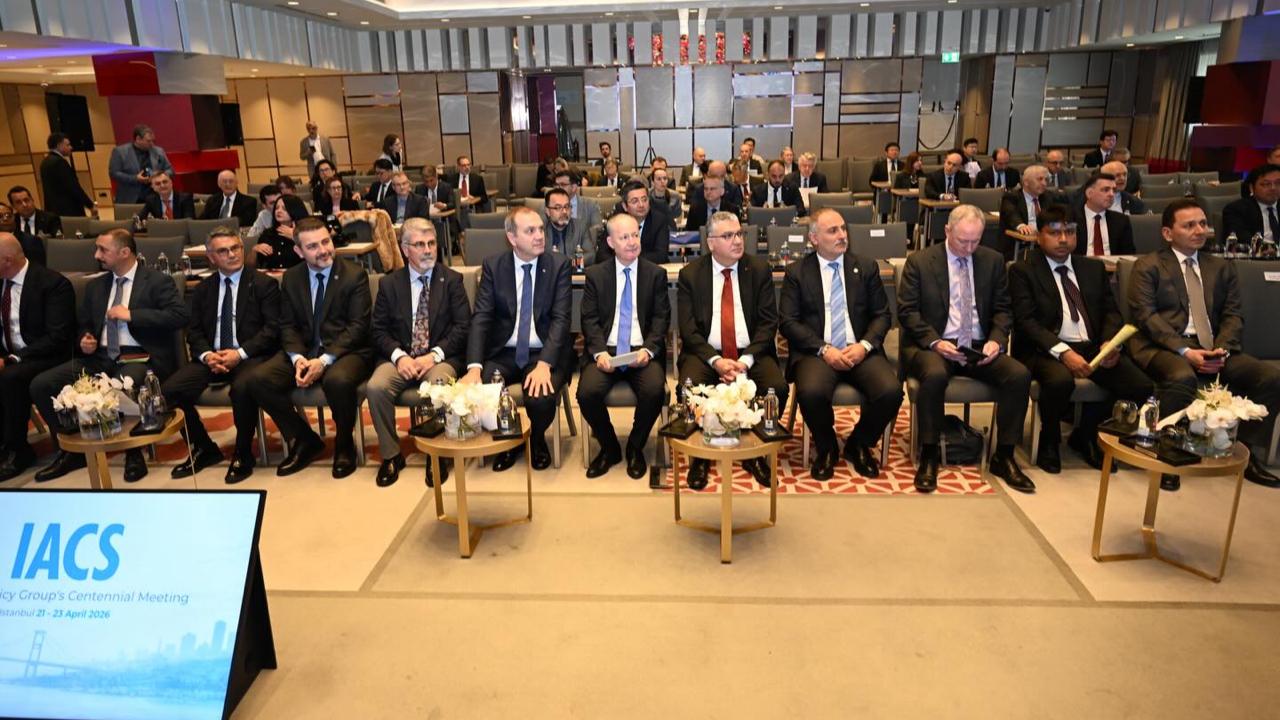
The IACS GPG 100 Summit in Istanbul focused on safety, sustainability, and global cooperation in the maritime industry, hosted by Turkish Lloyd.
The 100th special meeting of the International Association of Classification Societies (IACS) General Policy Group (GPG), one of the most important platforms in the international maritime sector, was held on April 21, 2026, in Istanbul. Hosted by Turkish Lloyd, the event brought together leading representatives from the industry. The meeting highlighted topics such as safety in maritime, sustainability, technical standards, and global cooperation.
Robert Ashdown: 'GPG is the driving force of IACS'
The meeting began with an opening speech by Robert Ashdown, Secretary-General of IACS. Ashdown emphasized that the General Policy Group is the 'driving force' of IACS, stating that the group guides technical work in the areas of safety, environment, and new technologies. He noted that this meeting, held for the first time in Istanbul, carries special significance following Turkish Lloyd's membership in IACS.
Ashdown said: 'I would like to start by expressing my great pleasure to be in Turkey. This is special not only because it is the hundredth meeting of the General Policy Group but also because it is being held in Istanbul, the main city of Turkish Lloyd, which is the newest member of IACS. We thank them for hosting us so beautifully.'
The General Policy Group is essentially the driving force of IACS. It is responsible for directing and approving our broad technical work program, which includes safety, environment, and other newly emerging technologies. While doing this, we remain committed to our fundamental goal of providing safer ships and cleaner seas.
However, the word 'policy' in 'General Policy Group' also signifies that this group works closely with sister organizations across the industry and with regulators at international, regional, and national levels. This allows IACS to remain sensitive to technical, political, or sometimes operational developments.
IACS does this to ensure that its members can continue to support the maritime sector, take on a role that produces and facilitates solutions, and contribute to the smooth operation of maritime activities wherever possible.
As I look at you here today, I am very pleased to see all stakeholders of IACS among us: government ministers, shipowners, shipbuilding companies, marine insurers, academia, flag states, and other regulatory bodies… Media representatives are also among us. I sincerely thank each of you for your interest and support.
Throughout this afternoon, we will discuss not only the achievements of the IACS General Policy Group but also how these works are carried out. We will share how we balance the need for independent work by IACS with our commitment to transparency and interaction with the sector.
We will also evaluate how we advance our work program both internally and with the International Maritime Organization (IMO). In this context, we will illustrate the process from the initial idea stage of an initiative to a mandatory decision through a case study and explain how we supported this process through our interactions with the IMO.
Later, in the second session, we will hear the views of other stakeholders who regularly work with IACS. These stakeholders will share how they value the development of minimum standards and the benefits that the consistent application of rules by IACS members brings to the sector.
At the end of both sessions, time will be allocated for questions and comments from you, esteemed participants. I especially encourage your participation and look forward to hearing your contributions.
Now, before we move on to the detailed sessions, I would like to give the floor to Prof. Dr. Oral Erdoğan, President of the Turkish Lloyd Foundation, to speak on behalf of the host organization.
Prof. Dr. Oral Erdoğan: 'Istanbul is also a bridge of ideas'
Speaking as the host, Prof. Dr. Oral Erdoğan expressed great pleasure in welcoming participants to Turkey and recalled the saying in culture, 'Guests come with abundance.' Erdoğan stated that the presence of the participants brings this saying to life.
Erdoğan expressed happiness in hosting the IACS General Policy Group meeting on behalf of Turkish Lloyd and thanked the Deputy Minister of Transport and Infrastructure of the Republic of Turkey, IACS Secretary-General Robert Ashdown, IACS delegates, and all sector representatives.
Emphasizing that Turkey is at the crossroads of continents with its unique character, Erdoğan stated that the country connects not only geographies but also ideas, trade, cultures, and technological knowledge. Highlighting Turkey's rich maritime history, Erdoğan noted that the country maintains strong ties with the sea, from historical shipyards to a modern and dynamic shipbuilding industry.
Erdoğan remarked that Turkey's strength comes not only from its geography but especially from visionary individuals who have advanced the sector since the 1940s. He mentioned his mentor, Prof. Dr. Ata Nutku, stating that Nutku was one of the pioneers of knowledge production in Turkey and that his legacy continues to inspire today.
Erdoğan pointed out that classification societies play a critical role in global maritime transportation in terms of safety, reliability, and sustainability, emphasizing that independence, neutrality, and transparency are the cornerstones of this system. He expressed that these principles are not just goals but a shared responsibility.
Noting that the maritime sector is going through a significant period shaped by digitalization, carbon reduction, and rapidly changing regulations, Erdoğan stated that cooperation is a necessity, not a choice, in this process. He expressed that the expertise and determination of the participants will shape the future.
Erdoğan expressed that the meeting is not just a technical gathering but an important opportunity for exchanging ideas, strengthening collaborations, and growing together for a more resilient and sustainable maritime future.
Durmuş Ünüvar: 'IACS is the fundamental reference for global standards'
In the opening speeches, Durmuş Ünüvar stated that IACS has played a critical role in the development of international maritime safety, the protection of the marine environment, and the harmonization of global maritime standards for over half a century.
Ünüvar emphasized that the unified requirements, interpretations, and technical recommendations created by the association provide a reliable reference framework not only for classification societies but also for flag states, port state authorities, and all sector stakeholders.
Noting that the maritime sector is under the influence of multidimensional transformations such as digitalization, automation, alternative fuels, energy efficiency, cybersecurity, and climate change, Ünüvar stressed the importance of developing technical standards in a consistent, applicable, and technologically mature manner.
He stated that the work carried out by IACS contributes to the safe, sustainable, and competitive development of the sector in accordance with International Maritime Organization regulations, noting that these efforts are commendable.
Ünüvar pointed out that geopolitical developments directly affect the maritime sector, mentioning that recent tensions in the Strait of Hormuz have put serious pressure on maritime transportation and impacted global supply chains. He stated that these developments have made the concepts of security, predictability, and resilience more critical than ever.
Recalling that approximately 88% of world trade is transported by sea in 2025, Ünüvar expressed that maritime continues to be the backbone of global trade. He noted that Turkey holds an important position with its strong fleet and port infrastructure, stating that by the end of 2025, the Turkish commercial fleet will rank 11th in the world.
Emphasizing that Turkey has a strong maritime infrastructure with its developing shipbuilding and maintenance capacity, Ünüvar stated that thanks to yacht manufacturers combining traditional craftsmanship with modern techniques, Turkey has risen to second place in the world in terms of total yacht project length.
He noted that in recent years, the Turkish shipbuilding industry has demonstrated a pioneering vision in autonomous and alternative fuel vessel projects, particularly in the defense industry, stating that many firsts have been achieved worldwide. He highlighted that the ongoing 39 projects aimed at the defense industry once again underscore the strategic importance of the sector.
Ünüvar stated that as a Ministry, sustainable and environmentally friendly transformation in the maritime field is among the priorities, and efforts are being carried out with determination.
Two Main Sessions Held
Two main sessions were held as part of the program. The first session addressed IACS's contributions to the global maritime sector, while the second session discussed the role of classification societies within the changing regulatory framework. A wide range of speakers participated in the sessions, from IMO representatives to international insurance organizations.
Concluded with a Reception and Dinner
The meeting concluded with thank-you speeches followed by a reception and dinner program. Participants emphasized that the event is a strong platform that strengthens cooperation in the maritime sector and conveys important messages for the future.
Source: SeaNews Türkiye


