
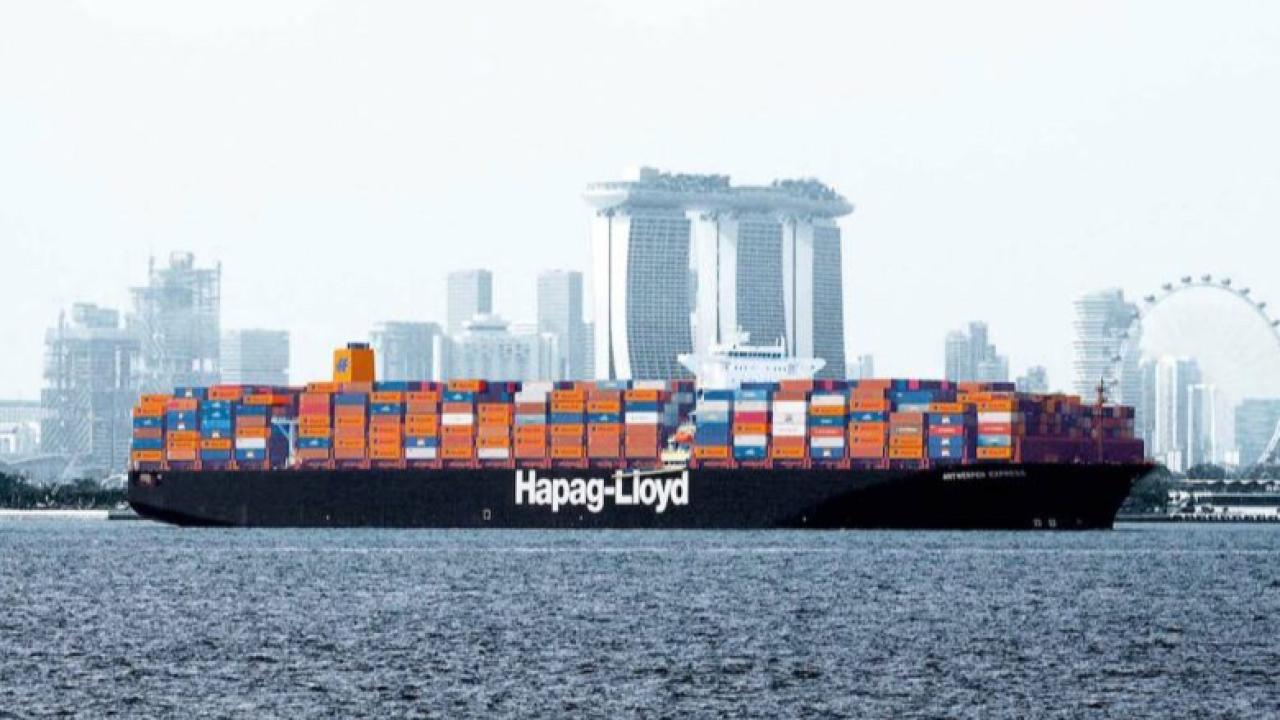
Hapag-Lloyd invests $500 million in eight dual-fuel ships to enhance fleet efficiency and reduce carbon emissions by 2030.
German container shipping giant Hapag-Lloyd has made a significant investment in its fleet renewal and carbon reduction goals by ordering eight dual-fuel (methanol-conventional fuel) container ships from CIMC Raffles Shipyard in China. Additionally, the company has secured long-term charters for 14 more vessels.
The new ships, each with a capacity of 4,500 TEU, are scheduled for delivery between 2028 and 2029. This investment, exceeding $500 million, represents Hapag-Lloyd's first newbuilding project utilizing a methanol propulsion system.
Equipped with dual-fuel engines capable of operating on both methanol and conventional fuel, these vessels are expected to be up to 30% more efficient than older ships of similar size. When operating on methanol, they could achieve annual emissions reductions of up to 350,000 tons of CO₂ equivalent.
This order contributes to Hapag-Lloyd's expanding fleet of alternative fuel vessels. The company currently operates or has on order 37 LNG dual-fuel ships that can also utilize biomethane.
In addition to the firm order, Hapag-Lloyd has reached an agreement for the long-term charter of 14 additional feeder vessels, including four with a capacity of 4,500 TEU. These vessels are expected to be delivered between 2027 and 2029, bringing the total investment in vessels under 5,000 TEU to 22.
Hapag-Lloyd's CEO, Rolf Habben Jansen, emphasized that fleet renewal is central to the company's 2030 Strategy. He stated, "The new ships will replace older tonnage, contribute to the decarbonization of our fleet, and reduce our dependence on the charter market. Additionally, operating costs will be lower."
The new methanol-fueled vessel construction program aligns with other initiatives aimed at emission reduction. Hapag-Lloyd has partnered with Seaspan for the conversion of five 10,100 TEU vessels to a methanol dual-fuel system in 2026-2027. Furthermore, a contract was signed last year with Chinese company Goldwind for the annual supply of 250,000 tons of green methanol, which is expected to reduce greenhouse gas emissions by at least 70%.
The company aims to reduce fleet emissions by one-third by 2030 compared to 2022 levels and to achieve net-zero emissions by 2045. As of the end of September, Hapag-Lloyd operates over 300 ships with a total capacity of approximately 2.5 million TEU, making it the fifth-largest container line in the world.
Source: www.denizhaber.com


