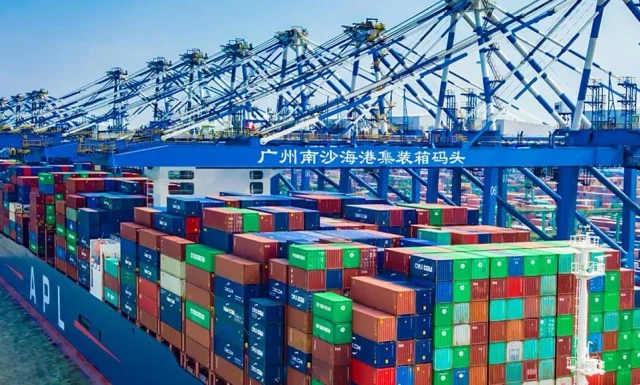
China's container export market showed stability in September 2026, with rising freight rates on major routes despite challenges in Europe.
China's container export market remained stable in September 2026, with freight rates rising on most major trade lanes and lifting the country's benchmark composite indices. Strong export growth, firm demand on transpacific and regional routes, and continued geopolitical pressure in the Middle East shaped the month. However, Europe-bound lanes moved in the opposite direction, extending their downward adjustment.
According to the Shanghai Shipping Exchange, the China Export Container Composite Freight Index averaged 1,887.59 points in September, up 2.8% from the August average. The Shanghai Export Container Composite Index, which reflects the spot market, averaged 3,657.79 points, up 8.0% month-on-month.
The gains come against a backdrop of strong trade performance. Data from the General Administration of Customs show that China's exports rose 25.0% year-on-year in US dollar terms in August. This continued the rapid growth of the country's foreign trade and supports the stable development of China's container shipping market.
China's port container throughput fell for another month in August, weighed down by typhoon disruptions and a high comparison base from the previous year. National port container throughput reached 30.12 million TEUs, down 4.4% year-on-year.
The decline was evident across both port categories: Coastal ports handled 26.68 million TEUs, a year-on-year decrease of 3.9%, while inland ports handled 3.43 million TEUs, down 8.0% year-on-year.
Smaller vessels posted the strongest gains. Firmer charter costs across every size class point to sustained demand for tonnage, a factor carriers and logistics providers will continue to weigh in capacity and pricing decisions.
Europe-bound freight rates fell further in September, even as overall transport demand held steady.
Eurostat data show that the Eurozone's consumer price index rose 3.3% year-on-year in August, the highest level since September 2023. Energy prices drove the rebound. The ongoing Middle East conflict continued to push up oil and natural gas prices, and those increases are gradually reaching the broader consumer market.
In response, the European Central Bank announced a 25-basis-point interest rate hike in September and raised its inflation projections for the next two years. The move suggests the tightening cycle is far from over, and continued monetary tightening may weigh on the region's future economic growth. Developments in China-Europe trade also remain a key factor to monitor.
In September, the average freight rate indices for the two main European trades were: China-Europe: 2,088.57 points, down 10.9% month-on-month; China-Mediterranean: 2,572.10 points, down 11.4% month-on-month.
In the spot market, average freight rates for exports from the Port of Shanghai stood at USD 2,425 per TEU to basic ports in Europe, down 15.4%, and USD 3,185 per TEU to basic ports in the Mediterranean, down 16.7%.
Transpacific routes extended their gains, supported by robust US economic activity and a constructive turn in US-China trade relations.
According to S&P Global, the US composite PMI rose to 58.4 in September, its highest level in nearly five years. Demand continues to drive the expansion in US business activity. However, rising input costs and persistent supply chain tightness may put pressure on future corporate earnings and inflation trends.
At the end of September, US and Chinese trade and economic teams held their latest round of consultations. Guided by the consensus of the two countries' heads of state, the two sides held frank, in-depth, and constructive talks and reached several agreements. These include establishing and advancing mechanisms such as a trade council and a '30 billion' reciprocal tariff reduction arrangement. The outcome supports the continued stable and positive development of bilateral trade and economic relations.
Transport demand performed well early in the month, and solid supply-demand fundamentals kept freight rates on an upward path:
- US West Coast: The freight rate index averaged 1,679.51 points, up 9.8% month-on-month. The average spot rate from Shanghai reached USD 7,436 per FEU, up 10.6%.
- US East Coast: The freight rate index averaged 1,921.65 points, up 6.2% month-on-month. The average spot rate from Shanghai reached USD 10,482 per FEU, up 8.6%.
The Persian Gulf-Red Sea route recorded the strongest increase of any major trade lane in September. Tensions in the Middle East remained high, and the conflict spread to the Red Sea. Geopolitical developments continue to significantly affect container shipping in the region.
The average freight index for China's exports on the Persian Gulf-Red Sea route reached 3,921.32 points in September, up 20.0% month-on-month. The average spot rate for exports from the Port of Shanghai to key Persian Gulf ports was USD 6,353 per TEU, up 12.7% from August.
Transport demand on the Australia-New Zealand route grew steadily, and supply-demand fundamentals remained solid. Freight rates continued to rise as a result. The average freight rate index for the China-Australia-New Zealand route was 1,775.63 points in September, an 8.6% increase from the previous month.
Transport demand on China-to-Japan routes was stable and improving, and freight rates moved higher. The average freight rate index for the route was 992.13 points in September, up 6.5% month-on-month.