
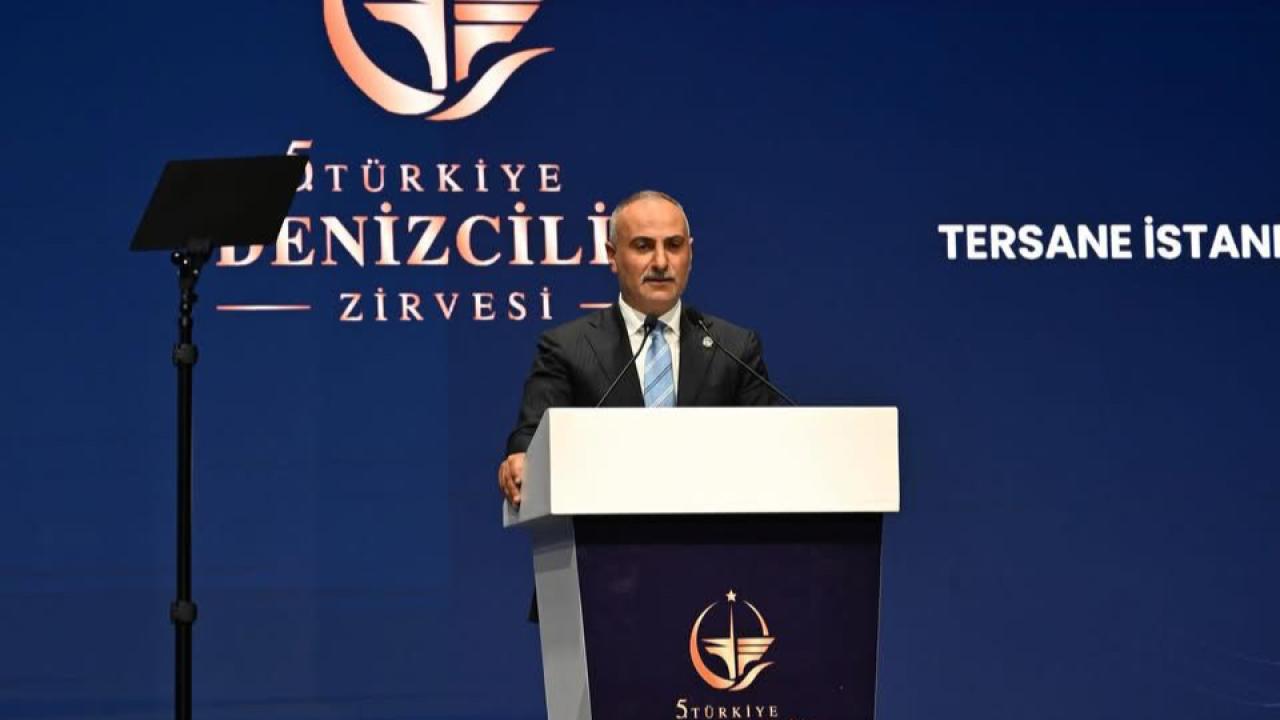
Baylan highlights Turkish maritime's record achievements and future expectations at the 5th Turkey Maritime Summit, despite ongoing challenges.
Baylan: 'Despite all adversities, we continue with records in maritime.'
Ünal Baylan, the Director General of Maritime Affairs at the Ministry of Transport and Infrastructure, presented the current state of Turkish maritime with figures in his presentation titled 'Turkish Maritime in the 100th Year of Cabotage' at the 5th Turkey Maritime Summit. Baylan announced that a record 573 million tons of cargo were handled in ports last year, and a new record is expected this year. He also stated that one of the world's most modern vessel traffic service systems will be established in Cyprus on July 20, that $254 million in revenue was generated this year from the gold franc application under the Montreux Convention, and that the year-end expectation for cruise tourism is 2.5 million passengers.
ISTANBUL – Speaking at the first section of the 5th Turkey Maritime Summit held in Istanbul on the 100th anniversary of the Cabotage Law, titled '100th Year of Cabotage: A Maritime Nation, A Maritime Country,' Director General of Maritime Affairs Ünal Baylan provided a comprehensive assessment ranging from strait passages to port statistics, incentive mechanisms, vessel traffic services, and shipbuilding capabilities.
'The narrowest, yet the safest waterways.'
Baylan reminded that Turkey has a blue homeland larger than half of its land territory and a coastline exceeding 10,000 kilometers, which is much longer than many European countries. He stated that ensuring all efficiency that can be derived from this homeland is the duty of everyone, especially seafarers. He emphasized that the Turkish Straits, managing all traffic in the Black Sea, are among the world's most important waterways, and thanks to comprehensive safety measures taken, these waterways are considered 'the narrowest yet the safest waterways in the world.'
Baylan reported that over 40,000 vessels pass through the Bosphorus annually, and nearly 50,000 vessels transit through the Dardanelles. He noted that Turkey is one of the first countries in the world to establish a vessel traffic service (VTS) system, which was set up in the early 2000s and now operates not only in the Straits but also in the Izmit Bay, Izmir, and Mersin regions where maritime traffic is most intense. Baylan stated, 'With the system we will launch on July 20 this year, we are establishing one of the world's most modern vessel traffic services in Cyprus. Thus, we will monitor and manage all traffic in the Eastern Mediterranean along with our vessel traffic services in Cyprus.'
Reminding that approximately one-fifth of the world's oil flow passes through the Strait of Hormuz, Baylan pointed out that around one-tenth of global oil traffic is safely routed through the Turkish Straits.
'Ports handling the most cargo in Europe are in Turkey.'
Baylan stated that there are over 190 port facilities open to international maritime traffic in Turkey and announced that a record 573 million tons of cargo were handled at these ports last year. He indicated that the total cargo handled in the United Kingdom, which consists of several countries, remained at around 400 million tons, asserting that Turkey is the country with the most cargo-handling ports in Europe. Baylan shared that Turkish ports hosted 63,000 vessels last year, and five of the world's busiest 100 container ports are located in Turkey, with over 14 million TEUs handled in containers last year.
He explained that serious problems were experienced, especially with ships affected by sanctions following the war in the Black Sea, but that solutions to these issues, particularly regarding insurance, have been developed. He noted that substandard vessels are being inspected much more frequently through a targeting system, and that vessels banned as a result of inspections under the Paris Memorandum in European Union ports are now being directed to Turkish ports, where they are closely monitored.
Baylan emphasized that despite all adverse conditions, the rise in maritime trade continues with the following words: 'Despite the war in the Black Sea and the geopolitical troubles around us, we continue with records. As you know, we do not trade with Israel; we do not accept any vessel flagged by Israel or even insured by Israel into our ports. Nevertheless, we will achieve a new record this year.'
Touching upon port state control inspections, Baylan stated that Turkey is a party to the Mediterranean Memorandum of Understanding and a leading country in the Black Sea Memorandum of Understanding; he announced that 42.7% of all inspections conducted in Mediterranean countries last year were carried out by Turkey's trained experts. Baylan said, 'No matter how much our trade increases, we protect both our environment and the goods being transported as well as our seafarers without compromising safety.'
Seafarers: 'They wave the Turkish flag all over the world.'
Baylan pointed out that Turkey is one of the world's most important supplier countries for seafarers, ranking fourth globally in terms of numbers and among the best countries in terms of quality. He stated that Turkish sailors, from crew members to officers, provide significant foreign currency inflow to the country and wave the Turkish flag all over the world. Baylan mentioned that agreements to further strengthen the rights of seafarers are still on the parliamentary agenda and are expected to be enacted within this year, and that bilateral agreements for Turkish seafarers to work in other countries are also ongoing.
Baylan expressed that search and rescue at sea is one of the most prestigious duties for which no fee is charged, explaining that Turkey operates on a 24/7 basis in its vast search and rescue responsibility area, saving the lives of people in distress at sea. He also referred to maritime education, stating that the education system carried out in cooperation with the Ministry of National Education and YÖK has passed inspections by the European Maritime Safety Agency (EMSA), which was attended by both the IMO and the director, and that Turkey is on the white list and in the highest performance group.
Fleet target: Back to the top 10 by 2027.
Baylan noted that the Turkish-owned fleet ranked in the top 10 globally last year with a carrying capacity of 53 million tons, but has slipped to 11th place this year. He expressed that Turkish shipowners are conducting new purchases and new construction projects worldwide and believes that they will rise again in the upper ranks by the statistics of January 1, 2027.
Baylan emphasized that serious efforts have been initiated by the Ministry regarding resource allocation to maritime, announcing that $27 million in incentives have been provided under the support mechanism for shipowners who build new ships in Turkish shipyards and scrap their old ones, and that both the amount of incentives and the number of ships will be increased next year, thus supporting the global green transformation. He highlighted that the application of tax-exempt fuel is only for commercial vessels, and that private boats and yachts do not benefit from this application, stating that in 2025, a support of 5 billion TL will be provided to maritime in this context.
Baylan also announced new incentive programs for passenger transportation, stating that with the regulation whose legislative work has been completed, an incentive mechanism will be implemented for vessels transporting passengers to Cyprus, primarily across the Sea of Marmara, both in terms of transportation and new ship investments. He explained that an incentive mechanism has been initiated to shift vehicles to maritime routes against the congestion at land border gates in trade with the European Union, noting that last year, 725,000 vehicles were transported by Ro-Ro shipping, and that the route between Turkey and Italy and the European Union is among the world's busiest Ro-Ro routes, with Turkey being the leading country in this area.
Gold franc revenue: $254 million.
Baylan also addressed the gold franc application gained by the Republic of Turkey through the Montreux Convention, explaining that the fees for strait passage services were updated based on the value of gold until 1982, after which they were frozen for a long time, and that the Ministry began to update them again in 2022. Baylan stated, 'Our revenue this year was $254 million. We continue to increase this every year, ensuring that our country receives the fees it deserves under the Montreux Convention.'
Cruise expectation of 2.5 million passengers.
Baylan noted that more than one-fifth of Turkey's tourism revenue, which exceeds $60 billion, is related to maritime tourism, with cruise tourism being one of its main components. He explained that the cruise traffic, which nearly hit zero in the early 2020s due to the pandemic, has shown a strong recovery thanks to port infrastructure, services provided, and security, announcing that nearly 2.2 million cruise passengers were hosted last year, with an expectation of 2.5 million passengers this year.
Baylan emphasized that green transformation should not be thought of as limited to industry, stating that many incentives have been provided to support the green transformation of ports, with two ports having gained green port status so far, and that this number will increase with new incentives to be implemented on the subject.
'With the experience gained in commercial vessels, the best warships in the world are being built.'
Baylan pointed out that with the green transformation, old ships will be replaced by new ones, but that there is no infrastructure in Europe to recycle these ships, stating that Turkey ranks among the top three countries in ship recycling, and that the capacity in this area is becoming increasingly important.
Baylan also mentioned the outstanding special projects of Turkish shipyards, stating that the world's first sailing Ro-Ro vehicle carrier was built in Turkey, the second one has been laid down, and more will follow, adding that the largest fully electric ferry in history is still under construction in Turkish shipyards. He said, 'Our shipbuilders and workers can build the best warships in the world today with the experience they gained from commercial vessels. I believe this capability needs to be kept alive.'
In his speech, Baylan referred to Prof. Dr. Hüseyin Bağcı, who spoke before him, stating, 'As my professor beautifully said, the primary issue of trade is security; the Silk Road operated securely for 300 years. Despite many security problems today, the Republic of Turkey is progressing with records in maritime.'
Baylan concluded his presentation by thanking all the guests from abroad who participated in the 100th anniversary events of the Cabotage Law.
Source: SeaNews Türkiye
