
The maritime industry will need to scrap more vessels or delay orders for
new ships if dry bulk companies are to escape a fate similar to South
Korea's troubled Korea Line Corp, analysts said.South Korea's No. 2 dry bulk shipping line filed for bankruptcy
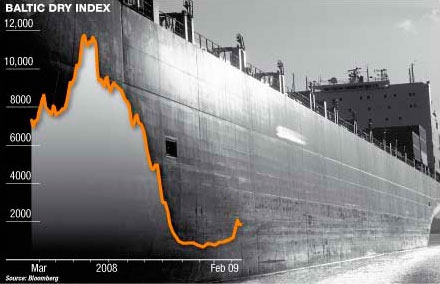
protection with a local court on Tuesday after struggling to stay afloat amid a sharp drop in freight rates. The Baltic Exchange's main sea
freight index , which tracks rates to ship dry commodities, slid to a
near two-year low of 1,292 points on Tuesday, as a glut of ships and
slow business took their toll.
This is just adding to the woes of the industry and making the industry wake up and acknowledge the overcapacity problem,' said Janet Lewis, shipping analyst for Macquarie Securities.
'The good outcome of this all would be if it accelerates restructuring and scrapping.'
The global dry bulk fleet could expand between 11 and 13 per cent to nearly 600 million deadweight tonnes, even with scrapping and delays in new deliveries taken into account. That far outpaced demand of around 8 per cent, analysts said.
Shipowners went on a buying spree before the economic downturn two years ago and those vessels are only now coming to the market.
The oversupply problem was further exacerbated in the last few weeks by deadly floods in Australia, the world's biggest coal exporter, that disrupted shipping activity and cut into freight demand.
'Korea Line will drive down the market. Everyone who had planned to charter or charter out their vessel will be affected,' said Jung Shin, an analyst at HSBC in Hong Kong.
'I think the BDI (Baltic Dry Index) will go down to the 1,100 level.'
The benchmark freight index last traded below 1,100 in February 2009.
Average daily earnings for capesizes, which typically haul 150,000-tonne cargoes of iron ore and coal, fell to US$8,000 a day on Tuesday - below the level of operating costs for many companies.
'The industry can't continue indefinitely operating below operating costs or you will begin to see people forced out of the market, and the most expensive ships becoming fodder for the scrap yards,' Ms Lewis said.
Korea Line operates more than 100 borrowed vessels, most on long-term contracts with other shipping companies at rates far above current daily earnings.
A court could decide whether to restructure or liquidate the South Korean dry bulk shipper within a month, said a company official, who asked not to be named.
This is just adding to the woes of the industry and making the industry wake up and acknowledge the overcapacity problem,' said Janet Lewis, shipping analyst for Macquarie Securities.
'The good outcome of this all would be if it accelerates restructuring and scrapping.'
The global dry bulk fleet could expand between 11 and 13 per cent to nearly 600 million deadweight tonnes, even with scrapping and delays in new deliveries taken into account. That far outpaced demand of around 8 per cent, analysts said.
Shipowners went on a buying spree before the economic downturn two years ago and those vessels are only now coming to the market.
The oversupply problem was further exacerbated in the last few weeks by deadly floods in Australia, the world's biggest coal exporter, that disrupted shipping activity and cut into freight demand.
'Korea Line will drive down the market. Everyone who had planned to charter or charter out their vessel will be affected,' said Jung Shin, an analyst at HSBC in Hong Kong.
'I think the BDI (Baltic Dry Index) will go down to the 1,100 level.'
The benchmark freight index last traded below 1,100 in February 2009.
Average daily earnings for capesizes, which typically haul 150,000-tonne cargoes of iron ore and coal, fell to US$8,000 a day on Tuesday - below the level of operating costs for many companies.
'The industry can't continue indefinitely operating below operating costs or you will begin to see people forced out of the market, and the most expensive ships becoming fodder for the scrap yards,' Ms Lewis said.
Korea Line operates more than 100 borrowed vessels, most on long-term contracts with other shipping companies at rates far above current daily earnings.
A court could decide whether to restructure or liquidate the South Korean dry bulk shipper within a month, said a company official, who asked not to be named.