The trans-Pacific trade lane is now the highest-yielding container route globally, reshaping carrier strategies and boosting profits.
The trans-Pacific trade lane has established itself as the highest-yielding major container trade route in global shipping. Measured by revenue per nautical mile, spot freight earnings on the Shanghai-Los Angeles corridor stand at approximately five times those recorded on the Cape of Good Hope-Northern Europe route, with the strength of the U.S.-bound market having already moved well beyond the bounds of its traditional peak season cycle.
Analysis published by Alphaliner indicates that the Shanghai-Los Angeles service, spanning 5,775 nautical miles, generates spot freight revenue of approximately USD 7,500 per FEU, translating to roughly USD 1.30 per box per nautical mile. By comparison, the Shanghai-Rotterdam service via the Cape of Good Hope yields approximately USD 0.26 per box nautical mile; the Suez Canal routing to Rotterdam approximately USD 0.34; and Shanghai-New York approximately USD 0.96. Spot rates on the Shanghai-New York corridor have held above USD 10,000 per FEU since late August, with overall U.S.-bound freight levels now approaching the peaks recorded during the pandemic era.
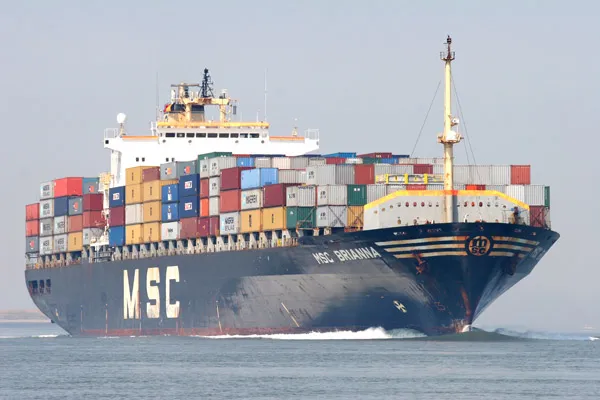
The pronounced gap in unit yield is reshaping carrier capacity deployment strategies. Mediterranean Shipping Company recently upgraded its Sentosa service, substituting vessels of approximately 15,000 TEU with ultra-large tonnage of 23,600 TEU. ZIM currently allocates 52% of its total capacity to the Pacific market and has announced plans to introduce an additional China-California service in December. The concentration of capacity on high-yield routes reflects the direct pursuit of profitability that now defines carrier strategy across the trans-Pacific.
Elevated market conditions have translated directly into strengthened financial performance. COSCO Shipping Holdings recorded a liner segment profit of USD 2.66 billion in the third quarter, doubling year-on-year, with trans-Pacific revenue rising 61.2% over the same period. These figures confirm that U.S.-bound trades have become a primary driver of profit recovery among the leading container carriers.
Freight rate levels remain elevated. Freightos data places Asia-U.S. West Coast rates at approximately USD 8,340 per FEU and Asia-U.S. East Coast rates at approximately USD 9,911 per FEU - both approximately USD 5,500 per FEU above pre-peak season levels. Upcoming inventory build-up ahead of the Lunar New Year may moderate the extent of any near-term rate correction.
Nonetheless, early cooling signals have emerged. Drewry reports that Shanghai-Los Angeles rates declined 6% week-on-week to USD 7,514 per FEU, while Shanghai-New York fell 5% to USD 9,631 per FEU. The firm projects that U.S. ocean import volumes will contract 11% month-on-month in November, with rates likely to soften further. Demand-side dynamics are positioned to become the defining variable in the trajectory of the U.S.-bound market in the period ahead.
Capacity deployment volumes warrant equally close attention. Sea-Intelligence has noted that trans-Pacific capacity deployment has reached unprecedented levels, with weekly Asia-U.S. West Coast capacity projected at 400,000 TEU in November. Port congestion and vessel delays are, however, inflating headline capacity figures, and a meaningful divergence between nominal and effective available capacity may persist across the lane.