New maritime regulations impose heavy penalties and stricter inspections, reshaping ship construction and maintenance practices significantly.
The 'new era' in the maritime sector has officially begun. The 'Regulation on the Construction, Modification, and Maintenance Repair of Ships and Watercraft,' published in the Official Gazette dated January 14, 2026, has abolished the regulation that has been in effect since 2015 for nearly a decade. The most significant detail that has caught the attention of industry representatives is the heavy administrative and financial burdens introduced by the regulation. The phrase 'will cause harm' used in the title is not an exaggeration; as the new regulation reconfigures administrative fines both logically and in terms of amounts, it ties not only hazardous operations but also bureaucratic processes involving registration, notification, and monitoring to serious costs. The new text, most of which will come into effect three months after its publication, is based on three fundamental pillars: a centralized registration system, an inspection architecture, and the deterrence of penalties.
Flexibility for the Public, Strict Monitoring for the Sector
When examining the scope of the regulation, it is seen that exceptions on the public side have been expanded. While the previous regulation excluded only military vessels and Coast Guard and Security elements, the new text includes vehicles belonging to the Gendarmerie and other public institutions deemed appropriate by the Administration. This situation provides operational flexibility for the public sector while seemingly bringing discussions of 'different regimes for the same job' to the private sector.
On the inspection side, the definition of 'inspection officer' is undergoing a transformation. Previously limited to areas such as shipbuilding and marine technology, the authority is now expanded to include other engineering graduates who have been authorized through training provided by the Ministry. While this move aims to broaden the pool of inspectors to prevent bottlenecks in operations, it raises concerns that the standard of technical expertise may vary based on the content of the training.
A New Era in Hazardous Materials and Off-Site Activities
One of the most critical changes awaiting the sector will occur in the permitting processes. In the old regulation, the permit threshold was generally determined based on a length of 12 meters and a limit of 12 passengers, while the 2026 regulation has added the 'hazardous materials' criterion to this. Now, all ships and watercraft that will transport hazardous materials are included in the permit regime, regardless of their size. This means a new bureaucracy and inspection line, especially for niche operations that fall under hazardous cargo or transport.
More importantly, there is an emphasis on 'on-site production' that will fundamentally change mobile maintenance and repair habits. While construction, modification, and maintenance-repair are considered to be carried out at the facility, facilities will not be able to operate outside their authorized areas even if they are registered with the GSVP. When this rule is violated, not only warnings but also serious fines will come into play.
Increasing Bureaucracy and Costs
Application and permit processes are also entering a more costly and lengthy path with the new regulation. Review periods have been extended from 15 business days to 25 calendar days, and a condition has been introduced that requires the service fee determined by the Ministry for the issuance of the permit document to be deposited into the revolving fund. This situation increases costs by clarifying the 'payment-document' relationship beyond merely changing the time calculation.
The role of the Chamber of Ship Engineers (GMO), another important actor in the process, has also evolved. Previously focused mainly on professional inspections of unclassed vessels, the GMO is now more deeply involved in the process with the titles of design rules and project inspection. In fact, a GMO signature is now required before the Port Authority approval for unclassed vessels. While this aims to raise the quality standard, it carries the risk of creating bottlenecks in the process with the addition of a new layer of inspection to the 'master-engineer-port' triangle.
A New Era for Engineers: 'Setup at the Slipway, Forms at the Desk'
The job description for control engineers working in non-class-required jobs has also changed. Engineers are no longer just participants in inspections; they are now required to conduct suitability checks at intervals of no more than 30 days and to prepare periodic monitoring forms. Obligations such as storing these forms for 5 years and uploading them to the GSVP place not only engineering but also paperwork at the center of the process.
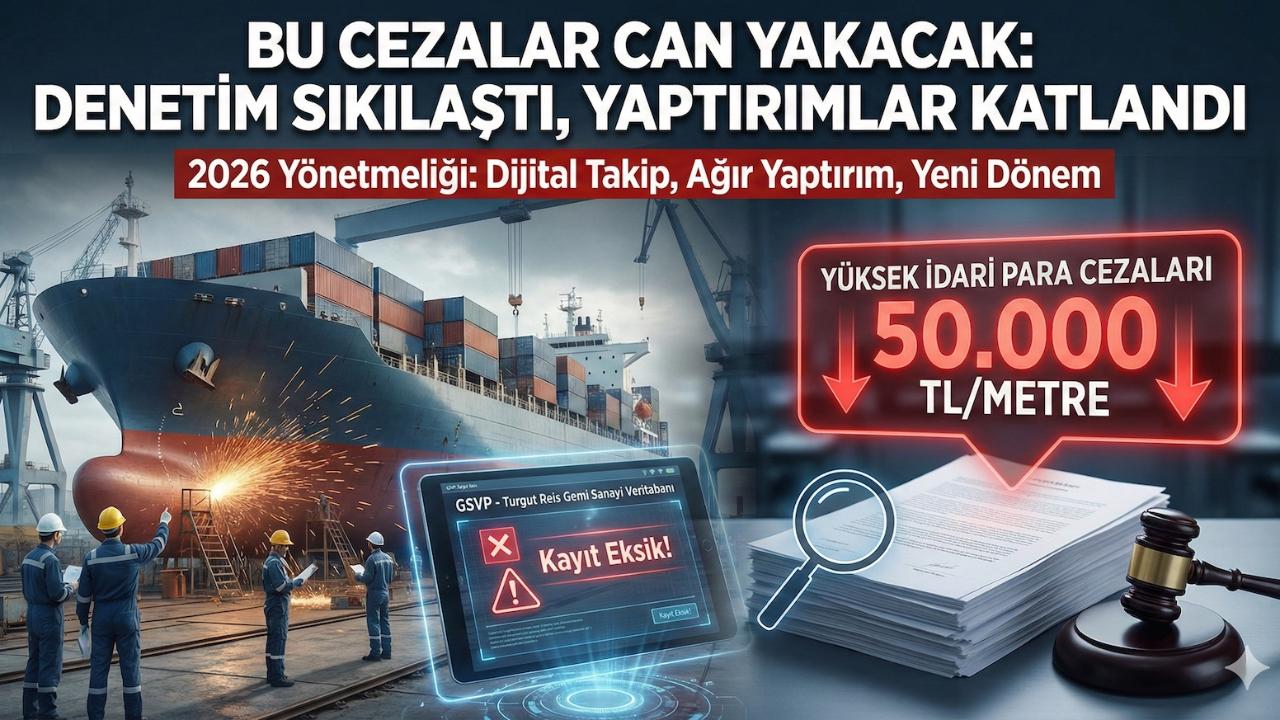
However, perhaps the most critical regulation is the 'digital lock' application, which could potentially pull the plug on the system. The new regulation states, 'Surveys will not be conducted for vessels that do not have GSVP data entry,' establishing a definitive rule. This clause stands out as an administrative tool that can effectively halt the operations of a vessel with incomplete registration, which could mean a much heavier penalty for vessel owners than a monetary fine.
Astronomical Increases in Fines: 50,000 TL per Meter
The most talked-about aspect of the regulation will undoubtedly be the penalty regime. Fines that were in the hundreds or thousands per meter in the 2015 text have risen to a range of 10,000 TL to 50,000 TL per meter with the 2026 text. For example, for construction or modification operations carried out without a permit, fines of 10,000 TL per meter are foreseen for Turkish-flagged vessels within the facility, and in some exceptional cases, up to 50,000 TL. Even if a permit is obtained, if it is determined that operations are conducted outside the facility, a fine of 20,000 TL per meter will be applied.
Control engineers and classification organizations have also been affected by this increase. For engineers, violations of obligations carry a fixed fine of 50,000 TL and a risk of a 5-year activity ban upon recurrence, while for classification organizations, fines for certain violations can reach up to 250,000 TL. The regulation aims to curb the astronomical figures that could arise in large-tonnage vessels by setting an upper limit of 1 million TL on the total fine amount; however, fines ranging from 100,000 TL to 500,000 TL can still shake the operating capital of small and medium-sized enterprises.
Safety or Bureaucracy?
The new regulation aims to ensure maritime safety by preventing high-risk actions such as unauthorized construction and modification with heavy penalties. However, concerns in the sector focus on the point that 'document' deficiencies, such as GSVP data entry, uploading periodic forms, or notifying the general layout plan, are penalized with weights similar to safety violations. The practical restrictions and increases in penalty amounts stemming from the rule 'no survey without GSVP entry' may strengthen the perception that 'penalties are imposed more for bureaucracy than for the safety of the job.' Additionally, open-ended expressions such as 'as deemed appropriate by the Administration' in the regulation bring along risks of uncertainty and differences in application between ports.
While some classification obligations for fishing vessels will continue under the old regime until 2028 within the transitional provisions, the cancellation of off-site maintenance and repair permits within three months will require businesses holding old permits to reopen their files.
Source: SeaNews Türkiye