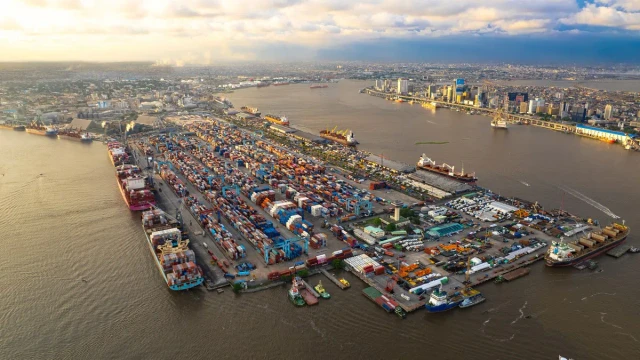
West Africa faces severe port congestion, with delays over 10 days at major terminals, impacting cargo handling and shipping operations.
Congestion across multiple major ports in West Africa has continued to intensify, with vessel berthing and cargo handling delays increasing markedly in recent weeks. At Guinea's Port of Conakry and Sierra Leone's Port of Freetown, delays have already surpassed the 10-day threshold - a development that underscores the growing mismatch between surging cargo volumes and the region's existing port infrastructure and operational capacity.
According to the latest reporting from The Loadstar, Ghana, Guinea, and Sierra Leone represent the most severely affected markets along the West African coast. Cargo volumes in the region have grown at an accelerated pace, with some countries now handling cargo quantities that approach their projected full-year 2025 levels. Port infrastructure, container yards, and inland transport networks, however, have not expanded in parallel - a structural gap that continues to drive vessel waiting times and container dwell time to elevated levels.
Among the affected ports, Ghana's Tema Port has drawn particular attention from shippers and freight forwarders. Hapag-Lloyd has advised clients to anticipate handling delays of up to approximately 10 days at Tema, while reefer yard utilization at the terminal has exceeded 100 percent - compounding operational pressure on cold chain cargo. In response to the congestion, carriers have moved to implement additional surcharges. CMA CGM has announced a congestion surcharge of USD 400 per TEU on refrigerated cargo destined for Tema, translating to an additional cost of approximately USD 800 per 40-foot reefer container; Hapag-Lloyd has similarly introduced a surcharge of USD 250 per TEU on affected reefer shipments.
Conditions at Conakry and Freetown, however, are assessed as more acute. Industry data indicates that vessel waiting times at both ports have exceeded 10 days, with Freetown recording a deterioration of approximately four additional days compared to the prior week. Conakry continues to face persistent congestion, and while local operators have sought to alleviate backlogs through extended truck operating hours and improved vessel scheduling, the near-term impact of these measures remains limited.
Hapag-Lloyd's latest Africa operational advisory further quantifies the scale of disruption: berthing delays at Conakry are currently estimated at 16 to 20 days; Monrovia, Liberia at 8 to 10 days; Tema at 4 to 6 days; and Abidjan at 3 to 4 days. Compounding these delays, several West African ports are simultaneously contending with elevated yard utilization rates, equipment shortages, and constrained empty container repositioning - factors that limit recovery even as demand continues to rise.
The broader picture confirms that this is not an isolated incident at any single port. Kuehne+Nagel's latest port operations data indicates vessel waiting times at Abidjan of up to 12 days, reinforcing that congestion pressure now extends across the West African coastline. Industry observers note that if trade volumes continue to expand at current rates without commensurate investment in port expansion, yard capacity, trucking networks, and equipment, congestion risks spreading further - both to additional ports and deeper into inland supply chain nodes.
For carriers, freight forwarders, and exporters, the immediate operational priority is clear: close monitoring of vessel schedules and congestion surcharge developments at Conakry, Freetown, Tema, and Monrovia, combined with proactive allocation of additional transit time buffers for refrigerated and time-sensitive cargo. The situation across West Africa's ports reinforces a fundamental principle of global maritime logistics - in an environment where regional hub dependency continues to deepen, cargo will accumulate at the port long before vessel capacity becomes the binding constraint, whenever volume growth outpaces ground-level handling capacity.