
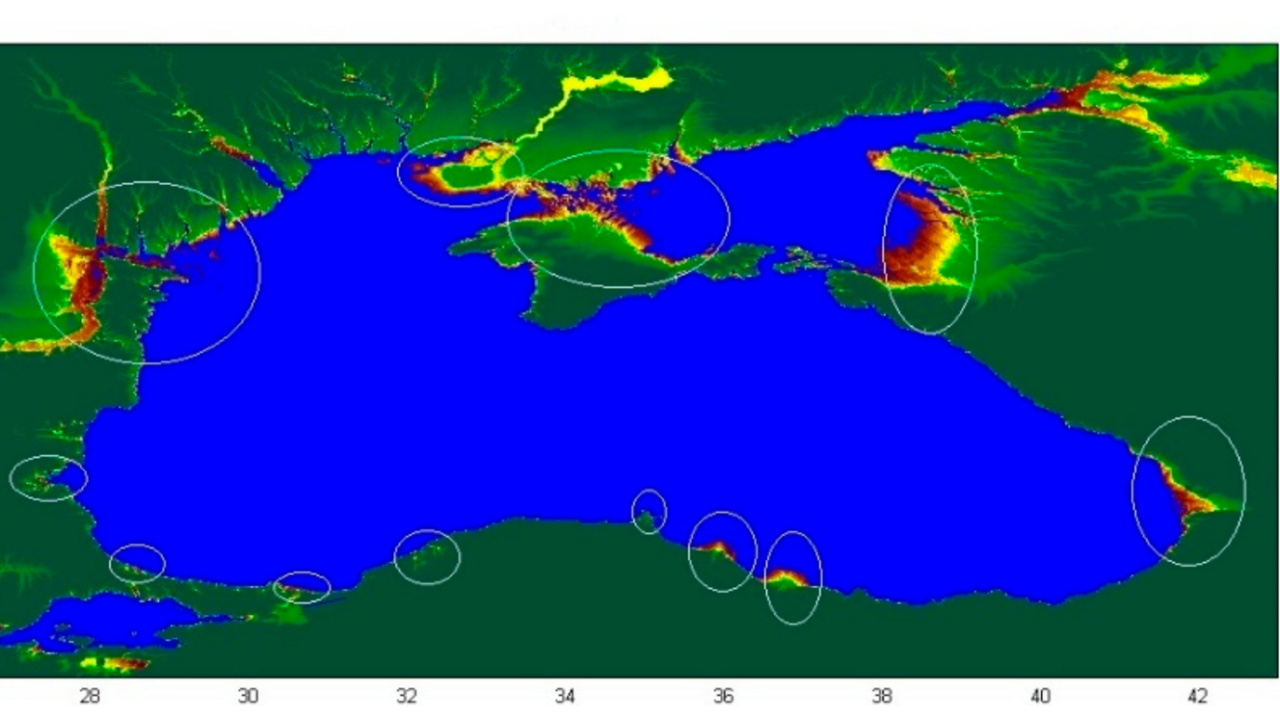
Experts warn rising sea levels in the Black Sea could lead to severe erosion and flooding, impacting millions of residents along the coast.
Professor Dr. Hakan Kutoğlu, a faculty member of the Department of Geomatics Engineering at Zonguldak Bülent Ecevit University, has warned that the sea level in the Black Sea is rising at a rate comparable to that of the world's oceans. This trend poses serious risks of coastal erosion and flooding, threatening residential areas in the coming years.
In his evaluations regarding the effects of global warming and climate change on the Black Sea coasts, Professor Kutoğlu emphasized that scientific studies utilizing satellite altimetry data have shown a consistent and continuous rise in sea level in the Black Sea.
"Globally, it is expected that sea levels will rise by 3 mm per year due to global warming and climate change. This rise is projected to accelerate, potentially reaching up to 2 meters by 2100. Such an increase could lead to the sea advancing kilometers inland in low-lying coastal regions, resulting in many settlements being submerged during stormy weather when wave heights are significant. Unfortunately, studies on sea level and coastal erosion related to the Black Sea have been insufficient. We collected data obtained through satellite altimetry techniques dating back to 1993 and performed a time series analysis, revealing that the Black Sea has a similar rise to that of the oceans. From 1993 to 2020, the average sea level in the Black Sea has risen by approximately 3 millimeters per year, totaling about 10 centimeters. While these figures may seem small, a rise of just 1 unit in sea level can cause the sea to advance 50 to 100 times further inland in lower elevation areas. Thus, a rise of 1 mm over a year could expose much more inland areas to coastal erosion, especially during stormy periods when waves can reach further inland and cause flooding," he stated.
"With a 2-meter rise, the sea could advance 500 meters inland," he added.
Highlighting the global increase in sea levels, Kutoğlu remarked, "In this study, we discovered that the Black Sea rises at the same rate as the oceans, up to 3 mm per year. However, scientific studies indicate that as temperatures rise and global warming intensifies, glaciers will melt more rapidly, leading to an even greater rise. According to one scenario, when glaciers melt, the world's seas and oceans could rise by up to 2 meters. Consequently, this rise could result in the sea advancing approximately 200 to 500 meters inland, and in some lower-lying areas, the sea could penetrate several kilometers inland."
"This could affect a population of 160 million," he emphasized.
Kutoğlu pointed out that the effects of this rise will be more significant than anticipated, stating, "Since the Black Sea rises at a rate equivalent to that of the oceans, the same threats apply to its coasts. Areas marked in yellow and red on the map indicate where coastal erosion will be most severe and is currently being observed. The northern Black Sea, particularly in regions of Ukraine and Russia, has lower coastal elevations, making coastal erosion much more pronounced there. While our coasts appear to be more resilient due to their higher elevation, serious coastal erosion may still occur in some areas in the future. Approximately 160 million people live in the coastal regions of the Black Sea Basin, with a majority settled along the coast. Therefore, this population may face significant coastal erosion in the next 50 to 100 years, highlighting the need for awareness and precautionary measures now."
Kutoğlu also warned about current and future investments, stating, "In areas where coastal erosion is observed, such as the Karasu region in Turkey, measures must be taken to prevent erosion through coastal fortifications. However, these measures incur additional maintenance costs. In the future, when making investments, it will be beneficial for national economies to consider coastal erosion and sea level rise, and to invest in higher and more distant areas." Professor Dr. Hakan Kutoğlu's scientific study on sea level rise and coastal erosion in the Black Sea was presented at the 16th International Conference on Environmental Science and Technology.
Source: www.denizhaber.com


