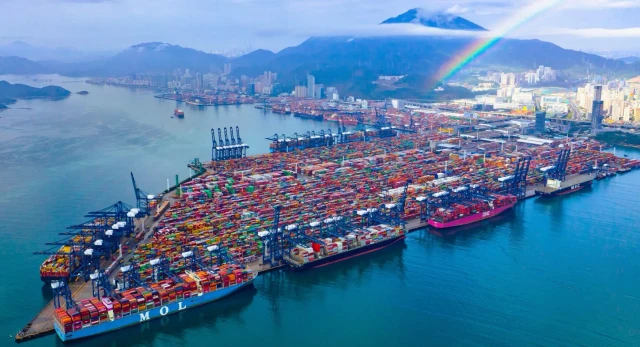
Qingdao Port and Singapore's MPA sign a pact for a green, digital shipping corridor, enhancing trade efficiency and sustainability.
Two of Asia's most significant maritime gateways have taken a decisive step toward cleaner, more transparent trade. Shandong Port Group's Qingdao Port, one of the world's busiest container ports, and the Maritime and Port Authority of Singapore (MPA), which oversees the world's largest ship bunkering hub, have formally signed a Work Plan for Green and Digital Shipping Cooperation.
The agreement lays the groundwork for a dedicated green and digital shipping corridor linking the two ports. For cargo owners moving goods between North China and Southeast Asia, it signals a route built around lower emissions, sharper schedule visibility, and more efficient port calls.
The Work Plan delivers on the broader China-Singapore and Shandong-Singapore green and digital shipping corridor frameworks. It moves the bilateral partnership beyond high-level consensus and into hands-on execution at the port operational level.
The agreement is regarded as a landmark deliverable of China-Singapore cooperation. It builds on the extensive shipping route networks and industrial strengths of both hubs. Qingdao serves as a primary gateway for northern China's manufacturing and export base, while Singapore anchors transshipment and bunkering activity across major east-west trade lanes.
Under the plan, the two parties will focus joint efforts on three core pillars: green marine fuels, digital shipping integration, and joint research and innovation.
The first pillar targets decarbonizing vessels serving the corridor. The partners will roll out demonstration bunkering trials for methanol and other zero or near-zero greenhouse gas (GHG) fuels. Bunkering is the process of supplying fuel to ships. These trials will cover vessels operating direct services between Qingdao and Singapore.
For shippers, the trials point toward a practical pathway to lower-emission ocean transport on a defined trade lane. As international decarbonization requirements tighten and more customers demand lower-carbon supply chains, corridors with proven alternative-fuel supply can help cargo owners plan ahead. They can also help them meet their own sustainability commitments without sacrificing route reliability.
The second priority centers on data. The two port authorities will draw on Shandong Port's Cloud Port Connect platform and Singapore's OCEANS-X digital maritime ecosystem to advance the interoperability of vessel operational data. Interoperability means the systems can exchange and use each other's information.
Shared data between the two ports is expected to deliver four operational gains: greater visibility over vessel arrival schedules, streamlined berth allocation for calling ships, optimized deployment of port resources, and improved terminal turnaround efficiency for vessels at both ends of the corridor.
These gains address persistent pain points along the supply chain. More accurate arrival data supports better planning for cargo owners, who depend on predictable transit times to meet customer commitments and manage inventory. It also helps freight forwarders coordinate multimodal connections, and importers align customs clearance and warehouse capacity with vessel schedules. Fewer delays in port can also reduce the knock-on costs that build up when ships wait for berths.
The third pillar strengthens the corridor's technical foundation. Both sides will partner with leading research bodies, including the Water Transport Institute under China's Ministry of Transport and the Singapore Maritime Institute. Together, they will drive technical exchanges and collaborative research on alternative marine fuels and maritime digitalization.
This research track positions the corridor as more than a single trade lane. It creates a platform to develop and test solutions that could inform green and digital shipping practices across the wider industry.
The Qingdao-Singapore Work Plan combines alternative-fuel trials, cross-border data sharing, and institutional research within one coordinated framework. The result strengthens the operational case for low-carbon shipping between two critical hubs. It also advances the shift toward more visible and predictable port operations.
For shippers, freight forwarders, and importers, the agreement marks a meaningful development to watch as implementation progresses. With the framework now in place, Qingdao and Singapore are not just connecting two ports; they are building a template for how cleaner, data-driven shipping corridors can support reliable global trade.