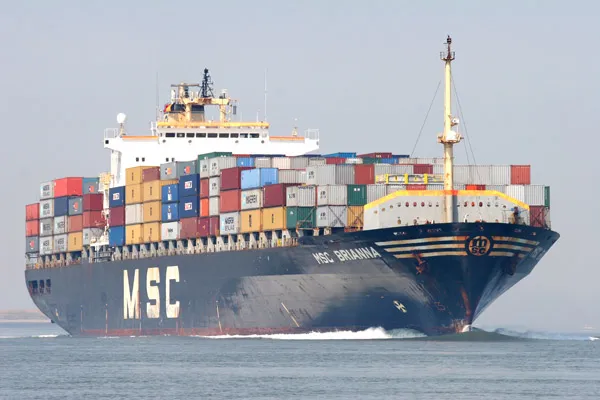
MSC has reinstated Suez Canal transits for its Australia Express service, improving trade efficiency between Europe and Australia.
Mediterranean Shipping Company (MSC) has resumed Suez Canal transits on its Australia Express service between Europe and Australia. The service now routes both eastbound and westbound cargo through the Red Sea, extending a phased return that the carrier is applying to a limited number of its East-West services.
The decision follows what MSC describes as 'a comprehensive review of the latest security and operational conditions in the Red Sea region.' The Geneva-headquartered carrier confirmed the change in an operational update issued on October 31, 2026.
MSC enters this next phase from a position of considerable scale. According to Alphaliner's TOP 100 ranking dated November 15, 2026, the company operates 1,026 vessels with a combined capacity of 7,502,942 TEU (twenty-foot equivalent units, the standard measure of container capacity). That fleet represents 21.6% of global liner capacity. MSC also has an orderbook of 180 vessels totaling 3,361,396 TEU, reinforcing its ability to adjust deployments as trade conditions change.
For shippers moving goods between European and Australian markets, the Suez routing marks a significant operational shift. Since the security situation in the Red Sea deteriorated, many East-West sailings have been diverted around Africa's Cape of Good Hope. That longer route has added distance, time, and cost to supply chains on both ends of the trade lane. The restored routing positions the Australia Express to offer a more direct connection for cargo owners who depend on predictable schedules to meet customer commitments.
MSC stated that it will implement the transition 'on a case-by-case basis.' It will update individual booking confirmations and online schedules progressively to reflect the new voyage plans.
This approach means that changes may not apply to every shipment at the same time. Cargo owners, freight forwarders, and importers with active bookings on the Australia Express should closely monitor their confirmations and the carrier's online schedules. Revised voyage details may affect arrival planning, inventory timing, and downstream steps such as customs clearance and inland delivery.
MSC emphasized that safety continues to guide its decisions in the region. 'Protecting our seafarers, vessels, and customers' cargo remains our overriding priority,' the company stated.
The carrier will continue to closely monitor developments across the region, in coordination with relevant authorities and security partners. MSC also confirmed that contingency arrangements remain in place, which allow it to adjust individual voyages if circumstances require.
This combination of restored routing and retained flexibility gives cargo owners a clear picture of the carrier's risk management approach. MSC can resume the shorter Suez passage where conditions allow and still divert specific sailings if the security environment shifts. For businesses that manage high-value or time-sensitive goods, this framework supports both reliability and cargo protection.
The Australia Express update follows MSC's earlier move to partially restore Suez Canal transits on select East-West services, according to industry reports. Other major container carriers have taken similar steps to return to the Suez Canal and Red Sea route. These steps signal a gradual, carefully managed recalibration of global trade flows rather than a wholesale return.
The restoration of the Australia Express routing is not simply a schedule change. It reflects a deliberate strategy to rebuild shorter, more efficient trade connections without compromising the safety of crews, vessels, and cargo. As MSC continues to assess conditions across the region, the move positions the world's largest container fleet to strengthen reliability on the Europe-Australia trade while keeping the flexibility to respond to whatever the coming months bring.