
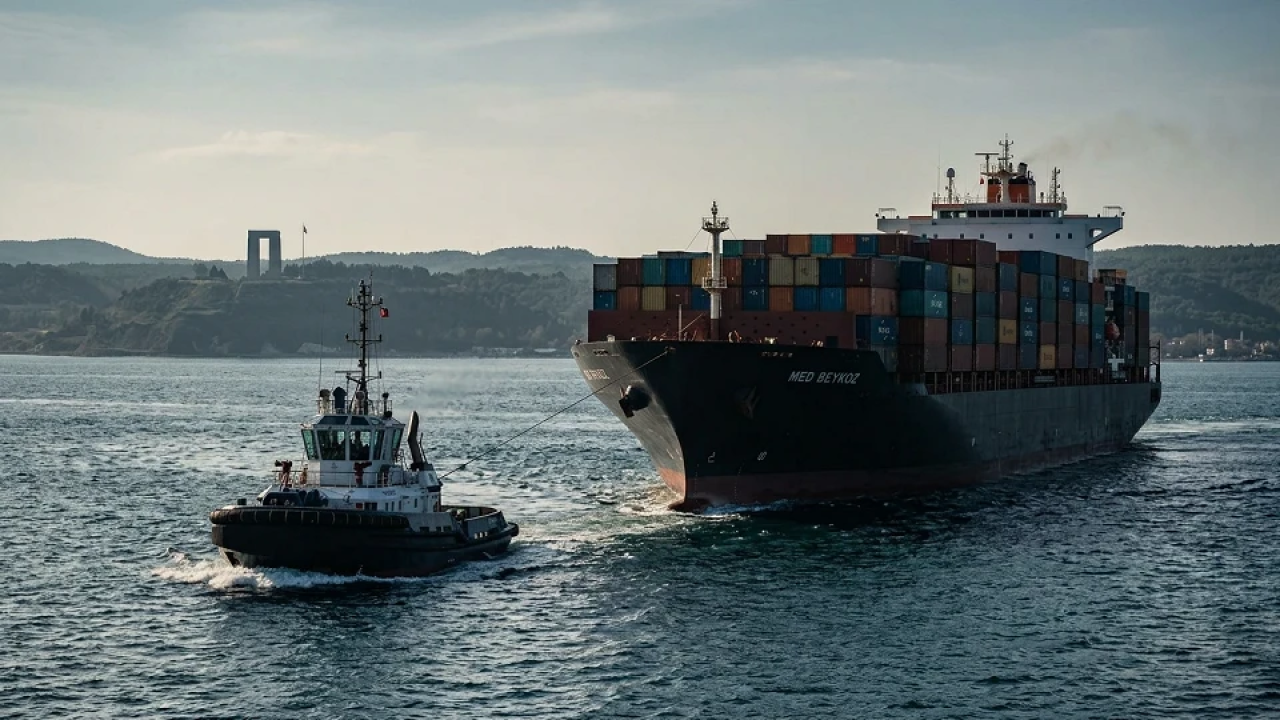
MSC's Soren Toft emphasizes ongoing port congestion and geopolitical uncertainty as key challenges for the container shipping industry.
MSC Chief Executive Officer Soren Toft, in a recent quarterly update on social media, stated that port congestion has become the new normal for the container shipping industry, with geopolitical uncertainty remaining a persistent feature of the operating environment.
Against this backdrop, liner operators must maintain agility to navigate a landscape of continuous disruption. As the world's largest liner company, MSC's assessment reflects a broader industry recognition that supply chain disturbances have become a structural, long-term condition rather than a cyclical anomaly.
Unlike publicly listed liner companies, MSC is controlled by Italy's Aponte family, operates as a private entity, and does not publish full financial results. In recent years, Soren Toft has used annual and quarterly social media summaries to communicate the company's market observations externally. While these statements do not include detailed financial data, they offer meaningful insight into how leading carriers interpret industry trends.
According to Sea-Intelligence data, MSC achieved a schedule reliability rate of 68.9% in August and September, marginally surpassing the average rate of 68.4% recorded by the Maersk and Hapag-Lloyd 'Gemini' cooperation network across several major port delays during the same period. The gap of 0.5 percentage points is narrow in absolute terms, yet sufficient to challenge a prevailing market assumption: that scale and redundancy are inconsequential to supply chain resilience.
The Gemini network's hub-and-spoke model reduces port calls and enhances mainline efficiency - theoretically favorable to schedule reliability. MSC, by contrast, draws on a larger fleet and a broader direct-call network, demonstrating an alternative source of resilience during periods of frequent port delay. Schedule reliability comparisons are influenced by statistical methodology, route structure, and directional variation, and no single metric can fully characterize overall service capability. Nevertheless, the result suggests that network architecture and capacity redundancy warrant reassessment in terms of their value during periods of disruption.
The Middle East conflict, the Red Sea crisis, and congestion at the world's major ports - particularly across Asia - are reshaping the container shipping market. Despite global market growth of approximately 5.0%, Maersk recorded a year-on-year decline in liftings of 0.8% in the third quarter, while Hapag-Lloyd saw a reduction of 0.5%, with both carriers primarily impacted by congestion at Asian ports. A decline in liftings does not necessarily indicate weak financial performance; it more likely reflects constrained effective capacity. The contrast nonetheless underscores that network efficiency and capacity flexibility carry equal strategic weight during periods of operational disruption.
The current configuration of the container shipping industry is closely tied to the expansion strategy MSC has pursued since 2020. Under the leadership of founder and Group President Captain Gianluigi Aponte, MSC has advanced an unprecedented fleet expansion program with considerable resolve, constructing the world's largest independent network to serve customer demand. Industry data indicates that MSC's annual liftings are projected to exceed 30 million TEU. An independent network confers greater scheduling autonomy and provides broader capacity flexibility when port congestion or service disruptions emerge - positioning the carrier to absorb operational shocks that more tightly structured alliance models may find harder to accommodate.