
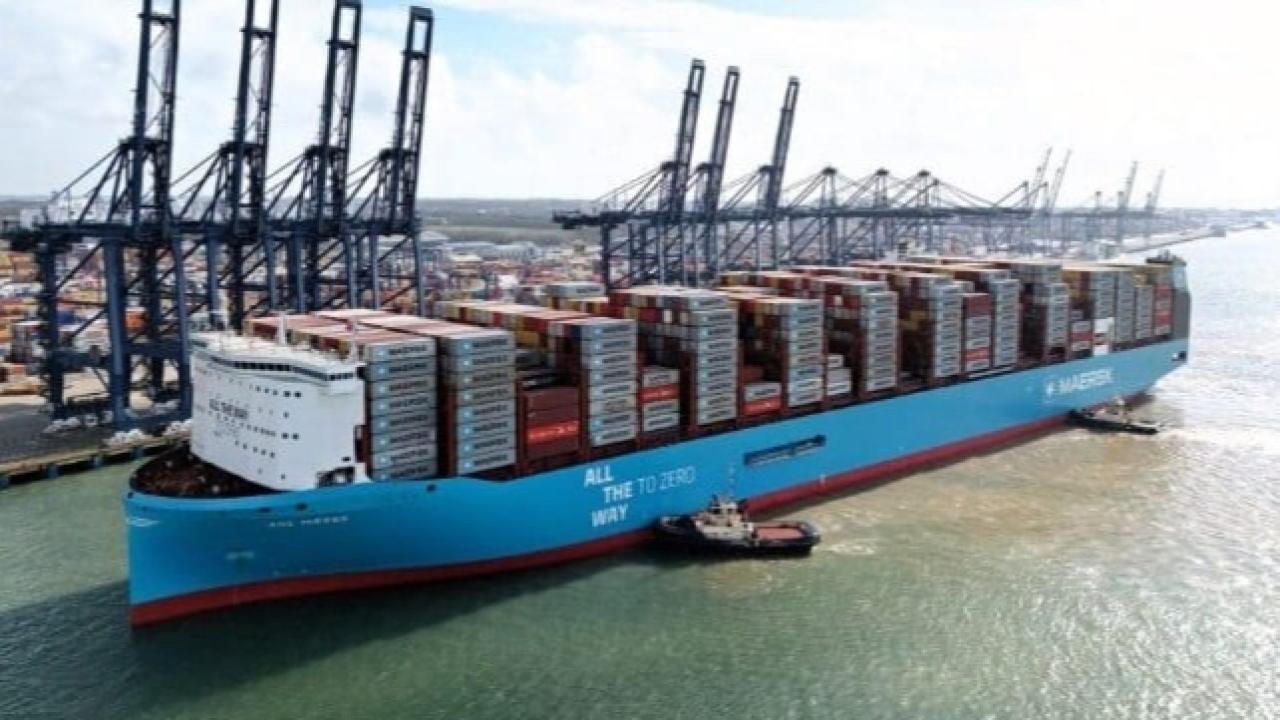
Maersk and Hapag-Lloyd's Gemini Cooperation resumes Red Sea voyages, ensuring high security with naval forces amid regional stability concerns.
The Gemini Cooperation between Maersk and Hapag-Lloyd has decided to commence joint voyages for the first time through the Red Sea and the Suez Canal as part of a gradual normalization process. The carriers emphasized that all of these transitions would be conducted with the support of naval forces and under high security measures.
Although Maersk has organized some independent voyages from the region under the Gemini Cooperation launched a year ago, the alliance had not utilized the Suez Canal–Red Sea corridor until now. The companies announced that starting from mid-February, the route connecting India to the Middle East and the Mediterranean would be redirected to this corridor.
The first westbound voyage will be carried out by the Albert Maersk (2025 built, 16,592 TEU), while the first eastbound voyage will be conducted by the Astrid Maersk (2024 built, 16,592 TEU). It has been reported that Maersk’s newly built dual-fuel vessels will also operate on this route.
For Hapag-Lloyd, this step signifies the first return to the Red Sea route since the beginning of 2024. The Gemini Cooperation also announced plans to launch two additional services via the Red Sea and the Suez Canal between Asian–Adriatic ports and Turkey. However, no further route changes are anticipated at this stage.
In their joint statements, the carriers stated, 'The safety of the crew, the vessels, and the customers’ cargo is our highest priority. The security situation in the region will continue to be closely monitored, and any potential changes to the Gemini services will depend on the stability in the Red Sea.'
The emphasis on 'naval forces support' coincides with the second year of the EU Naval Forces (NAVFOR) Operation Aspides. In the operation initiated by the European Union to protect commercial vessels from Houthi attacks in the Red Sea, it has been reported that support was provided to over 1,450 commercial vessels just in January. CMA CGM also stated that their vessels frequently received escorts during transitions through dangerous areas in this context.
With the return to the route, Gemini Cooperation indicated that disruptions experienced by customers would be reduced, and transit times and costs would decrease due to shorter distances. Following Maersk and CMA CGM, Gemini’s return to the corridor could accelerate the return of other major container lines to the Red Sea.
On the other hand, analysts point out that this return could lead to the release of additional capacity that was activated due to long African routes, which could raise the risk of overcapacity in the sector and bring the long-postponed reactivation of older vessels back into discussion.
Source: SeaNews Türkiye


