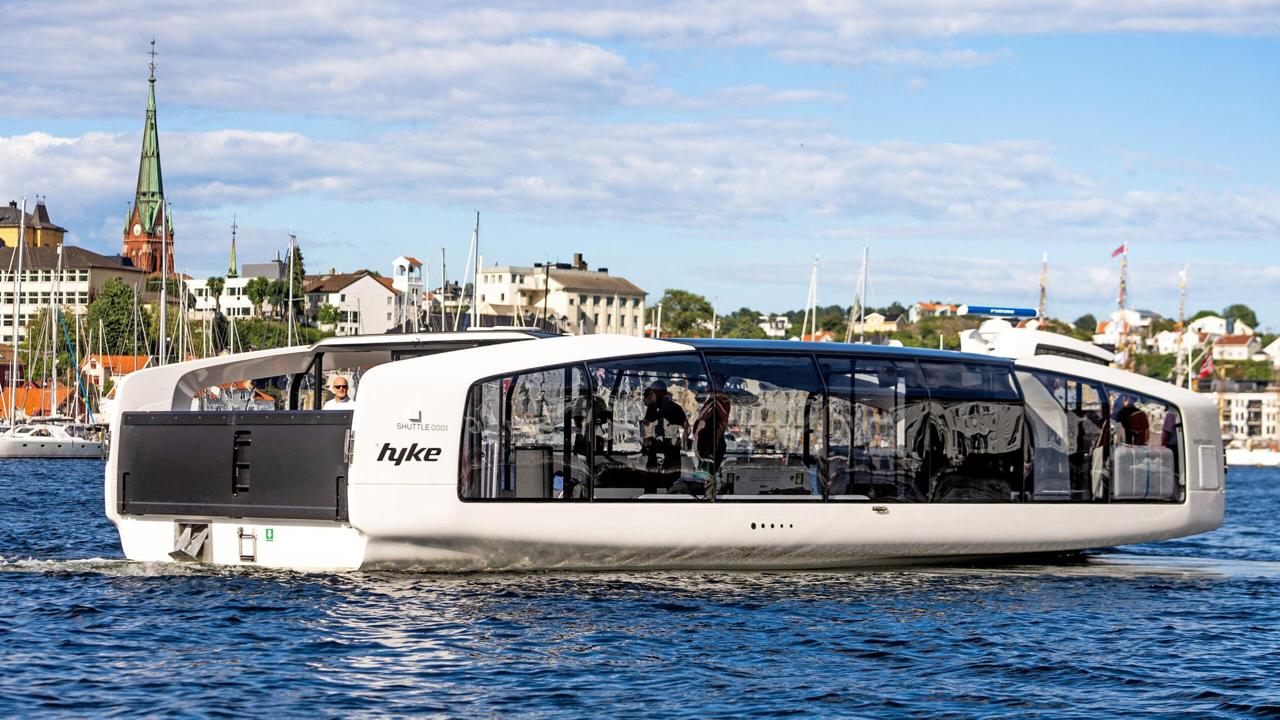
Norwegian company Hyke’s groundbreaking electric F-15 shuttle has proven to be one of the most efficient ferries in operation.
Hyke’s electric urban ferry declared a milestone success in Norwegian public transport
Norwegian company Hyke’s groundbreaking electric F-15 shuttle has proven to be one of the most efficient ferries in operation. After 14 months of service in Fredrikstad, it demonstrates a strong case for urban electric ferries as a cost-effective alternative to land-based infrastructure.
Oslo, Norway — April 20, 2026
Traffic jams plague cities worldwide, yet their waterways remain underused. After successful public transport, Norwegian tech company Hyke shows there’s a better alternative to building bridges or tunnels, unlocking the potential of water and existing urban infrastructure.
Fredrikstad Municipality has confirmed the successful outcome of the Hyke F-15 Shuttle pilot in a new report, following 14 months of continuous operation in public transport service, demonstrating very low energy costs and high passenger demand. The vessel was deployed in active public service, providing a direct test of electric ferry performance vs diesel vessels within the Fredrikstad public transport network.
Between April 2024 and July 2025, the fully electric passenger 50 passenger ferry operated as part of Fredrikstad’s municipal transport system on the Bekkhus–Vaterland route, carrying more than 41,000 passengers in daily operation. The route covered a 225-metre river crossing with an average crossing time of approximately two minutes, demonstrating a high-frequency urban transport application.
With up to 88% or 8x lower energy consumption than diesel vessels, the Hyke F-15 Shuttle sets a new benchmark for efficiency. It uses roughly the same amount of power as five household hair dryers.
This shows that electric urban ferries are a key enabler in electrifying cities and can often replace not just other ferries but also serve as a cost-efficient alternative to building pedestrian bridges or tunnels.
Comparison based on energy consumption per passenger-kilometre (kWh/pkm). Reference values derived from IEA and industry benchmarks.
“The project shows that our urban waters can be used much more efficiently. Instead of digging tunnels or building bridges, which are hugely costly, electric ferries can quickly be deployed to shuttle large numbers of passengers. It’s time to rethink urban planning by putting waterways at the center,” said Halvor Vislie, CEO of Hyke. “Together with Fredrikstad Municipality, we’ve demonstrated that Hyke F-15 can operate as part of everyday public transport — efficiently, quietly, and with strong passenger acceptance “
Electric Ferry Proven in Daily Public Transport Use
The Hyke Shuttle was introduced as a dedicated service within Fredrikstad’s ferry system, operating alongside existing routes and serving commuters throughout the pilot period.
During the project, the vessel delivered:
· Operated for 14 months in live public transport with no safety incidents
· 8 × lower energy consumption than comparable diesel ferries
· 4.72 / 5.00 passenger satisfaction and 100% user loyalty
· More than 41,000 passengers transported in daily service
“The Hyke f-15 Shuttle pilot represents a clear success for Fredrikstad Municipality in advancing sustainable urban mobility.” — Fredrikstad Municipality, Tom Mauno.
A New Generation of Electric Passenger Ferry
Hyke F-15 Shuttle is a fully electric passenger vessel developed for short urban crossings and municipal transport applications.
Key vessel characteristics:
· Length 14.9m
· Beam: 5.7m
· Passenger capacity: 50 persons
· Vessel weight: approximately 11 tonnes
· Battery capacity: 196 kWh
· Energy consumption: 10 kWh per hour
· Operational endurance: approximately 10 hours per charge
· Charging: 150kW DC, 22Kw AC
The pilot demonstrated that the vessel operates with significantly lower energy consumption compared to conventional diesel ferries, while eliminating direct emissions and reducing noise levels in urban environments.
A Milestone for Hyke
For Hyke, the project represents a key milestone in demonstrating its electric passenger ferry technology in real-world public transport use.
Hyke develops fully electric vessels designed for urban and inland mobility, combining lightweight construction, energy efficiency, and system architectures intended for future scalability.
Backed by European and National Programmes
The pilot was conducted as part of Fredrikstad’s broader sustainable mobility strategy and supported through:
· The Urban Growth Agreement (Bypakke Nedre Glomma)
· The EU Horizon Europe SUM (Seamless Urban Mobility) programme
As a designated “living lab” within the SUM programme, the project contributes to European efforts to develop and scale sustainable urban mobility solutions.