According to a recent Washington Institute for Near East Policy report, Houthi-led attacks in the Red Sea and surrounding waterways have intensified, transforming the region into a high-risk zone for global shipping.
Houthi Maritime Attacks Escalate as Red Sea Security Hangs in the Balance
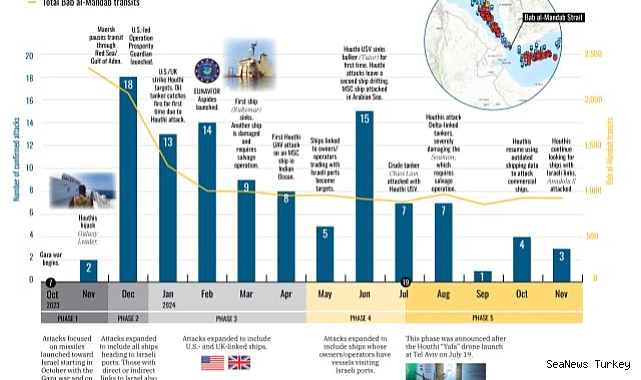
According to a recent Washington Institute for Near East Policy report, Houthi-led attacks in the Red Sea and surrounding waterways have intensified, transforming the region into a high-risk zone for global shipping. The Iran-backed group has conducted over 100 attacks on commercial and military vessels since November 2023, exploiting the conflict in Gaza as justification and imposing escalating restrictions on maritime activity.
The Houthis’ maritime campaign evolved through five distinct phases, progressively expanding their target list to include Israel-linked, U.S., and British vessels, as well as ships indirectly connected to these nations. Their actions have forced many shipping companies to reroute around southern Africa, increasing operating costs and bunker fuel consumption. Major players like Maersk have shifted away from the Gulf of Aden and the Bab al-Mandab Strait, while others like CMA CGM continue limited operations in the region.
The report highlights that maritime transit through the Bab al-Mandab remains down by 50% year-over-year, significantly impacting regional ports and the Suez Canal, where vessel transits have dropped dramatically.
Looking ahead to 2025, the Washington Institute warns that the security of vital shipping lanes will depend heavily on U.S.-Iran relations and the U.S. approach to the Gaza conflict. A hardline U.S. policy toward Iran under a Trump administration could trigger retaliatory Houthi and Iranian attacks, extending beyond the Red Sea into the Arabian Seaand the central Indian Ocean. These attacks may include sea mines, aerial drones, cruise missiles, and unmanned surface or underwater vehicles (USVs and UUVs).
The report also emphasizes that resolving the Red Sea crisis will require strong regional alliances and active U.S. engagement with partners like Saudi Arabia, especially given improving Saudi-Iranian ties since their China-brokered reconciliation in 2023.
The Washington Institute concludes that the next U.S. administration's policies will play a decisive role in shaping maritime security and the freedom of navigation in this volatile region.
This news summary is based on research conducted by the Washington Institute for Near East Policy.