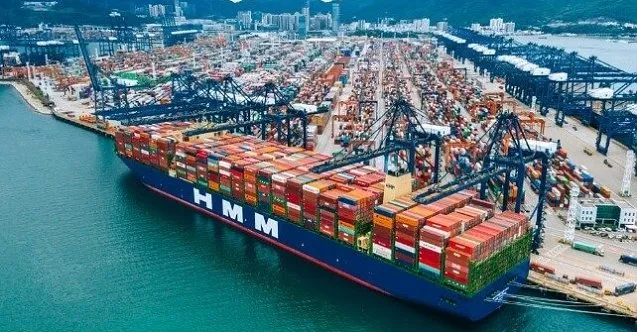
HMM accelerates fleet expansion with a $1.617 billion investment, adding 12 vessels to enhance capacity and regional services.
According to foreign media reports, HMM, South Korea's largest container shipping company, is accelerating its fleet expansion plans. In a stock exchange announcement, HMM's board of directors recently approved a total investment of KRW 2.17 trillion (approximately USD 1.617 billion). The plan includes the ordering of eight 13,000 TEU container vessels, as well as the acquisition of three 2,800 TEU vessels and one 1,700 TEU vessel through resale transactions involving vessels currently under construction.
The 12 vessels combined will add 114,100 TEU of capacity to HMM's fleet, with all deliveries scheduled for completion by the end of December 2029. In terms of vessel type composition, the order encompasses both 13,000 TEU mainline vessels and 1,700 to 2,800 TEU feeder vessels, reflecting HMM's intent to strengthen its regional feeder network while simultaneously expanding its deep-sea capacity.
This investment represents a significant move following HMM's latest revision of its medium-to-long-term development strategy. Under the new strategy, HMM's container fleet is set to expand to 166 vessels with a capacity of 1.47 million TEU by 2030, while its bulk carrier fleet is targeted to reach 110 vessels with a deadweight tonnage of 13.52 million. Compared with the previous strategy's container fleet target of 130 vessels and 1.50 million TEU, the revised strategy adjusts both the number of vessels and the capacity structure: the vessel count increases while the total capacity target is slightly reduced, reflecting a strategic shift away from the pure pursuit of large-scale vessels toward greater emphasis on route compatibility and network flexibility.
HMM has stated that it will leverage a hub-and-spoke transport network to enhance the deployment of its deep-sea and short-sea routes. Industry analysts suggest that this move could alter the landscape of capacity allocation and is expected to increase slot supply in niche markets and for specific cargo types suited to smaller vessels. Particularly against the backdrop of continued trade growth in emerging markets such as Southeast Asia, the Middle East, and Latin America, the deployment of feeder and mid-size vessels is positioned to improve regional transshipment efficiency and extend coverage to small and medium-sized ports.
The world's leading container shipping companies are currently engaged in a new wave of capacity expansion. Maersk, CMA CGM, MSC, and others have successively ordered large and ultra-large container vessels, driving the ratio of the global container ship orderbook to existing fleet capacity to historically elevated levels. HMM's decision to increase its vessel orders reflects both a necessary response to the competitive dynamics of the industry and an acknowledgment of the challenge of rebalancing market supply and demand when large volumes of new capacity are delivered concurrently. Analysts have noted that if new vessels are delivered in concentrated batches around 2029 without a commensurate increase in global trade growth, the liner market may face renewed pressure in absorbing excess capacity. By structuring its orders to encompass both large mainline vessels and feeder ships, HMM may enhance the flexibility of its capacity deployment to a certain degree, reducing the risk exposure associated with reliance on a single vessel type during periods of market volatility.
For freight forwarding enterprises, HMM's fleet expansion signals the prospect of increased slot supply on intra-Asia and deep-sea routes, with the range of available options likely to broaden particularly in relation to small and medium-sized port calls and regional feeder services. Relevant enterprises are advised to monitor HMM's subsequent route deployment decisions, the pace of new vessel deliveries, and alliance cooperation arrangements on an ongoing basis, and to conduct advance assessments - taking into account client cargo types and destination structures - of how shifts in capacity may affect booking costs and schedule reliability.