
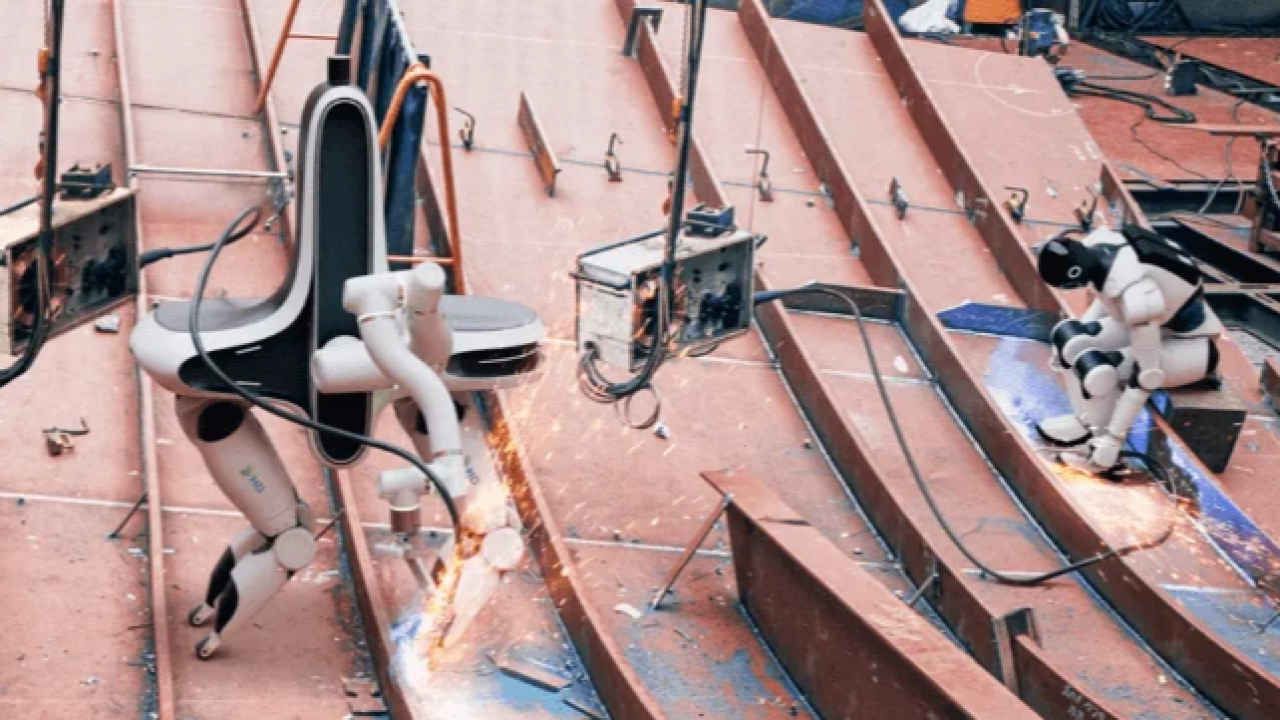
HD Hyundai Samho plans to integrate humanoid robots in shipyards by 2027 to enhance efficiency and tackle labor shortages.
The South Korean shipbuilding company HD Hyundai Samho has announced that it is exploring ways to integrate humanoid robots into shipyard operations and has analyzed the return on investment (ROI) to identify the areas where this technology can be used most efficiently.
The shipyard tested humanoid robots during a demonstration event held last year. In the trials, the robots were used for tasks such as carrying items and welding operations. The initial demonstration video included scenes of a humanoid robot interacting with a forklift.
In the project, alongside HD Hyundai's own robotics unit, support is also provided by Neura Robotics and LG CNS. The robots are expected to initially be used for low-level tasks, and as trials and training processes develop, they will be moved to higher-value jobs within the value chain. The company aims to begin physical distribution in 2027 and plans to provide intensive artificial intelligence training to employees beforehand.
Competition from China and labor issues
Robotic technologies are seen as a crucial part of South Korean shipyards' strategy in competing with China, the world leader in shipbuilding. Due to demographic structure and the career preferences of the new generation in South Korea, the domestic workforce remains limited. Consequently, shipyards have turned to migrant workers from Thailand, Vietnam, and other countries.
As of 2024, approximately 16% of the shipyard workforce consists of foreign employees. A significant portion of new hires also comprises foreigners with temporary work visas, and this trend is expected to continue. It is anticipated that robots will not only help fill the labor gap but also provide advantages for Korean companies in accessing the U.S. market, where finding qualified workers is challenging.
Technical challenges and alternative solutions
Humanoid robots have the advantage of being able to work in environments designed for humans. However, they are expected to face significant technical challenges in heavy industrial areas like shipyards. These devices need to navigate constantly changing field layouts, walk on uneven surfaces, and withstand dust and harsh weather conditions.
As an alternative, small and single-purpose robotic solutions that keep humans within the system are also being tested. Collaborative robot (cobot) welding arms used in DSME and HD Hyundai shipyards have yielded positive results. In this system, a worker carries, positions, and sets up the robotic arm; while the worker attends to another task, the robot performs precise welding operations.
A similar approach is being applied in HD Hyundai's panel assembly lines. Four-legged autonomous robots operating in a semi-structured manufacturing environment have found their place in the field with intermittent human supervision.
Source: SeaNews Türkiye


