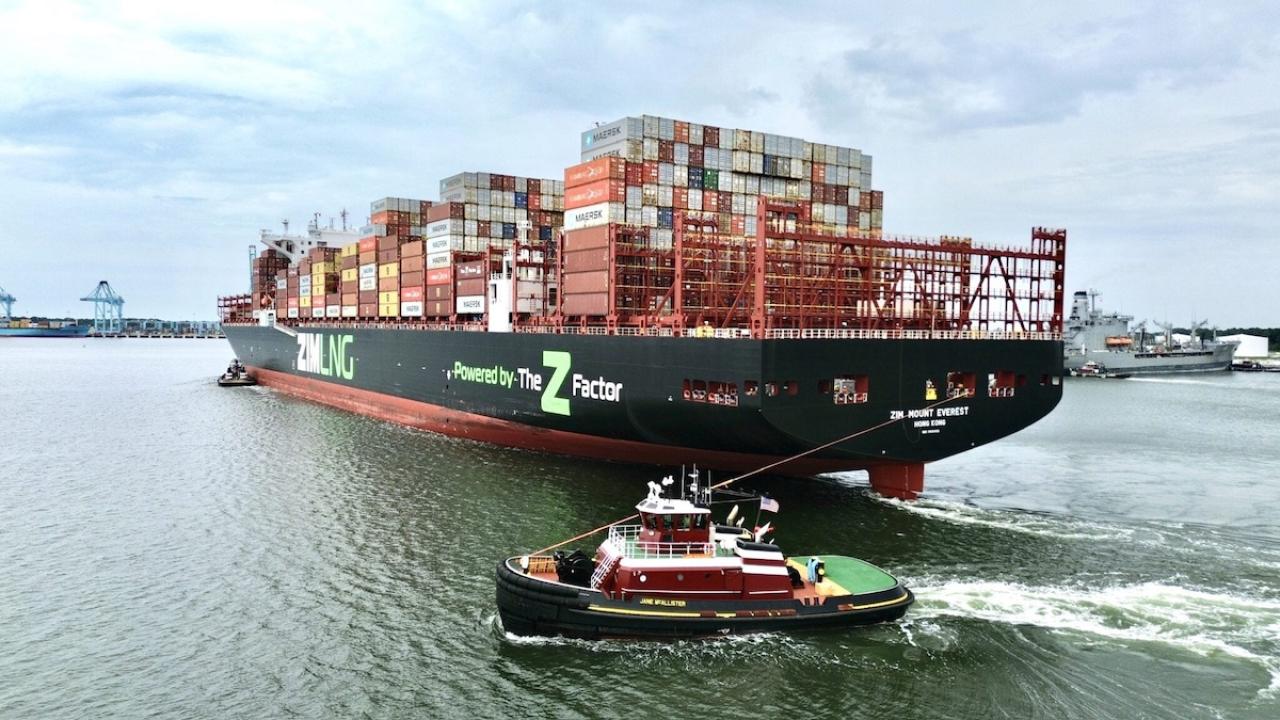

Hapag-Lloyd calls for a reevaluation of ocean freight contracts as market volatility challenges traditional agreements ahead of 2027 negotiations.
The traditional annual ocean freight contract is confronting a new reality. For decades, carriers and major shippers have relied on year-long agreements to lock in rates and capacity. However, as spot rates fluctuate sharply and contracted prices drift further from market conditions, the viability of this longstanding arrangement is coming under serious scrutiny.
According to a report by the 'Journal of Commerce' dated November 12, Hapag-Lloyd Chief Executive Rolf Habben Jansen argued that traditional fixed-rate annual contracts have become ill-suited to the volatility now characterizing the container shipping market. He emphasized that the industry must reconsider how ocean freight contracts are structured. The timing is significant: a fresh round of contract negotiations for 2027 is already drawing near.
Annual contracts once represented a mature and mutually beneficial arrangement between carriers and shippers. Cargo owners committed to volume in exchange for rate stability and capacity assurance, while carriers secured forward bookings and could plan capacity deployment accordingly. In a stable market, both parties operated with reasonable commercial predictability.
Recent years, however, have delivered successive disruptions: the post-pandemic rate surge, the return of tonnage, the Red Sea crisis, shifting U.S. tariff policy, and a fresh round of route restructuring triggered by Middle East developments in 2026. Freight rates and transport costs have shifted materially within short timeframes, rendering a contract that appeared reasonable at signing potentially misaligned with market reality within months. Because contracted rates do not adjust daily to reflect the spot market, structural tension is an inherent consequence.
When spot rates rise above contracted levels, shippers move to book at contract prices while carriers absorb revenue losses and face pressure on capacity allocation. Conversely, when market rates fall, shippers feel constrained by rates locked in at higher levels and seek renegotiation. Both parties consistently seek terms that favor their own position, yet the market does not remain static on either side. Hapag-Lloyd's proposal to revise the contract model directly addresses this structural contradiction.
The environment surrounding the next round of contract negotiations is far from settled. Incremental capacity additions, downward rate expectations, and persistent geopolitical uncertainty mean that neither shippers nor carriers are eager to be bound by a fixed-price commitment over an extended horizon. Contract duration, rate adjustment mechanisms, and the structure of capacity guarantees are therefore likely to emerge as the central issues in the 2027 negotiations.
From an operational standpoint, future contracts may trend toward tiered durations, index-linked pricing, hybrid structures combining partial capacity locks with spot exposure, and embedded renegotiation triggers alongside defined capacity protection clauses. Whether such arrangements can reconcile price stability with market flexibility remains a question that both sides will need to work through at the negotiating table.
Hapag-Lloyd's recent operating performance illustrates precisely the tension between spot market dynamics and long-term contracted rates. According to its third-quarter 2026 results, published November 12, the liner segment recorded an average freight rate of USD 1,808 per TEU, compared with USD 1,413 per TEU in the same period of 2025—an increase of approximately 28 percent year-on-year. Transport volume for the period reached approximately 3.383 million TEU, broadly in line with the prior year. With volume growth negligible, it is the rate increase that has delivered measurable earnings improvement to the carrier.
For the third quarter, Hapag-Lloyd Group reported EBITDA of USD 1.726 billion, EBIT of USD 1.085 billion, and net profit of approximately USD 999 million. On November 11, the company revised its full-year 2026 guidance upward, projecting group EBITDA of USD 4.6 billion to USD 5.0 billion and EBIT of USD 2.0 billion to USD 2.4 billion. Management noted that fourth-quarter spot rate performance remained strong and that overall trading conditions had exceeded earlier expectations.
These results explain why carriers have grown increasingly sensitive to contract mechanics: spot market pricing directly determines the yield achievable on available capacity. When a substantial share of that capacity is pre-committed at fixed rates set during a lower-rate environment, carriers are structurally constrained in their ability to capture the full upside of a rising market.
For cargo owners, fixed-rate contracts retain genuine commercial value. On peak-season sailings, high-demand trade lanes, and time-sensitive shipments, confirmed capacity carries meaningful worth beyond the rate itself. Carriers, meanwhile, require sufficient pricing flexibility to absorb volatility in capacity deployment, bunker costs, and geopolitical risk. The fundamental challenge for both parties lies in reconciling the competing demands of price stability and market responsiveness—a balance that neither a purely fixed nor a purely variable structure has yet resolved satisfactorily.