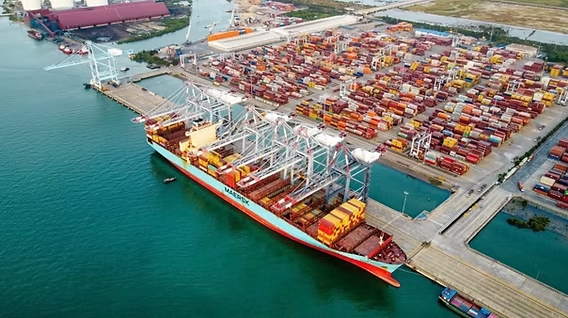
DSV is prioritizing profitability over volume by eliminating low-margin customers, signaling a shift in logistics strategy.
Customers may have cargo to ship, but major logistics companies are not necessarily willing to take it. A recent operational adjustment by DSV, one of the world's leading logistics companies, has drawn attention across the international logistics industry: the company has begun proactively phasing out customer business with low margins that fail to meet return requirements, with some loss-making warehousing business also included in the exit plan.
On October 21 local time, DSV released its financial report for the third quarter of 2026. The report showed that DSV's air and sea freight volumes fell by about 3% year over year this quarter, yet adjusted EBIT in the air and sea division increased by 18.9% year over year. This contrast—lower volumes but improved profitability—has become a key topic of market discussion. During the earnings call, DSV CEO Jens Lund disclosed that about 2 percentage points of the decline in air freight volume were related to the company’s proactive removal of low-yield customers. In other words, the drop in volume was not simply due to a lack of cargo from customers or intensified market competition, but also reflected DSV's deliberate business choices.
Looking at overall performance, DSV Group posted revenue of DKK 80.702 billion in the third quarter, while EBIT before special items reached DKK 6.606 billion, up 19.5% year over year. Adjusted EBIT for the air and sea division came in at DKK 4.278 billion, up 18.9% year over year. The profit growth benefited both from integration effects following the acquisition of DB Schenker and from cost control and business mix adjustments. Profit improvement cannot be attributed entirely to customer cleanup, but DSV management has clearly stated that the company is actively eliminating business that does not meet return thresholds.
For the freight forwarding industry, this logic is not unfamiliar. Some customers may provide stable cargo volume and appear attractive on the surface, but once service costs such as last-minute rerouting, amendment requests, inspections, exception handling, extended payment terms, and low pricing are fully factored in, the actual profit margin may be very limited. If such business also consumes substantial operational and management resources, it may even reduce the ability to serve higher-margin customers. DSV’s latest adjustment is essentially a reassessment of whether a deal is truly worth doing: cargo volume is only one side of the equation, while retained profit after costs is the real key.
In addition to optimizing its customer mix, DSV’s warehousing adjustments also reflect its operating mindset. Lund said the company is terminating warehouse business with extremely low margins or even losses and replacing it with business that carries more normal margins, rather than shutting down warehouse locations on a large scale. Warehousing involves fixed costs such as rent, equipment maintenance, and labor allocation. If customers occupy large amounts of storage capacity over the long term without generating reasonable returns, a busier warehouse is not necessarily a more economical one. Rather than filling warehouse space with low-priced business, it may be more efficient to free up resources for business with better commercial conditions.
In the third quarter, DSV’s contract logistics division posted adjusted EBIT of DKK 1.673 billion, up 50.3% year over year. The company attributed the improved performance to acquisition synergies, higher productivity, better warehouse capacity utilization, and the integration of low-margin sites. This suggests that earnings improvement in warehousing and contract logistics came more from better resource utilization and business structure optimization than from simple scale expansion.
DSV's case of lower volumes and higher profits offers a thought-provoking example for the China freight forwarding industry. In recent years, price competition in the forwarding market has been intense, and some companies have chosen to sacrifice profit margins in order to retain customers, first focusing on cargo volume and then seeking other business opportunities. This strategy may be reasonable at certain stages, but if volume grows over the long term without a corresponding improvement in profits, expanding scale may actually increase operating pressure.
Of course, proactively giving up orders is not a universal path for every company. Different companies have different cost structures, customer mixes, and market positioning, and cleaning up low-margin business may also bring risks such as customer loss and reduced network utilization. What DSV's adjustment reflects more broadly is an operating principle: pricing should not be calculated simply by adding ocean freight and booking costs. Labor, document processing, payment-term exposure, frequent exception handling, and additional customer services should all be included in the true cost assessment.
For exporters and cargo owners, there is no need to worry excessively that logistics providers will broadly reject low-price business. What determines whether cooperation can be sustained over the long term is not price alone, but whether price, service standards, shipment stability, and payment terms are properly aligned. For freight forwarders, building a sustainable balance between volume, profit, and service quality may be more important than simply chasing scale.