
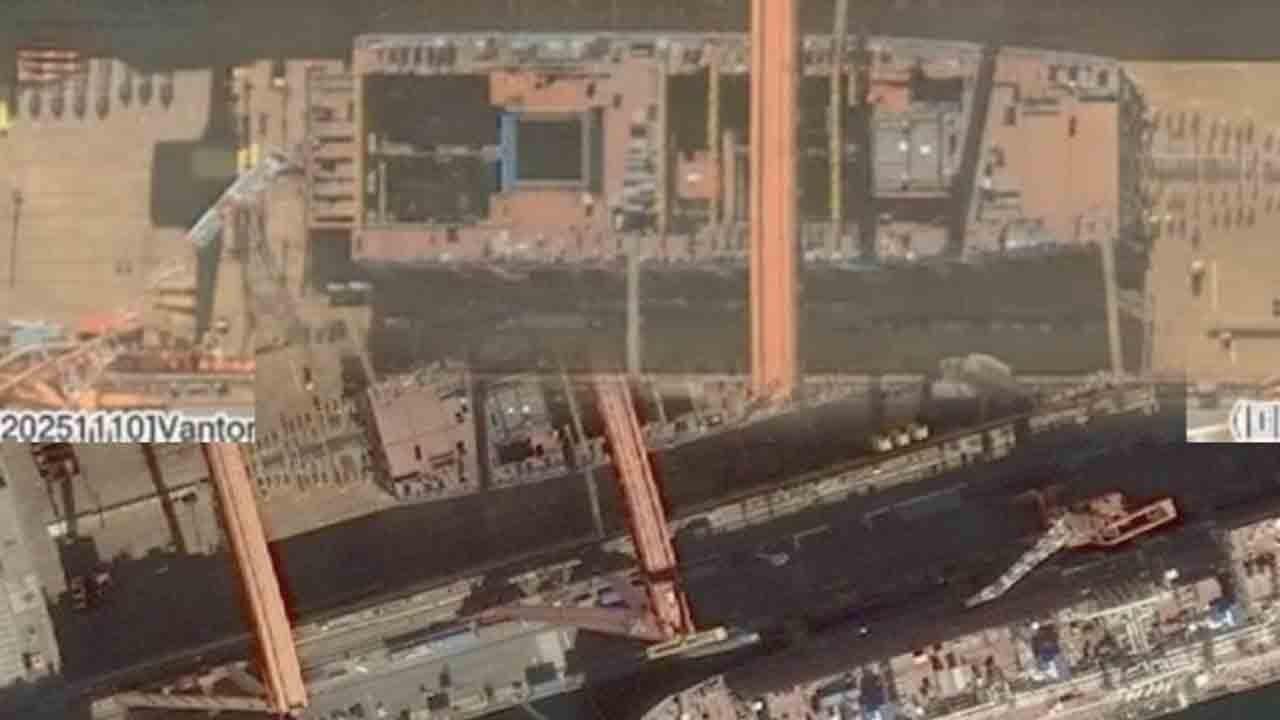
Satellite images reveal China may be constructing its first nuclear aircraft carrier, potentially shifting Pacific power dynamics long-term.
Satellite images suggest that the construction of China's first domestically built nuclear aircraft carrier may have begun at the Dalian shipyard. This development could significantly impact the balance of power in the Pacific in the long term.
According to satellite images obtained by the Japanese think tank National Institute for Policy Research (NIPPR), signs indicate that construction has commenced on the country's first indigenous nuclear aircraft carrier at the Dalian shipyard in northeastern China. This raises new questions regarding Beijing's long-term maritime power objectives in the Pacific.
The images reveal structures specific to nuclear shipbuilding that were not present during the construction of China's previous conventionally powered aircraft carriers at the Dalian shipyard. Since February, approximately 270-meter-long ship skeleton blocks have been observed.
The satellite photos show a partial hull measuring 150 meters in length and 43 meters in width, containing two rectangular frames approximately 16x14 meters in size. NIPPR researchers noted that these frames correspond to reactor containment blocks used in the construction of nuclear aircraft carriers in the United States.
NIPPR researcher Maki Nakagawa stated, "The size and shape of the frames at the Dalian shipyard are strikingly similar to those of the frames used in the nuclear aircraft carriers built in the U.S. and are likely reactor containment blocks." Nakagawa predicts that China could possess a nuclear aircraft carrier comparable to U.S. vessels by the early 2030s.
Meanwhile, infrastructure work continues at the Chinese Navy's base in Qingdao, where the Liaoning vessel is currently stationed. Expansions of the docks, de-magnetization facilities to reduce the magnetic signature of ships, and aircraft carrier landing training areas are being established. Analyses indicate that these preparations are being made for the deployment of a fourth aircraft carrier.
Although China currently lags behind the U.S. in terms of aircraft carrier capability, the introduction of a fourth vessel could change regional maritime balances. A nuclear-powered ship equipped with a catapult system would be able to remain at sea longer compared to conventional vessels, thereby extending China's operational range in the Western Pacific.
Experts emphasize that China's advancements could create a situation requiring constant surveillance and intelligence gathering by Japanese and U.S. forces, potentially altering regional dynamics.
Source: www.denizhaber.com


