
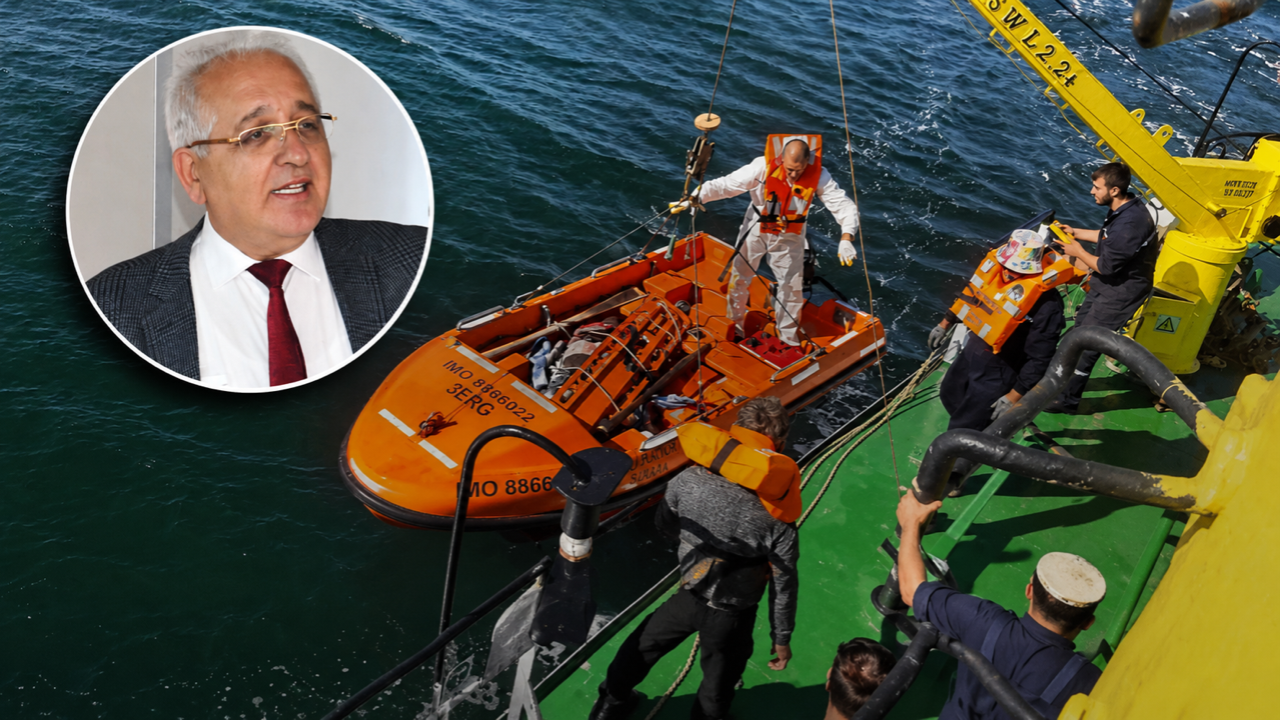
Capt. Mustafa Can calls for stronger protections for civilian vessels in the Black Sea amid ongoing conflict, emphasizing the need for effective diplomacy.
The Chairman of Transbosphor Maritime and shipowner Captain Mustafa Can highlighted the loss of lives resulting from civil commercial vessels becoming targets in the Black Sea, calling for a more effective mechanism to protect Turkish shipping and ensure regional security.
Captain Mustafa Can, who closely monitors operations in the Black Sea and Turkish Straits along the Turkey-Russia maritime trade route, drew attention to the security risks faced by commercial vessels under the shadow of the Russia-Ukraine war. In response to questions from Tayfun Ercan, the News Director of Kent Yaşam Newspaper, Can stated that it is unacceptable for civilian mariners to become targets in the Black Sea, asserting, 'A war story cannot be written over the blood of cooks and sailors.'
While the Black Sea continues to be a strategic transit point for maritime trade between Turkey and Russia, the war environment poses serious security issues for commercial vessels, shipowners, and maritime workers in the region. Captain Mustafa Can, the owner of Transbosphor, which operates in ship agency, port operations, and international maritime transportation, assessed the risks faced by Turkish shipping and developments in the region.
Expressing that the ongoing war between Russia and Ukraine has turned the Black Sea into a high-risk area for civilian mariners and commercial vessels, Can called on both the Moscow and Kiev administrations to adhere to international maritime law. He emphasized that Turkey needs to conduct more effective diplomacy to ensure safe trade in the Black Sea, stating that maritime trade security should be addressed through an institutional framework.
THE BALANCE SHEET OF ATTACKS AND THE FOG OVER THE NUMBERS
In response to Tayfun Ercan's question about how many Turkish vessels have been attacked and the losses suffered by the sector, Captain Mustafa Can pointed out the confusion in public information and the evaluations made solely based on the flag carried by the vessel.
Can stated that a vessel being flagged by a different country does not mean that it is not operated by Turkish capital or that Turkish sailors are not harmed, emphasizing that the ship owner, operating company, and crew elements should be evaluated together.
Highlighting that there is no independent and confirmed official balance sheet, Can clarified the data confusion with the following words: 'Ukrainian sources announced that more than 21, 35, 76, and even 90 vessels were targeted in operations around the Sea of Azov and Kerch in July 2026. However, these figures are operational claims. It is noteworthy that only two of the 12 tankers referred to as the 'shadow fleet' in a Reuters investigation were confirmed to be on the sanctions list. Therefore, the verified minimum cases and the number of operational targets differ from each other. Using uncertain totals as if they were confirmed is neither scientifically nor legally correct.'
Nevertheless, emphasizing that the danger is concrete, Can recalled that the Turkish-flagged tanker Sabahat Telli was hit in Taganrog, that tankers linked to Turkey were attacked in May 2026, and that sailors lost their lives in attacks in the region, stating, 'This is no longer an isolated incident; it is a systematic security crisis.'
'THE 'SHADOW FLEET' LABEL IS PROPAGANDA'
Describing the concerns created among Turkish shipowners and sailors by the attacks, Can stressed that the greatest danger is the inability to measure the risk. He noted that vessels are targeted with vague expressions such as 'contributing to the Russian economy' or 'shadow fleet,' even if they are not on the sanctions list, stating, 'Carrying commercial cargo does not turn the cook, oilman, or bosun on board into a soldier. Those people are civilians working on the ship to support their families.'
Evaluating Ukraine's stance from the perspective of international maritime law, Can stated that a civilian commercial vessel cannot be declared a military target simply for calling at a Russian port or carrying Russian goods. He indicated that the solution to the allegation of sanctions violation is to seize the vessel or obtain a court order, asserting, 'Hitting a vessel with an explosive-laden drone along with its crew is unlawful and may require an investigation into war crimes. The term 'shadow fleet' is a dirty propaganda aimed at discrediting the vessel and normalizing the attack.'
'TURKISH MARINERS WERE ALSO HIT IN RUSSIAN ATTACKS'
Captain Mustafa Can, Chairman of Transbosphor Maritime, reminded that the danger in the Black Sea is not one-sided, as Russia has also inflicted serious damage on Turkish vessels. He noted that the Turkish-owned vessel 'Ant,' carrying cargo from Odesa, was hit in a Russian drone attack in May 2026, injuring two Turks, and that in June 2026, a Russian attack on the vessel 'Victress' resulted in the death of a 58-year-old Egyptian cook. Can stated, 'I am not pro-Russia; I am in favor of law and human life. The identity of the perpetrator does not change the value of the life of the deceased sailor. It is unacceptable for Russia to strike commercial vessels while bombing ports, just as it is unacceptable for Ukraine to target vessels with controversial lists.'
CALL TO ANKARA: 'RULE-MAKING DIPLOMACY IS ESSENTIAL'
In response to the question of whether he finds the steps taken by the Republic of Turkey sufficient so far, Can provided a clear answer, arguing that Ankara should now conduct a 'rule-making' diplomacy rather than merely condemning events after they occur. The urgent action plan proposed by Captain Can includes the following points:
- A continuous Black Sea Maritime Trade Security Center should be established with the participation of the Ministries of Foreign Affairs, Transport, National Defense, and intelligence agencies.
- All Turkish-owned, operated, or crewed vessels should be monitored in real-time.
- A written notification mechanism should be requested to ensure that civil vessels from Russia and Ukraine will not be attacked.
- A special working group for the Black Sea should be established under the International Maritime Organization (IMO).
- A joint 'War Risk Fund' should be created with the participation of insurance companies, banks, and shipowners.
'FRIENDSHIP CANNOT BE SUSTAINED BY ATTACKING CIVIL VESSELS'
Emphasizing that Turkey's right to trade with both Russia and Ukraine is that of an independent state, Can stated that targeting Turkish vessels is inconsistent with friendly relations with Ukraine.
He warned that the sympathy felt for Ukraine in the Turkish public due to the Crimean Tatars would be severely damaged by such attacks, stating, 'Defending the rights of the Crimean Tatars is not the same as unconditionally supporting every action of the Ukrainian government. Targeting Turkish vessels and accusing them with the 'shadow fleet' label undermines public sympathy.' Can also pointed out that Turkish companies operating in Ukrainian ports are facing significant problems due to Russian missiles and rising insurance premiums, expressing that the Kiev administration needs to establish transparent coordination with Turkish shipowners.
'LIMIT YOUR WAR ZONE TO THE MILITARY AREA'
At the end of the interview, evaluating the future of Turkey-Ukraine relations, Mustafa Can noted that the two countries have strong strategic ties, but if civilians continue to be harmed, economic and diplomatic relations will inevitably suffer.
Can concluded his remarks with this historical call: 'We are not on the side of Russia’s or Ukraine’s propaganda. We stand with the murdered sailor, the seafarer working in fear, and the Turkish shipowner conducting trade within the framework of the law. The warring parties must limit their targets to the military area. A military success story cannot be written over the blood of cooks, captains, engineers, and sailors. The Black Sea is not an unlimited battlefield for any state!'
Source: SeaNews Türkiye


