
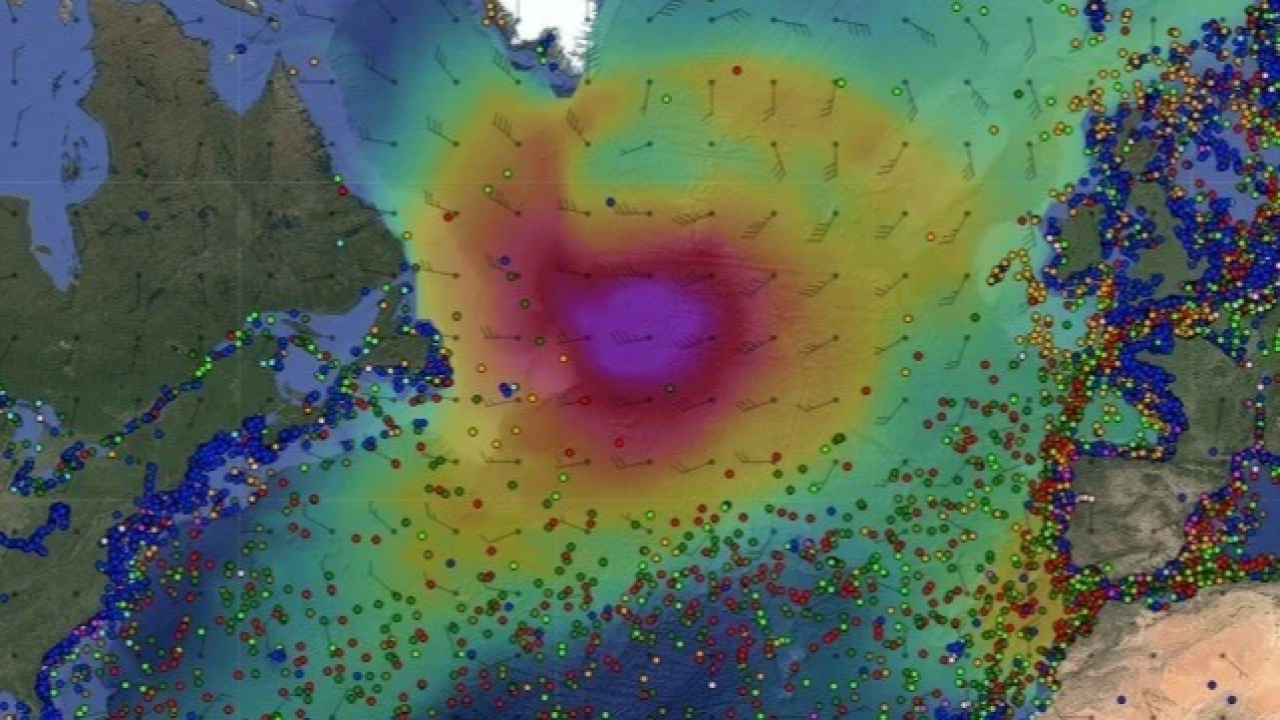
A powerful storm in the North Atlantic prompts ships to reroute southward, with winds up to 80 knots and waves reaching 54 feet.
A rapidly intensifying storm in the North Atlantic is forcing ships to head south to avoid dangerous conditions. A massive low-pressure system south of Greenland has seen its central pressure drop to 938 millibars, generating winds of up to 80 knots and extraordinary waves reaching 54 feet (approximately 16.5 meters). These conditions present an extremely challenging navigation environment, even for large commercial vessels.
According to AIS data from Pole Star Global, nearly all ships on transatlantic routes have altered their courses southward to avoid the highest waves observed in the southeastern and southwestern sectors of the storm. In the most heavily affected area, only a few vessels remain east of Newfoundland. One of these, the 60,000 dwt bulk carrier Nord Allegro, is proceeding southeast at approximately three knots to distance itself from the storm.
Weather consultancy firm Meteoblue emphasized the remarkable aspect of the storm is the extraordinarily rapid drop in central pressure. They noted, "A mid-latitude (extratropical) cyclone deepening by more than 24 hPa within 24 hours is classified as a 'bomb cyclone' resulting from explosive cyclogenesis, or bombogenesis. In this case, the pressure drop exceeds this threshold, placing the system among the most severe North Atlantic storms observed this season."
The stormy weather affecting the North Atlantic has led to a series of fatalities around the British Isles over the past week. The French-flagged fishing vessel Fastnet ran aground near Dingle, Ireland, on Sunday and remains stranded. While the crew was safely evacuated by helicopter, rescue teams are attempting to reach the area to assess the vessel's condition and begin fuel discharge operations. However, severe waves are complicating these efforts, and it is reported that the vessel may contain up to 10,000 gallons of fuel, raising concerns about potential environmental pollution.
On the other side of the Irish Sea, a 24-meter safety boat named Resolute, belonging to an offshore wind farm, ran aground on the North Pembrokeshire coast of Wales. The vessel struck rocks near Aber Hywel in the early hours of December 11, and the four crew members on board called for help. A helicopter dispatched to the scene was unable to conduct the evacuation due to the vessel's excessive rocking in the severe waves. Consequently, a small, rubber-fendered inshore rescue boat from Fishguard RNLI was deployed. During the rescue, one crew member fell into the sea but was quickly rescued. The remaining crew members were then evacuated and brought ashore.
Efforts are ongoing to discharge fuel from the Resolute to prevent environmental pollution, as reports indicate that the grounded vessel has started taking on water.
In the Scilly Islands, located in the southwestern part of England, supply disruptions have occurred due to weather conditions. The small coastal cargo ship Gry Maritha, which departed from Penzance on Friday evening, sustained damage due to the severe weather and was unable to unload cargo at St. Mary’s port. Local sources informed the BBC that the vessel could not approach the port due to heavy waves and returned to the mainland without unloading its cargo. In response, four tons of supplies were transported by air to St. Mary’s Island to meet the needs of the local population.
Source: www.denizhaber.com


