
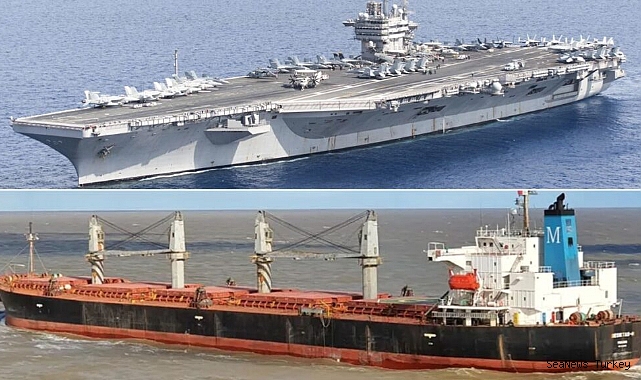
A late-night collision near Port Said involved the nuclear-powered USS Harry S. Truman and cargo ship Besiktas-M, with no injuries reported.
Details of the Incident
Late at night on February 12, 2025 (at approximately 11:46 p.m. local time), a rare maritime accident occurred near Port Said, Egypt, in the Mediterranean Sea. The U.S. Navy’s Nimitz-class aircraft carrier USS Harry S. Truman (CVN 75), weighing over 100,000 tons, collided with the 53,000-ton Panamanian-flagged merchant vessel Besiktas-M. According to the U.S. Navy’s Sixth Fleet, more than 5,000 sailors were aboard the carrier at the time of the collision, but fortunately, no casualties or serious injuries were reported. The carrier’s nuclear reactors and propulsion systems were declared safe and operational.
This collision stands out for involving two large, high-tonnage vessels. The USS Harry S. Truman is powered by two nuclear reactors, operates a four-shaft propulsion system, and is one of the U.S. Navy’s most capable ships, frequently deployed to hotspots around the world. The Besiktas-M is a commercial cargo ship, displacing approximately 53,000 tons, and is registered under the Panamanian flag.
In its initial statement, the U.S. Sixth Fleet reported: “The Nimitz-class aircraft carrier USS Harry S. Truman (CVN 75) was involved in a collision with the Panamanian-flagged merchant vessel Besiktas-M at approximately 11:46 p.m. local time on February 12, while operating near Port Said, Egypt, in the Mediterranean Sea. There are no reported injuries, nor any significant flooding aboard the carrier. The incident is under investigation.”
Although the precise cause of the incident has not yet been established, maritime experts note that collisions of this nature typically stem from navigation errors, communication breakdowns, or misjudgments in congested waters. Port Said is known for its heavy maritime traffic, as it serves as a gateway to the Suez Canal, which connects the Red Sea and the Mediterranean, making it one of the world’s most important maritime corridors.
Profiles of the Vessels
USS Harry S. Truman (CVN 75)
Class: Nimitz Displacement: Approx. 100,000 tons Power Source: Two nuclear reactors Propulsion: Four-shaft system Crew: Approximately 5,000 personnel Role: An aircraft carrier serving as a critical strategic asset of the U.S. Navy
Nuclear-powered aircraft carriers like the USS Harry S. Truman represent some of the most formidable military platforms in the world. With the ability to project air power from international waters, they play a key role in U.S. military strategy. The Truman has operated extensively in the Middle East and the Eastern Mediterranean, often as a deterrent in volatile regions.
Besiktas-M
Flag: Panama Displacement: Approximately 53,000 tons Type: Cargo ship (likely carrying bulk or containerized goods) Crew: Typically 20-30 people Operational Zone: Global merchant routes (frequenting the Mediterranean, Black Sea, Atlantic, etc.)
The Besiktas-M typically transports general cargo, grain, or containerized freight. Although it sails under the Panamanian flag, it is part of the global commercial shipping industry. The ship often travels through heavily trafficked routes, and the waters near Port Said are known to be especially crowded with vessels transiting to or from the Suez Canal.
Situation Prior to the Collision
Since mid-December 2024, the USS Harry S. Truman and its accompanying strike group had been operating in the Red Sea to help deter attacks by Houthi militants based in Yemen. These militants have occasionally targeted commercial vessels or naval ships in the Red Sea with missiles or drones, threatening vital international shipping lanes.
After a temporary lull in regional tensions—partly attributed to a ceasefire between Israel and Hamas reached in mid-January—U.S. Naval forces remained vigilant. The Truman and its strike group transited from the Red Sea into the Mediterranean via the Suez Canal, stopping near Port Said for a brief pause to conduct logistical checks and ensure operational readiness.
Meanwhile, the Besiktas-M was navigating in the vicinity of Egyptian ports, reportedly carrying cargo destined for a port in the northern Mediterranean. Due to the intense vessel traffic near Port Said, ships often line up to enter or exit the Suez Canal, and maneuvering space is sometimes limited. This creates conditions where a momentary navigational slip can lead to accidents.
Collision Dynamics and Possible Causes
The collision happened during nighttime operations on February 12. Large vessels such as aircraft carriers and merchant ships typically rely on advanced radar and electronic navigational aids to maintain awareness of other vessels, but accidents can still occur. Experts point to several possible contributing factors:
Communication Breakdown: Failure to communicate via radio or Automatic Identification System (AIS) could have led to confusion about right-of-way or intended maneuvers. Congested Shipping Lane: Port Said and the approaches to the Suez Canal experience high traffic density, where navigational errors are more likely. Violation of Navigation Rules: International Rules for Preventing Collisions at Sea (COLREGS) dictate priorities between vessels. A breach by either vessel can result in collision. Technical Malfunction: Any failure in electrical, radar, or propulsion systems might have compromised the maneuverability of one or both vessels.
Both the U.S. Navy and Egyptian authorities have launched investigations to determine the root cause of this collision. Investigators will review navigational logs, radar data, voice recordings, and crew statements to reconstruct events leading to the crash. Officials from the U.S. Navy have emphasized that the Truman’s nuclear reactor systems were unaffected.
Consequences of the Collision
Casualties and Damage: No injuries have been reported on either vessel, a fortunate outcome given their sizes. The U.S. Navy confirmed there was no flooding or serious structural damage to the carrier. For the Besiktas-M, initial reports suggest only superficial damage; however, thorough hull inspections will be carried out on both ships. Operational Readiness: Navy officials claim the Truman’s propulsion and nuclear systems remain fully functional. The carrier can continue to conduct flight operations if necessary, though it will likely undergo a detailed technical assessment. Investigation Process: The U.S. Sixth Fleet and Egyptian authorities, possibly in coordination with other international maritime organizations, will undertake a comprehensive review. Findings will be compiled into official reports, which could influence future navigational regulations and training protocols. Impact on Maritime Traffic: Although shipping lanes were temporarily restricted immediately after the collision, the route was reopened the following day. The incident caused minimal disruptions for other ships awaiting passage through the Suez Canal.
Military and Geopolitical Context
The USS Harry S. Truman’s prolonged presence in the Middle East region is part of the U.S. Navy’s effort to maintain maritime security, particularly against threats from Yemen-based Houthi militants. While a temporary ceasefire between Hamas and Israel in mid-January 2025 contributed to a slight easing of tensions, the region remains volatile. Houthi forces have asserted that their attacks on shipping were conducted in support of Hamas, adding another layer of complexity to regional security dynamics.
While this collision is unlikely to drastically alter the broader strategic picture, it does highlight the inherent risks of operating large warships alongside commercial traffic in congested maritime areas. Aircraft carriers such as the Truman often maintain robust situational awareness, but the unpredictability of civilian vessel maneuvers, combined with external factors such as technical failures or miscommunication, can still precipitate incidents.
Rarity and Challenges of Aircraft Carrier Collisions
Collisions involving nuclear-powered aircraft carriers and civilian vessels are exceedingly rare. These carriers typically have advanced radar suites, large bridge crews, and rigorous operational protocols. Merchant vessels are also obliged to follow standardized maritime regulations. Yet, bottlenecks like the Suez Canal region present unique hazards. The heavy flow of ships transiting between Europe and Asia means there is little room for navigational error. Even a brief lapse in communication or judgment can have serious consequences.
Environmental Considerations
One immediate concern when a nuclear-powered warship is involved in any accident is the potential for radioactive leakage. However, U.S. Navy officials have explicitly stated that the Truman’s reactors and propulsion systems were not compromised. As a result, there is no indication of any nuclear or radioactive threat to the surrounding waters.
Nonetheless, the Panamanian-flagged cargo vessel Besiktas-M could have been carrying fuel or other substances that pose a marine pollution risk if its hull was breached. Preliminary assessments suggest no significant leaks occurred, but Egyptian authorities may conduct further water quality tests to ensure no contamination took place in the collision zone.
Ongoing Investigation and Legal Framework
In the wake of the crash, both U.S. and Egyptian authorities have opened investigations. The legal aspects of such incidents can be complex, especially when involving a U.S. military vessel operating in or near Egyptian territorial waters and a merchant vessel flagged by a third country (Panama):
U.S. Navy Investigation: The Navy will conduct an internal inquiry focusing on potential crew negligence, technical failures, and operational decision-making. Egyptian Authorities: As the coastal state, Egypt has jurisdiction over incidents in its territorial waters. Egyptian legal bodies may examine violations of maritime safety regulations. Panama Maritime Administration: Since the Besiktas-M is registered in Panama, that nation’s maritime authorities also have the right to investigate and request data. International Maritime Organization (IMO): The IMO sets standards and guidelines for maritime safety. It often reviews findings from such collisions to update policies and best practices.
Future Implications and Conclusions
Final assessments regarding damages, liability, and any operational shortcomings will emerge as investigations proceed. The absence of injuries or severe damage remains the most positive outcome in an incident that could have been far more serious. Nonetheless, the collision underscores several themes relevant to global maritime operations:
Traffic Management: With ever-growing trade volumes, major chokepoints like the Suez Canal require updated traffic management systems and possibly stricter regulations to prevent accidents. Communication Protocols: Night operations and crowded sea lanes place a premium on robust communication and coordination between all vessels, military or civilian. Military-Civilian Cooperation: Data sharing and joint exercises between naval forces and commercial operators could enhance maritime safety. Environmental Safeguards: Governments and international bodies should remain prepared to respond swiftly to potential spills or other environmental hazards.
While the collision is unlikely to spark a major diplomatic crisis, the Egyptian government remains vigilant, aiming to ensure that such high-stakes operations in its waters do not pose long-term threats to safety or commerce. The U.S. Navy, for its part, has affirmed that the Truman and its strike group remain mission-capable, continuing their deployment in the region with heightened caution.
As the investigation unfolds and official findings are released, the maritime community will closely scrutinize this incident. Lessons learned may influence future ship design, navigational technologies, crew training, and regulatory frameworks—ultimately enhancing safety in critical waterways worldwide.