
Photo: DenizHaber
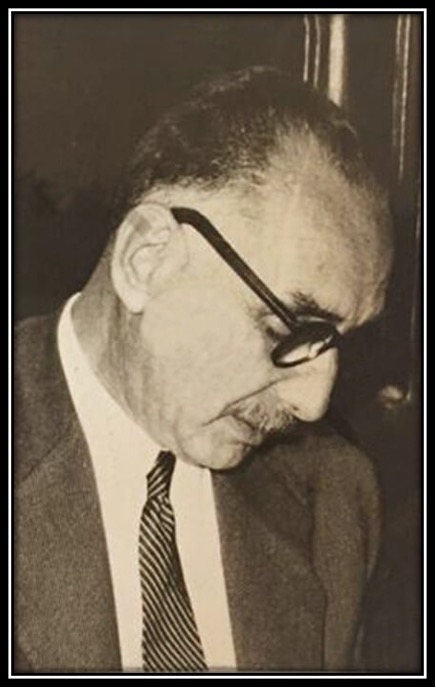
Photo: DenizHaber
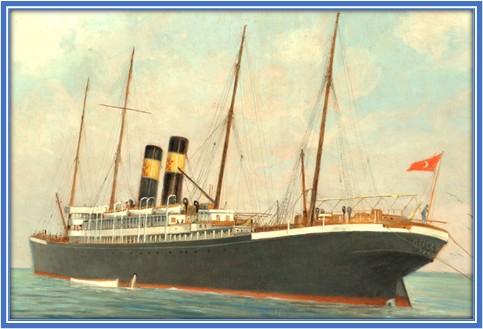
Photo: DenizHaber
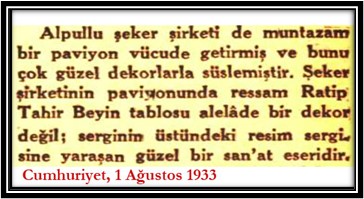
Photo: DenizHaber
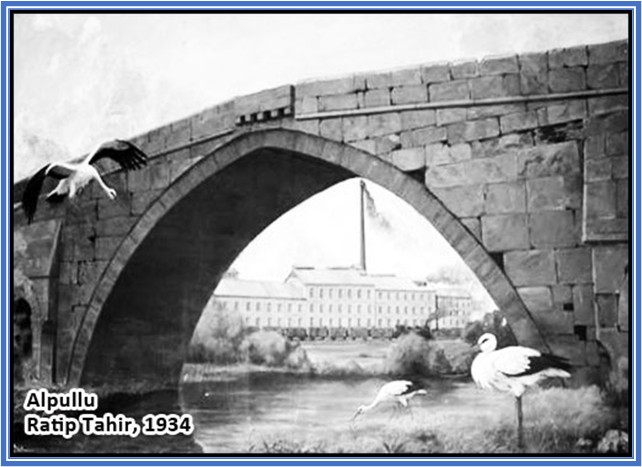
Photo: DenizHaber
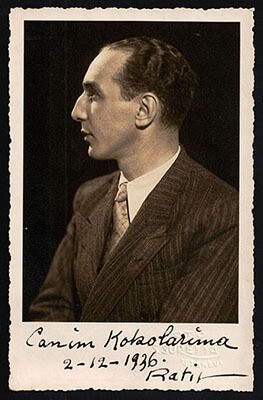
Photo: DenizHaber
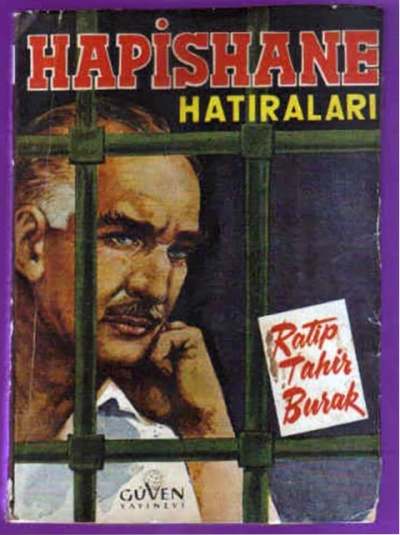
Photo: DenizHaber
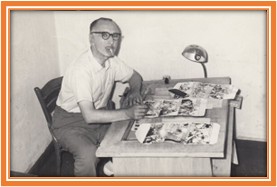
Photo: DenizHaber
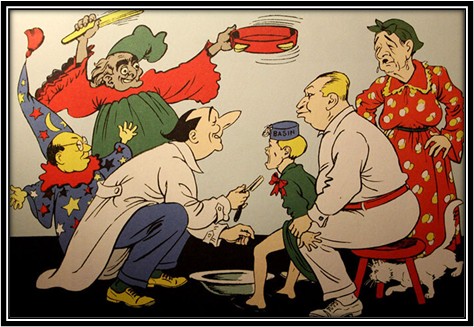
Photo: DenizHaber
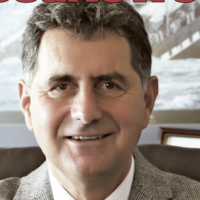
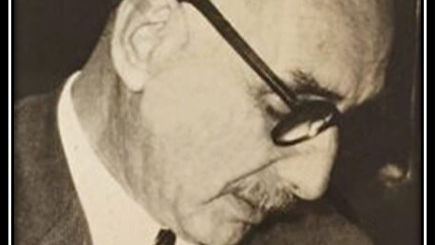
Dear brother İsmail Akpınar (Gv.82), when he mentioned our elder brother Ratip Tahir Burak (1921 Gv) who is now resting in the Hilton cell of the Ankara Ulucanlar Prison Museum, I decided to conduct some research about him. I would like to thank İsmail for enabling us to record another one of our valuable elder brothers.
Our elder is registered as Mehmet Ratıp Beler among the graduates of the 1921 "National Maritime Trade Captain and Engineer School," but since the name Ratıp is not commonly used, I believe his name has been misspelled.
On the other hand, in the sources we found about him, he appears as a graduate of our school under its name at that time. Our elder holds a significant place in the history of Turkish caricature. As you read about his struggles depicted in his drawings, you see him stand out with his fearless identity and realize that he accomplished beautiful works during his time. I am sharing the information and images about our elder with you below, along with an article by Kürşat Çoşgun from the Cartoonists Association.
Happy reading. Eng. A.İlker MEŞE
He was born in 1904 in Istanbul. He is the son of Mehmet Tahir Bey, one of the commanders of the Ottoman navy galleons, and Emine Saime Hanım, and the brother of Zekai Tahir Burak, one of the important obstetricians of the early Republic (*).
He studied at Üsküdar Ravza-ı Terakki School and Üsküdar High School between 1910-1917. In 1917, he entered the National and Private Maritime Trade Captain and Engineer School located at Üsküdar Paşa port, graduating from the deck department in 1921.
GÜLCEMAL Ship (Artist Amedeo Marello)
Between 1921-1925, he served as an officer on many ships of the Seyr-i Sefain Administration (State Maritime Lines). In 1923, he was also the deck officer of the GÜLCEMAL ship, which carried the delegation returning from the Lausanne Agreement between Constanța and Istanbul. During this voyage, he met İsmet İnönü, who appreciated Ratip Tahir's paintings and cartoons and suggested that he pursue further education in Europe.
Due to his proficiency in French and English, he left seafaring in 1925 and joined the Ministry of Foreign Affairs as a clerk. A portrait of Atatürk drawn on a large cardboard at the celebration ball for the second anniversary of the Republic was highly praised by Atatürk and those present in the hall, and everyone signed it as a memento of the night. Following this event, he began to gain recognition in Ankara circles.
While still in school, he started working on caricatures and portraits, with his cartoons first published in Aydede (1922). He later appeared in magazines such as Akbaba, Zümrüdüanka, Süs, Kelebek, Karagöz, and Karikatür. In 1924-25, he drew attention with portrait caricatures in the French-language magazine P’st alongside Theo (Kozma Togo). While studying in Paris, he worked as a decorator and sent cartoons to Akşam newspaper and Yeni Kalem magazine. Shortly after this period, upon encountering İsmet İnönü again on Abdülhak Hamid Tarhan's birthday, he was reminded of his earlier promise to go to Europe to study art, which led him to Paris for two years of art education (1926-1928).
Upon returning from Paris, he left his government job and fully dedicated himself to caricature. He first published a magazine called Tavuk (1929). Subsequently, he drew almost all the cartoons for the Kalem magazine published by Orhan Seyfi Orhon (1930).
In 1932, his oil painting titled "Ergenekon'dan Çıkış" was appreciated by Atatürk and exhibited in the entrance hall of the Ministry of National Education. The paintings titled "Ergenekon I" and "Ergenekon II," which were exhibited for years at the entrance of the Ministry of Economy, also belong to Ratip Tahir.
He adopted the surname Burak with the Surname Law enacted in 1934. In the same year, he created six paintings for the decoration of the social facilities of Alpullu Sugar Factory, featuring peasant and worker figures along with images of the Mimar Sinan Bridge.
One of the paintings he made for Alpullu Sugar Factory
In 1935, he graduated from the Fine Arts Academy. He worked briefly as a teacher at Kabataş High School (1935-1936).
In 1936, he received a job offer from the newspaper Ulus, which began publication under that name, and returned to Ankara. However, during this period, he could not find the opportunity to publish critical caricatures in the newspaper. He attended trials of significant cases in Ankara on behalf of the newspaper, drawing the courtroom scenes and portraits of defendants, judges, and prosecutors. In his spare time, he created dozens of portraits of Atatürk in a studio he set up in an apartment he rented in Ankara. With the income from selling these paintings to banks, hotels, schools, and public institutions, he purchased a plot of land in Istanbul (Mecidiyeköy) that he would later convert into an apartment building.
In 1936, he worked for two years as the Chief of Workshops at the Mineral Research Institute. He served for 12 years as a technical officer and ministry expert at Agricultural Institutes (1937-1949).
In 1949, he became actively involved in politics as a member of the Republican People's Party. After the Democratic Party came to power in the 1950 elections, he returned to caricature and became one of the most effective voices of the opposition. He drew cartoons targeting the DP government in a weekly panoramic cartoon series titled "Karikatürcünün Şakaları" published in Ulus newspaper. These drawings, published between 1950-1952, were compiled into an album titled "Karikatürcünün Şakaları" on the suggestion of the newspaper's machine room chief.
In 1953, he moved back to Istanbul and started drawing for Yeni Sabah newspaper with a good salary. However, due to pressures from the government, he had to leave the newspaper shortly after. He ended up in a legal dispute with the newspaper owner, eventually winning a substantial compensation.
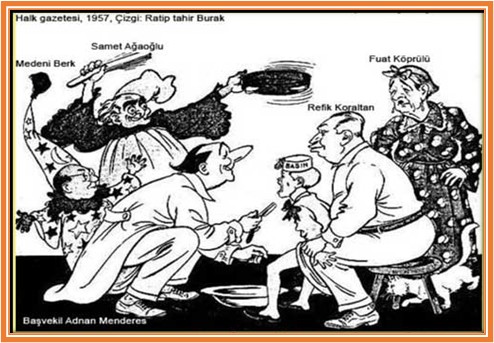
During this idle period, he launched the Siyasal Halk Gazetesi with his own resources. He continued his oppositional cartoons under the title "Karikatürcünün Şakaları" here as well. Besides Burak, the magazine featured writings from Falih Rıfkı Atay, Bülent Ecevit, and İsmail Hakkı Baltacıoğlu alongside Mim Uykusuz's cartoons. Between 1952 and mid-1956, the number of lawsuits filed against Ratip Tahir Burak reached 54; there was no military court, civil court, or collective press court he had not appeared in. On June 8, 1956, he was sentenced to 16 months in prison and fined 4000 lira for a cartoon he drew titled "Oldu da Bitti Maşallah." On April 11, 1957, he was transferred to Üsküdar Paşakapısı Prison to serve his sentence. With Burak's imprisonment, the publication of Siyasal Halk Gazetesi also came to an end.
In this cartoon, a child is crying while being prepared for circumcision, and the child's cap has "Press" written on it. The person depicted as the circumciser is the then Prime Minister Adnan Menderes. This drawing has been interpreted as a symbol criticizing the pressures of the Democratic Party government on the press.
The cartoon that led to his imprisonment: "Oldu da Bitti Maşallah"
Ratip Tahir Burak was sentenced to 1 year and 4 months in prison. He was convicted yesterday in the Collective Press Court for the cartoon titled "Oldu da Bitti Maşallah," published in the Halk newspaper on June 9, 1956, receiving a sentence of one year and four months and a fine of 4000 lira.
While in prison, the publication of the magazine Kumbara, where he drew illustrated stories to contribute to his and his family's livelihood, was terminated by the management of İş Bankası. Although there was no legal obstacle, he was prevented from running for parliament in the 1957 elections. On the first anniversary of his imprisonment, a cartoon exhibition organized by the CHP Istanbul Youth Branch was banned by the governorship, and the opening of the exhibition was obstructed by the police.
After his release from prison, he received an offer to work for the Taş magazine, which was being prepared for publication by Semih Balcıoğlu. He stated that he would not accept the offer if Kozma Togo, with whom he had previously had conflicts and even legal disputes, was involved. Consequently, Togo was removed from the team, and Burak began drawing in the same magazine alongside names like Turhan Selçuk, Semih Balcıoğlu, Ali Ulvi, Ferruh Doğan, Nehar Tüblek, and Oğuz Aral, known as the 50s Generation. Continuing his effective oppositional line in Taş and later in Taş-Karikatür, Ratip Tahir Burak faced difficult times again as these magazines had to shut down. He was detained in Istanbul in 1960 on allegations of being one of the orchestrators of the student events of 28-29, but regained his freedom with the May 27 coup.
Immediately after the May 27, 1960 coup, he published "Hapishane Hatıraları" both as a serialized piece and as a book. He first entered the parliament as a member of the Constituent Assembly and then as an Istanbul deputy of the CHP in the 1961 elections. Thus, he became the first cartoonist to take his place in the Turkish Grand National Assembly (1961-1965).
In addition to his painting and caricature works, Ratip Tahir Burak produced significant works in the field of comics starting from 1950. His cartooning adventure, which began with the historical comic strip movement he pioneered in Hürriyet newspaper, continued in newspapers such as Yeni Sabah, Milliyet, Ulus, and Akşam.
Ratip Tahir Burak passed away in Istanbul on October 28, 1977.
(*) Some sources confuse Ratip Tahir Burak with his namesake brother of Kemal Tahir. Kemal Tahir's brother lived between 1925-1984.
İstanbul İrfan Ordusu (1926), Karikatürcünün Şakaları (1953), Hapishane Hatıraları (1961), Barbaros’un Son Seferi (1950), Koca Yusuf (1950), Cem Sultan (1951), Saray kadınları (1952), Plevne (1953), Lale Devri (1953), Bir Yemin Uğruna (1953), Selma (1955), Küçükbey (1955), Kırk Şehitler Kalesi (1959), Bize Barbaroslu Derler (1960), Kara İbo (1963), Bir Kolun Diyeti (1963), Akdeniz’de Doğan Güneş (1963), Zaferden Zafere (1963), İstanbul’un Fethi (1964), Hürrem Sultan (1965), Hilal ve Salip (1967), Kara Ahmet (1968), Timur (1969), Timur ve Yıldırım (1969), Solak Reis (1976).
Kürşat Çosgun Cartoonists Association
Siyasal Halk Gazetesi and Ratip Tahir Burak, Ahmet Mehmetefendioğlu – Yasin Kayış, Social History, November 2008, Issue: 179.
– Burak’s Return, Bülent Ecevit, Ulus, 2.8.1958, p.3.
– Ratip Tahir Burak (https://www.alpullu.org/R/ratip_tahir.html)
– https://lcivelekoglu.blogspot.com/2013/10/tarihten-bugune-dusen-notlar-28-ekim.htm
Please pay attention to the comment writing rules below when making comments or replying to a comment. Do not make comments that violate the laws of the Republic of Turkey, or that praise crimes or criminals. Avoid comments that contain profanity, slang, insults, incite hatred, or promote hatred.
Source: www.denizhaber.com