


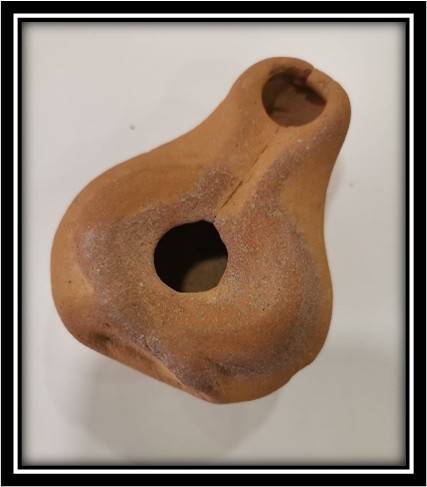
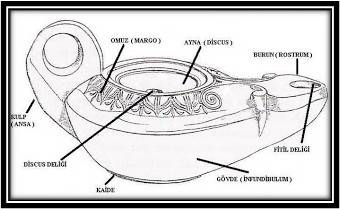

The oil lamp, which is perhaps one of the few remaining examples from the shipyard of Karamürsel Bey, is of great importance. This lamp, taken from the sea, was used for lighting while the olive oil residue was utilized in sleds.
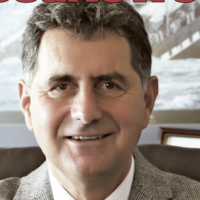
Dr. Ergun Koçer’s memory of the lamp is as follows:
“I was a high school student in Istanbul between 1976-78. We would come to Karamürsel during the summers. My grandmother was from the village of Oluklu in Karamürsel. She had a house in a garden by the beach. Every summer, when school was out, I would go there and stay for three months until school started again. We would swim in the sea, surrounded by fruit orchards, enjoying the bounty.
However, the lined stones on the beach always caught my attention. There were rows of stones starting from the shore and extending into the sea. I was always curious about them. An old man lived in a vineyard within a large plot of land behind. One day, I asked him, - What are these stones? He replied, - This used to be a shipyard. Look, we have jars down here, we stock olives here and seal their mouths. These were used as oil depots when the shipyard was operational; we took them out of the sea and are using them now. But there are many jars left from the shipyard. The jars were so large that when you entered one, you could stand up. Your head would stick out of the jar's mouth while your body remained inside.
The lamp donated to the İLKFER Maritime Museum
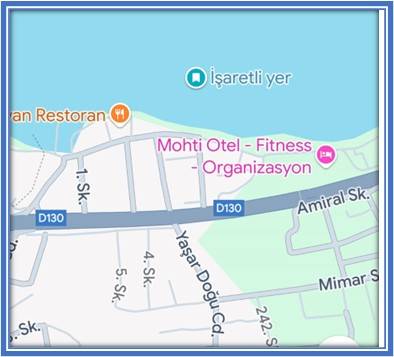
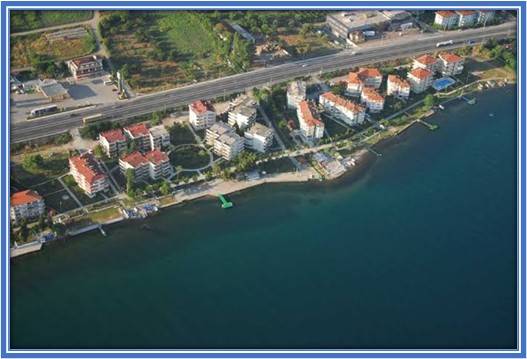
Dr. Ergun Koçer’s dive site. The lined stones still exist on the beach.
From then on, I started to examine more carefully. There were many broken jar pieces along the shore. Over time, the sea had eroded them and washed them ashore. But they were all pieces of jars. One day, a large piece of a jar in the sea caught my attention. It was clear that it had a bottom. It was buried in the sand. I dove down and cleaned a bit of it; inside was a pitch-black mud. I said we should take this out. My brother and cousins helped, and we finally pulled it out. We brought it to the shore along with the mud and slowly began to clean the inside. As we cleaned, I noticed something that resembled Aladdin's magic lamp inside. It was a beautiful lamp. Considering how it had remained so beautiful for such a long time, I realized that the black olive residue inside had turned into clay and prevented it from coming into contact with oxygen and saltwater. It had eroded over the years but had never lost its integrity.
This time, I started talking to the people around me. They said there was a shipyard from the Ottoman period and that they had found many lamps like this one. Then, as I began to research, I understood that the location was the site of the shipyard established by Karamürsel Paşa between 1324-26. I realized it belonged to the shipyard. Later, I showed the lamp in a couple of places, and they said it was excavated there. So I asked, is there something like a museum related to Karamürsel Paşa's shipyard? They said no, only a house where Atatürk stayed exists as a museum.
I was very surprised; I thought there should be a museum related to the first shipyard of the Ottomans, taken from the Romans, and the Kaptanı Deryası Mürsel Paşa from the 1320s. Then I thought, where would this lamp fit? I said it would fit in the museum of İlker Meşe, which is a Maritime Museum, and I handed it over.”
The house behind the green pier is Ergun Koçer’s house, and the location of his grandmother's house is where the Armutçuk harbor is, after the empty land on the left side of the house. The minibus stop in the area where Ergun Koçer’s house is located is still known as Kavak Mevkii.
Who is Kara Mürsel Bey (Mürsel Alp), the Turkish mariner, admiral, and Kaptan-ı Derya?
He was referred to as “Kara” due to his bravery in battles, meaning “black” in the sense of being bold and courageous. During the founding years of the Ottoman Empire, he made great efforts and established a naval base and shipyard in Karamürsel as the first admiral and shipbuilding engineer of the Ottoman Turks. Here, he began to operate in the seas with his “Fine Fleet.” He designed a ship of the “Çektiri” class (Özdemir, 2004).
Initially, he served the Karesioğulları. At the request of Orhan Gazi, he entered the service of the Ottomans. By capturing Karamürsel in 1324 or 1326, he ensured that the Ottomans settled on the southern shores of the İzmit Gulf. The town he conquered was named after him in accordance with the tradition of that time. The town was organized as a captaincy and Karamürsel Bey was appointed to the administration.
Aşık Paşazade's history provides the following information about Kara Mürsel Bey: “There was a brave and valiant man named Karamürsel. They gave him İznik and divided his province as a timar. They brought the timar soldiers aside to prevent them from harming the ship coming from Istanbul. He began to build ships by establishing a shipyard at the Armutçuk Harbor on the Kavak Boyu west of Karamürsel, which was given to him as a timar. By developing light and fast ships named after himself, Kara Mürsel Bey established a fine fleet and took control of the Sea of Marmara. By holding the entrance to the gulf with his fleet, he cut off the supplies sent from Byzantium to İzmit by sea, playing a significant role in the rapid capture of İzmit by the Ottomans. He is a Derya Bey, Kaptan-ı Derya, and the first Ottoman Turkish mariner. Due to his services, Orhan Gazi gave him the nickname “KARA,” while his real name was MÜRSEL ALP. Additionally, due to a trend observed during the Early Ottoman Turks period, it was named “KARAMÜRSEL” after him.
The first admiral of the Ottomans, Karamürsel Paşa
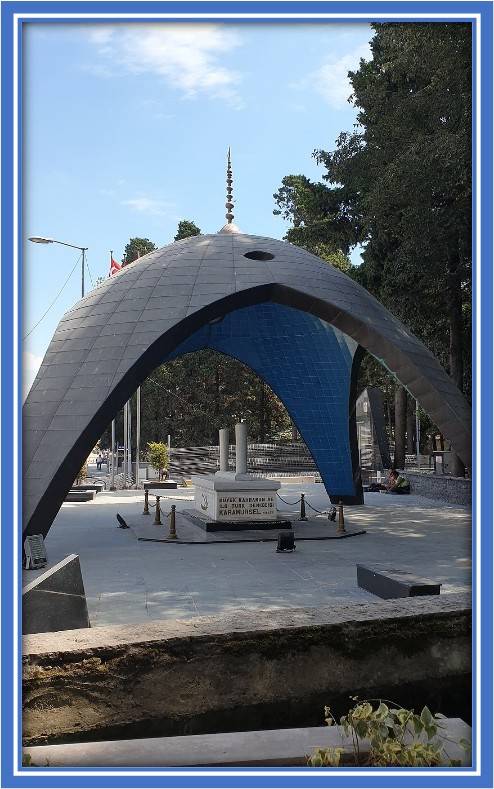
Kara Mürsel Bey’s grave is located on the D-100 İzmit-Bursa highway in the Karamürsel district.
The will of the first Kaptan-ı Derya of the Ottomans was as follows: “Bury me in such a place that my back rests against the mountains, give me the sea in my lap, and let me always see the fleet.” According to his will, he lies in his grave, which is located on a slope overlooking the sea behind the shipyard he established, in the marketplace of the district that bears his name.
Please pay attention to the commenting rules below when making a comment or responding to a comment. Do not make comments that violate the laws of the Republic of Turkey, glorify crime or criminals. Avoid comments containing profanity, slang, insults, incitement to hatred, or hatred.
Nodus Camadanus; Do you know the connection to the Camadan?
THE VIEW OF THE REPUBLIC OF TURKEY THALASSOCRACY ADMINISTRATION THROUGH A FOREIGN EYE
The Transformation of Originality in the Age of Artificial Intelligence
Inclusivity at the Center of the Maritime Sector
PILOT CAPTAIN TRANSFER EQUIPMENT: THE LATEST CHANGES IN SOLAS
The Story of the Unfinished Boat at the İLKFER Maritime Museum
A Legendary Name in the Turkish Steamship Owners and Agents Society - Mehmet Arif Erten
The Status of the Naval Command in İzmit Gulf and Gölcük Military Shipyard under the Regulations of Pilotage and Towage Services
Life and Death in the Baltic Sea
EU Approves 16th Sanctions Package Against Russia
Free Port and CTU Code: New Horizons in Maritime
Is Artificial Intelligence Good or Bad for Maritime Transportation?
International Law and Maritime Law: Innocent Passage Regime and Human Rights
Evaluation of the New Seafarers and Pilot Captains Regulation
Maritime Transportation in the Shadow of Wars... Who Profits from These?
NETTİN YAHU, YOU FINALLY PUT A FEATHER IN IT
A Cautionary Tale of the Future: The Russia-Ukraine War
DID THE OTTOMAN TURKS CAUSE OCEANIC DISCOVERIES?
INFLATION OR RECESSION IN THE GLOBAL ECONOMY IN 2023?
Source: www.denizhaber.com