

Photo: DenizHaber
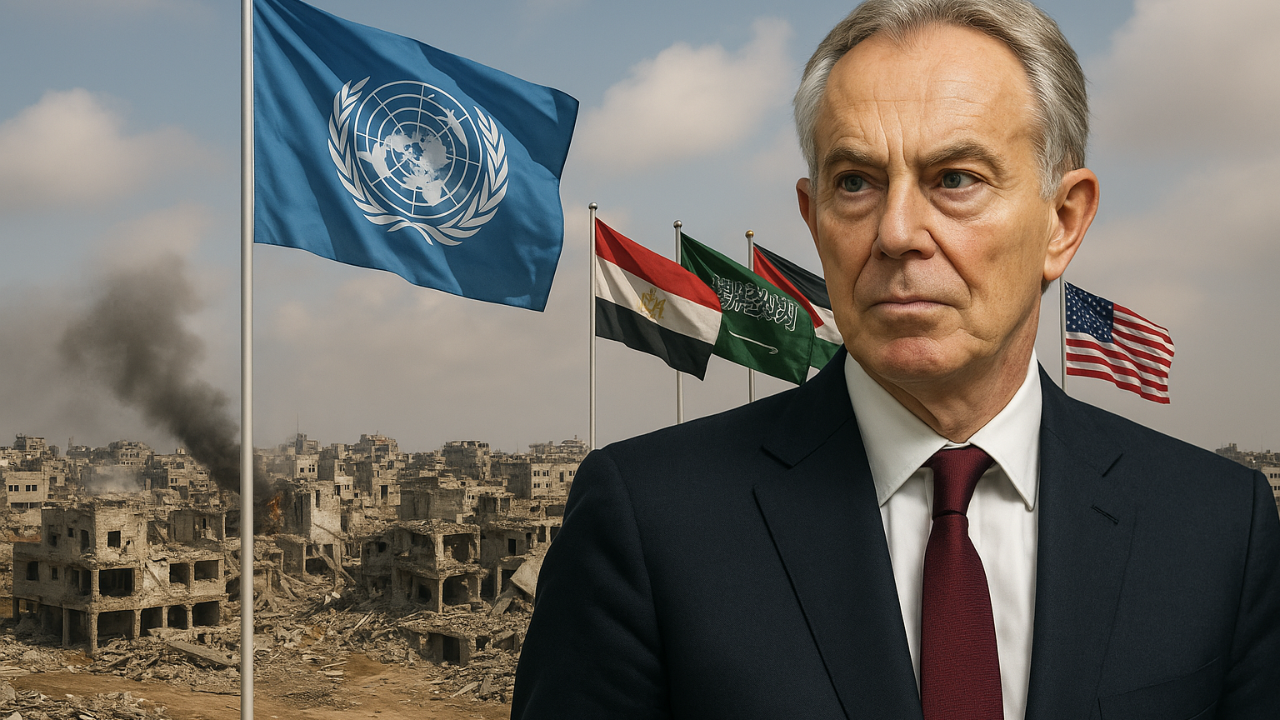
You may not fully recall the name that has once again emerged in the latest "peace plan" prepared for Gaza. Let me remind you: it is Tony Blair. The same person who stood alongside Bush in 2003 while erasing Iraq from the map, the one who instigated the war that led millions to death with the infamous "weapons of mass destruction" lie. Now, this same individual is being given a leading role in the "reconstruction" of Gaza.
Have you ever wondered why the same scenario keeps repeating? Why do the same types of people, albeit under different names, keep appearing in every crisis around the world, especially in the Middle East? The answer is quite simple: those who claim that imperialism is dead are mistaken. It has not died; it has merely changed its costume.
You may recall Nietzsche's phrase "God is dead." But many of us have forgotten the horrifying question he added: "How shall we comfort ourselves, the murderers of all murderers?" The issue of imperialism has taken on a similar form. Everyone thought it was over; they even dug its grave. Long live globalization! But no one asked: What if it hasn’t died but has merely transformed?
In the past, colonizers would arrive by ship, plant their flag, and appoint a governor. They called him the colonial governor. Today, they come with think tanks, write reports, and wear "consultant" badges. Foucault's theory of the invisibility of power explains this perfectly. According to Foucault, the power that was once a tribal chief in ancient times is now invisible but a much greater force than before. This power is aware of every development in the world, even plays the role of creator and overseer of these developments. Indeed, it is true: global imperial power is no longer centralized; it is everywhere. When chains turn into fabric, you struggle to realize you are imprisoned.
Tony Blair is the most striking example of this new era. After leaving the British premiership in 2007, he was appointed as the Special Representative for the Middle East by the "Quartet." Now, as he is made the "colonial governor" of Palestine, the logic is as follows: first destroy, then profit while rebuilding. Moreover, under the guise of a "peace process." This is the political adaptation of capitalism's principle of creative destruction. Schumpeter explained this in economics; Blair implemented it in politics.
Blair's Tony Blair Institute for Global Change, established in 2016, operates in over 40 countries today. They place experts in ministries from Africa to Asia, enter databases, and get involved in decision-making processes. They call this "aid." But essentially, they are producing structural dependency. Modern colonialism is now governed not by swords but by this algorithm. Hannah Arendt's concept of "the banality of violence" must be something like this. Violence becomes so normalized, so technical, that you no longer even realize it is violence.
The Trump administration's plan is simple: to establish a temporary "international administration" in Gaza. They intend to place a figure like Tony Blair at its head. Just as the 1917 Balfour Declaration handed the fate of the Palestinian people to the British, this plan does the same. Only now it is called a "digital transition process." Back then, there was a mandate governor; today, there is a "global consultant." The result is the same: the people are still extras, and the decisions are still made from outside. Wasn't democracy being imposed? Wasn't the people supposed to choose their own governance? Isn't this the very foundation of your intervention in Iraq and your export of democracy to other Middle Eastern countries?
When Marx said that history repeats itself, he was joking in a way. "The first time as tragedy, the second time as farce," he said. But understanding this joke in the Middle East is a luxury. Because here, the tragedy never ends for the comedy to begin. Each time, the same tragedy occurs; only the decor changes.
Almost all the countries in the region announced that they "welcomed the plan." This silence, stretching from Egypt to Saudi Arabia, from Qatar to the UAE, from Jordan to Pakistan, is the diplomatic mold of dependency in international relations. In reality, no one is pleased, but no one can say "we are disturbed." Because they are all compelled to Washington for security, finance, or regime stability. "Welcoming" is already a pose of honorable silence. As if it were not the fate of a people but the introduction of a new phone model, polite phrases are uttered, and then the agenda shifts. If this is not moral decay, it is undoubtedly a bankruptcy of political will.
Recall Sartre's concept of bad faith. You lie to yourself because you cannot bear the truth. This is precisely the situation of these countries. They know something, but they pretend not to. Because knowing requires taking a stance. Taking a stance means incurring a cost.
Tony Blair is no longer at the head of any state, but he plays the role of a statesman even better in terms of functionality. He talks about "digital ethics" in Davos, gives "leadership" lessons at conferences. The man who once defended military occupation is now marketed as a "development strategist." This is the greatest irony of our time: war criminals are now finding jobs as peace consultants. Instead of paying the price for his past, Blair profits from managing its consequences. Image has long replaced moral legitimacy.
Consider Baudrillard's theory of simulacra. When reality gives way to image, there is no longer right or wrong. There is only representation. Blair's current position is something like this. The real Blair is not important; the image he represents is what matters. And this image says: Even if you destroy, if you come back to build, no one will ask.
Today, there are no mandate governors; there are consultants. There are no colonial armies; there are investment funds. There are no invading ships; there are data networks. Colonialism has become modern, digital, and smiling. Weapons have turned into "soft power," land occupation has become "data dominance," and tyranny has disguised itself as "reform consultancy." And this transformation, as seen in Palestine, once again robs local peoples of their right to self-determination.
Heidegger used to say that the essence of technology is not a technical thing. The real issue is how technology shapes the world. What Blair's company is doing is exactly this. What appears to be technical assistance is actually constructing the world. It takes your data, shapes your decisions, designs your future. And you call this "cooperation."
The mention of Blair's name in relation to Gaza is not an irony of history. It is proof of the new mandatory order that the West conducts under the guise of a "civilizing mission." Blair is no longer an individual; he is a model. A model that profits from first destroying and then rebuilding a country, morally finished but technically very efficient.
Colonialism has not changed; it has merely changed its clothes. It now wears a suit, writes reports, and speaks with diplomatic politeness. But the essence remains the same: they want to govern. Because they still believe that we are in need of governance.
Camus's myth of Sisyphus comes to my mind. Sisyphus rolls the same stone up the hill every day, only to have it fall every time. But Camus says we must imagine Sisyphus happy. Because he is aware of the absurd. We, however, are not even aware. We roll the same stone, believing that one day it will be different. That is the real tragedy.
The sword is gone; PowerPoint has arrived. But imperialism is still here. And we still think it has died.
Source: www.denizhaber.c