
During the Second Persian War, launched by the Persians against Greece, the bridge that was formed by connecting logs between the two shores of the Dardanelles (Çanakkale Boğazı) and supported by ships anchored in the direction of the current is considered one of the engineering marvels of the ancient world.
The Second Persian invasion begins in the spring of 480 BC, when the Persian Army crosses the Dardanelles over these semi-stable bridges supported by ships. The famous historian from Halicarnassus (Bodrum), Herodotus, gives a highly exaggerated figure of two million soldiers in the Persian Army, though modern historians estimate this number to be at most between 200,000 and 300,000.
Before focusing on the bridge itself, let us briefly summarize the Second Persian Campaign:
- After crossing the Dardanelles, the Persian Army advances through Thrace and Macedonia into Thessaly.
- About 70 Greek city-states unite against the Persians, though some remain neutral, submitting to the Persian Emperor Xerxes I (referred to in some sources as 1. Serhas).
- In the famous Battle of Thermopylae—where the legendary story of the “300 Spartans” originates—the Greeks, with very few men, manage to hold back the massive Persian Army for two full days.
- However, a powerful Persian detachment uses a mountain pass to flank the Greek position, forcing the main Greek force to retreat and leave a rearguard behind. King Leonidas and that rearguard are annihilated.
- Following this victory, the Persian Army invades Boeotia and Attica, pushing the Greek forces back to the Peloponnese, where they fortify the Isthmus of Corinth and prepare a defensive stance.
At this point in the invasion, both sides stake everything on a decisive naval victory. The Athenian general Themistocles lures the Persian fleet into the narrow Salamis Strait using a cunning stratagem. In the ensuing Salamis Naval Battle, the numerically superior Persian fleet—three times as large as the Greek alliance—is disordered in these narrow waters and suffers a devastating defeat. Losing the fleet at Salamis crushes Xerxes’ hopes of conquering Greece. Fearing that the floating bridges across the Dardanelles might be destroyed by a naval attack, Xerxes withdraws most of his army back into Anatolia. The Persian forces left behind are eventually defeated by the Greeks, and Persian domination in the Aegean effectively ends in 479 BC.
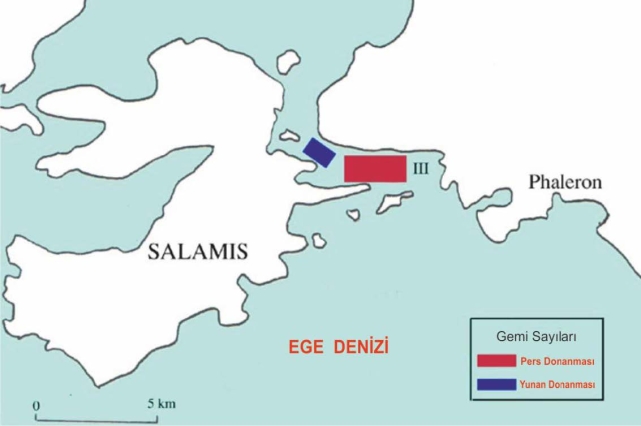
Salamis Naval Battle: Greek and Persian Fleets
Returning to our main topic, Xerxes I had two bridges built across the Dardanelles (then known as the Hellespont) from a settlement called Abydos near the modern Nara Burnu to the opposite shore near Sestos, before he and his retinue set out from Sardis (in what is now Manisa Province) toward the Dardanelles. However, before the Emperor arrived, storms destroyed the bridges. Outraged, Xerxes had those responsible for the construction executed, and in a ritual meant to “punish” the strait itself, he ordered 300 lashes dealt to its waters. Chains were then scorched with fire and cast into the sea, as if subjecting the waters to physical torment.
Afterward, the construction of a second bridge began. Logs, securely tied together with strong ropes, were laid over ships anchored against the current. A total of 674 ships were used for this purpose. Dirt was piled on top of the logs so that elephants would not be startled, and railings were installed on both sides of the two bridges.
Herodotus describes the construction of the bridge in his work as follows:
“…The workers assigned to build the bridge from Abydos onward created two spans; one using white flax (linen) cables by the Phoenicians, the other using papyrus cables by the Egyptians. The distance from Abydos to the opposite shore is seven stadia…
A fierce storm arose once the shores were joined; the cables snapped, undoing all their hard work. Xerxes flew into a terrible rage upon hearing this; he ordered that the Hellespont receive 300 lashes and a pair of shackles be cast into it. I have also heard that he commanded the Hellespont to be branded with hot irons and that, while whipping it, they should shout vile curses:
‘Sea, you wretched creature, our master punishes you thus because you wronged him without cause. Know that the Great King will cross you whether you will it or not. Justly, no man offers you sacrifice, for you are but a foul and bitter river.’
Such was the punishment inflicted on the sea. As for those overseeing the bridge, Xerxes had them beheaded.”
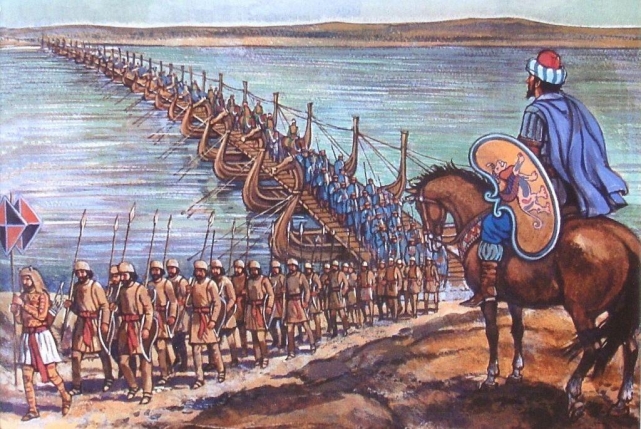
In a contemporary illustration showing Xerxes I and the Persian Army crossing, we see how they built the bridges across the Dardanelles:
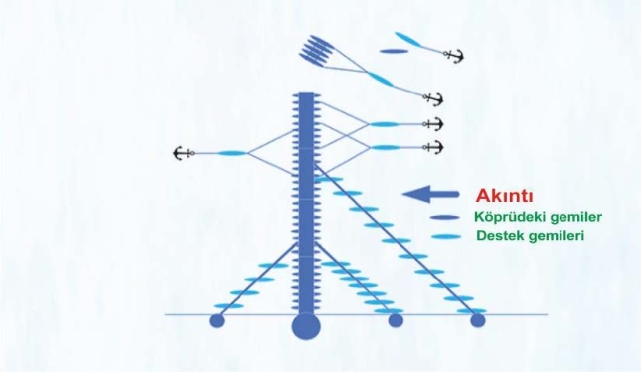
“They aligned side by side 360 penteconters and triremes to form the bridge toward the Euxeinos (Black Sea) side, and 314 ships for the other span. They fixed them in place with massive anchors. To avoid adding undue pressure on the cables, each ship’s axis faced the same angle as the current. For small vessels that ply toward the Black Sea, they left three openings.
Once that was done, they started hauling taut the cables from shore with wooden capstans. This time they did not separate the flax cables from the papyrus ones for the two bridges; they used four papyrus and two flax cables for each. These cables, impressive in thickness and appearance, were extremely durable—one cubit in diameter carried a weight of one talent.
After framing the bridge, they cut large planks suitable to its width, laid them in sequence, and lashed them together from the top. Then a sturdy wooden roadway was built across, and soil was heaped on it and leveled. Lastly, they raised railings on both sides, so that the pack animals and horses would not be frightened by the sea…”
According to Herodotus, as shown on the map below, the bridge extended from Abydos (near today’s Nara Burnu) to Sestos (near today’s Bigalı Castle). He notes that the distance between the two points was around seven stadia, roughly 1,300 meters. Today, this span is about 1,960 meters. Geographers attribute the difference to the fact that the Dardanelles have widened over time.
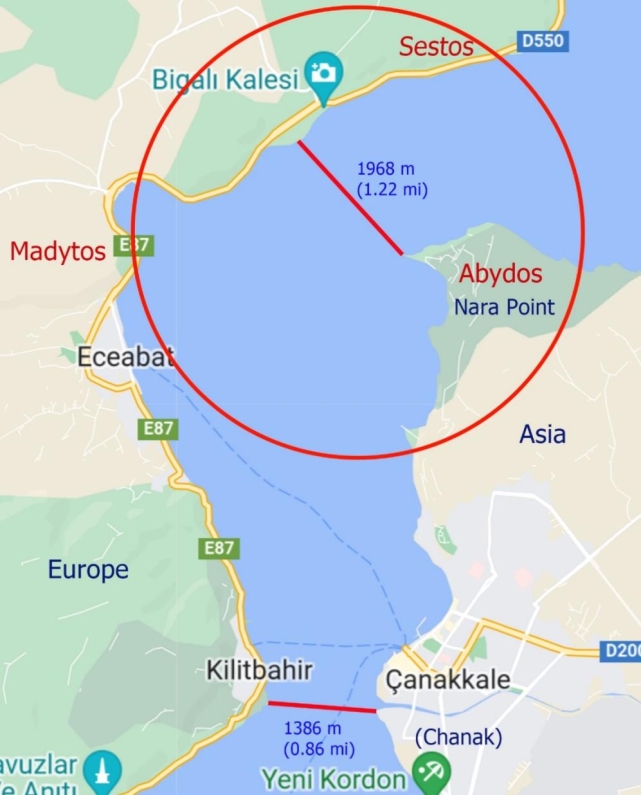
The Historic Bridge’s Modern Location
Looking again at the map, the shortest distance now between Çanakkale and Kilitbahir is 1,386 meters—raising the question of why Xerxes’ engineers did not choose that southernmost point. Geographers answer that 2,500 years ago, the distance between Çanakkale and Kilitbahir was likely much greater. The difference is attributed to alluvium deposited by the Kocaçay Stream—known as the Rhodios in antiquity—over the centuries, narrowing the strait at that particular spot.
The renowned German composer Georg Friedrich Handel (March 5, 1685, Halle, Germany – April 14, 1759, London, England) based his opera Serse (Xerxes) on the story of Xerxes I’s campaign recounted above, with some scenes set at the Dardanelles. Handel, who distinguished himself in the history of music for his operas, oratorios, cantatas, and duets, was a Baroque composer of towering significance, contemporary with Johann Sebastian Bach and Domenico Scarlatti. He is famed for works such as Water Music, Music for the Royal Fireworks, and the oratorio Messiah.
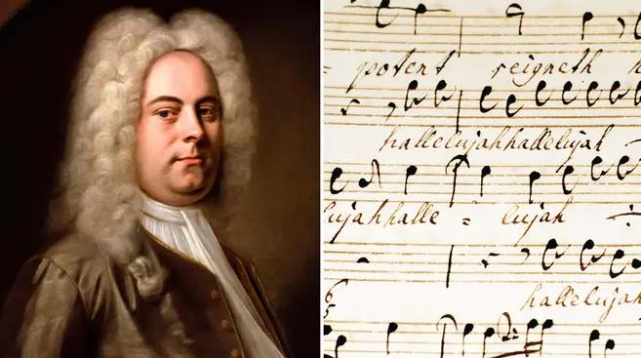
Georg Friedrich Handel
Handel composed four anthems for the coronation of King George II of England in 1727, including Zadok the Priest, which has traditionally been performed at every monarch’s coronation since. Before settling in London, he studied in Halle, Hamburg, and Italy, eventually becoming a British citizen in 1727 and spending the rest of his life in London.
Handel’s opera Serse opens with the famous aria “Ombra Mai Fu,” in which Emperor Xerxes, about to depart from his palace in Persia for the campaign, pours out his affection for a beloved plane tree in his garden. This aria is among the most recognized and frequently performed in the opera repertoire.
“Ombra mai fu di vegetabile,
cara ed amabile,
soave più.”Never before was a plant’s shade
so dear and lovely,
so soft and sweet.
Above, you will find a link to a video featuring the young Czech opera singer, soprano Patricia Janečková—who has tragically been battling a serious illness—performing this beautiful aria with a truly angelic voice.
Let us conclude on a hopeful note:
Who knows, perhaps in the not-too-distant future, a splendid opera house might be built in our beloved Çanakkale overlooking the very route where Xerxes’ bridge once stood. And maybe its grand opening will feature a performance of Serse itself.
— Kpt. Alpertunga Anıker