
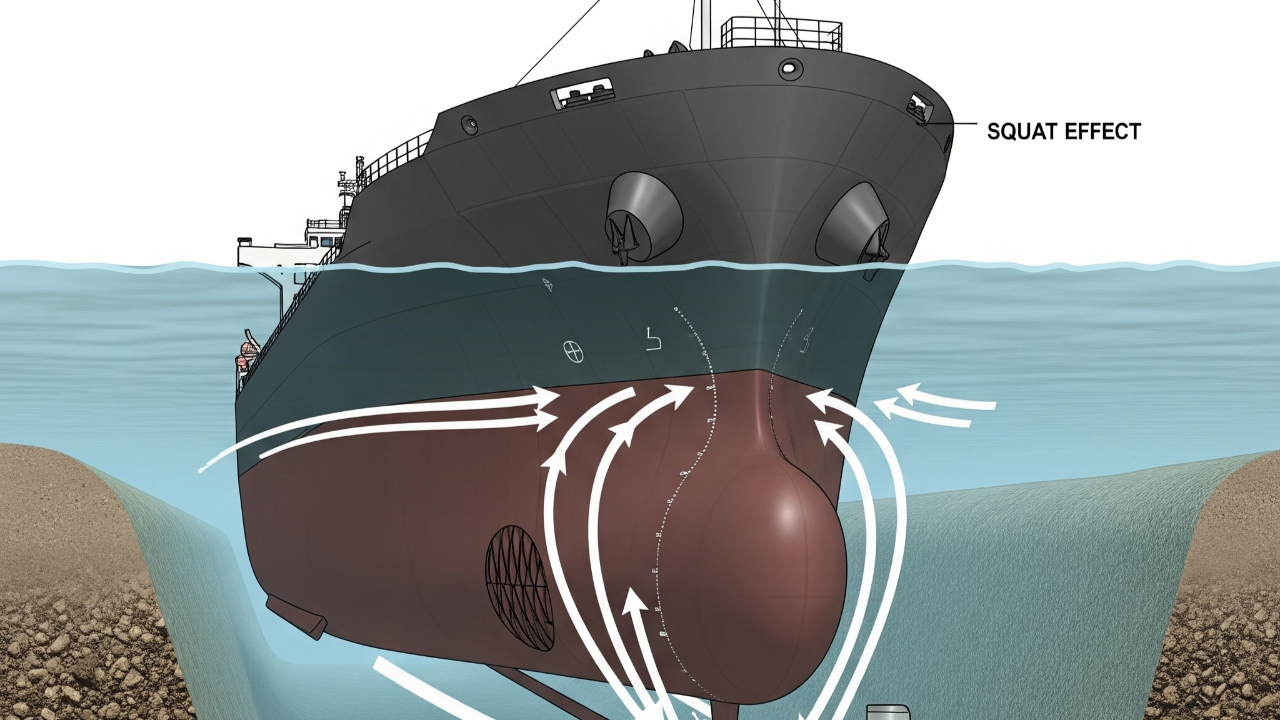
When a ship enters shallow waters, the mass of water that must be displaced due to the ship's movement struggles to pass under it as the depth decreases. As seen in Figure 1, when a ship approaches the dock without trim, the displaced water must move faster in a very narrow area under the bow as the ship attempts to move forward. Since the amount of water that needs to be displaced for the ship to move remains the same, the narrower the area becomes as the ship continues to move, the faster the water movement accelerates. In this case, a low-pressure area forms under the ship, especially at the bow, and the ship sinks a certain amount along its length, with more sinking at the bow. We define this effect as the “Squat Effect.”
In the situation described above, the ship sinks a bit more into the water and also trims forward. Considering this effect, it is beneficial for ships to arrive at ports with a slight stern trim for the safety of maneuvers, if possible. However, if the ship arrives at the dock without trim due to the port's draft limit and the maximum load taken, it is essential to keep the speed under control as much as possible during the maneuver. Since the “Squat Effect” increases proportionally to the square of the ship's speed, being able to control the speed is very important.
One of the other negative effects resulting from this is the shift of the pivot axis towards the stern of the ship, which reduces the steering responsiveness. Therefore, it becomes quite difficult to control the course of ships entering shallow water effects, requiring attention. When a ship drifts to starboard or port, it is necessary to use the rudder at higher angles. However, the point to be noted is that the ship may tend to turn to the other side this time. It has been determined that some ships arriving at the port with a considerable stern trim have a secondary effect of reduced pressure from the propeller wash, causing them to settle from the stern.
As a result of all that has been described; as far as conditions permit, there is a benefit in having ships arrive at the port with a reasonable, but not excessive, stern trim in terms of maneuvering safety.
There are some practical calculations that help us understand whether the squat effect of ships is greater at the bow or the stern. The most well-known of these formulas is the one referred to as the “Froude Equation.” The coefficient q obtained by dividing the speed of the ship in deep water in nautical miles by the square root of the ship's length in feet allows us to make some comparisons.
Froude Equation
q=Speed in knots / Square root of ship length (feet)
After finding the value of this coefficient:
q < 1 means the ship squats more at the bow.
q = 1.2 means the ship squats evenly.
q > 1.3 means the ship squats more at the stern.
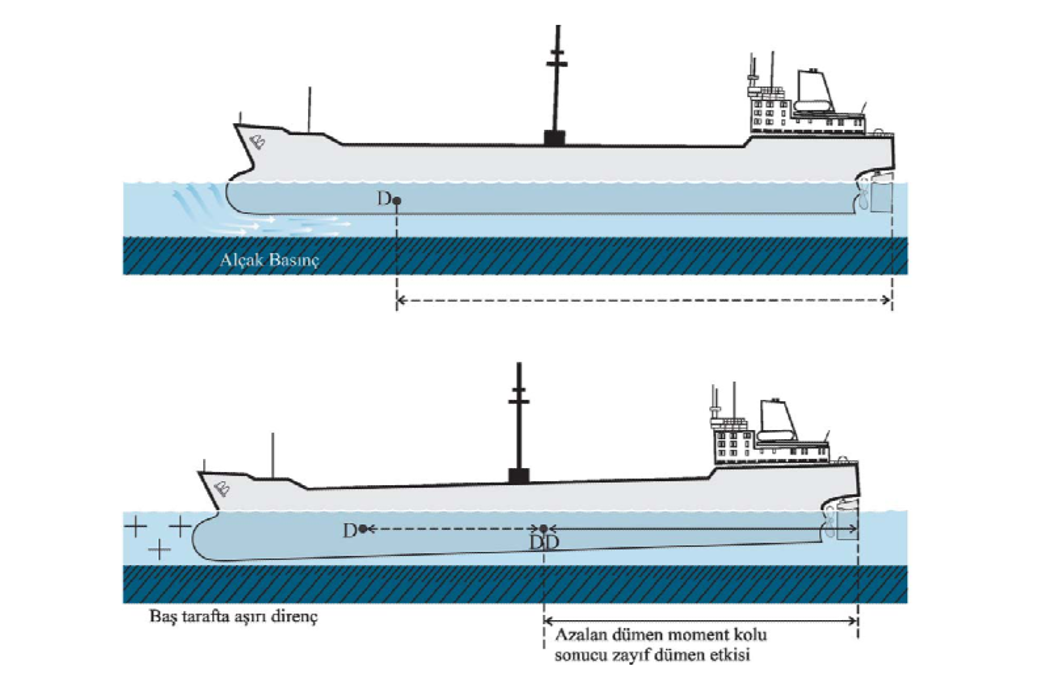
Figure 1: Reduced steering capability due to squat effect
The mass of water displaced by ships while moving creates a water movement known as the "ship wave." As the ship enters shallow waters, the height of the ship wave increases, and the wave trough deepens, negatively affecting the ship's buoyancy (Figure 2).
This effect increases the amount of sinking caused by the low pressure created by the accelerating water movement beneath the ship. We consider this effect not as a separate element but as one of the factors that create the squat effect.
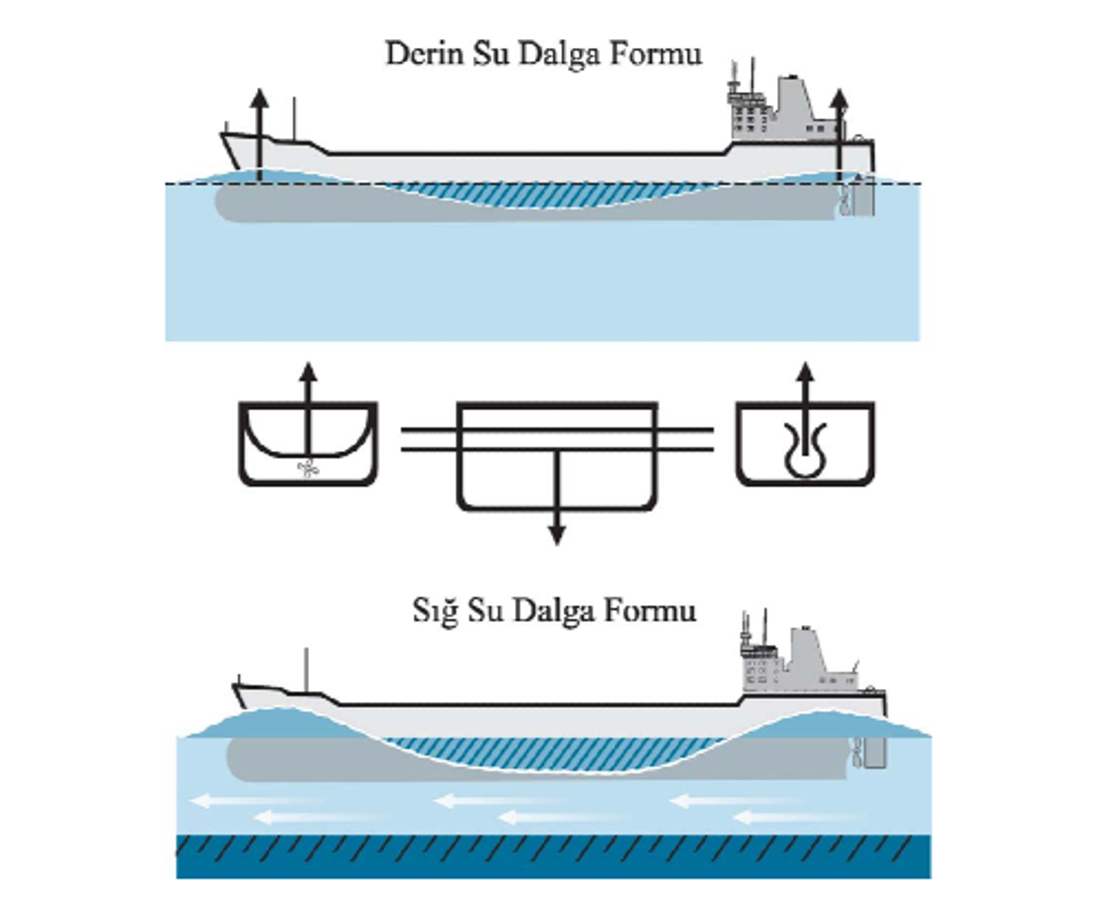
Figure 2: Deep water and shallow water wave form
As seen in the figure above, this wave has four main components:
The bow wave created due to high pressure at the bow.
The wave trough at the centerline of the ship.
The stern wave created by the water flowing to the stern.
The residual wave left behind the ship.
Although the shape of the wave can change according to the speed of the ship and the form of the vessel, as mentioned above, in shallow water, the wave trough deepens, and the wavelengths increase, negatively affecting the ship's buoyancy and causing some sinking.
The squat effects of ships in shallow water are directly related to several factors. To list them:
The ship's speed relative to the water,
The ratio of water depth to the ship's draft,
Blockage coefficient,
Ship slenderness coefficient (Cb),
The ship's displacement,
The acceleration of the ship's speed.
Bulk carriers and large tankers, which generally have a vessel slenderness ratio higher than 0.80, are more exposed to the squat effect and generally sink more from their bow. However, one advantage is that due to their generally high GM values, they do not easily list to starboard or port at high rudder angles. Vessels such as container ships and passenger ships, which generally have a vessel slenderness ratio less than 0.80, are relatively less affected by the squat effect and tend to sink more from the stern.
However, due to their generally low GM values, they can list to starboard and port to some extent due to the transverse thrust effect of high rudder angles, which often exceeds the maximum squat values. For example, a Panamax vessel with a beam of 32 meters will experience an increase in draft of approximately 28 cm when it lists one degree to starboard or port.
We mentioned that the squat effect increases in direct proportion to the square of the vessel's speed. When we double the speed, the squat increases fourfold. However, it is important to note that the speed in question is the speed relative to the water. A vessel can sink slightly due to the squat effect even when it is moored at a dock because of the current. There are various formulas that calculate the squat effect in great detail. However, the "Brass Formula" provides significant ease in this regard due to its practicality and the maximum squat effect it yields.
In this formula, the vessel slenderness ratio is multiplied by the square of the vessel's speed relative to the water and then divided by 100 to find the squat amount in meters. The "1st Formula" explained in Figure 3 expresses this situation for shallow waters where the Depth/Draft (H/D) ratio is between 1.1 and 1.2. If our vessel enters a channel where the blockage effect is present while navigating in shallow water, the sinking caused by the squat effect will be twice the amount calculated by the above formula.
This situation is expressed by the "2nd Formula," where a factor of 2 is added to the "1st Formula." In the explanation of the "Second Formula," the coefficient n is mentioned, which refers to the blockage coefficient discussed above. As can be seen in both formulas, the squat effect always increases with the square of the speed.
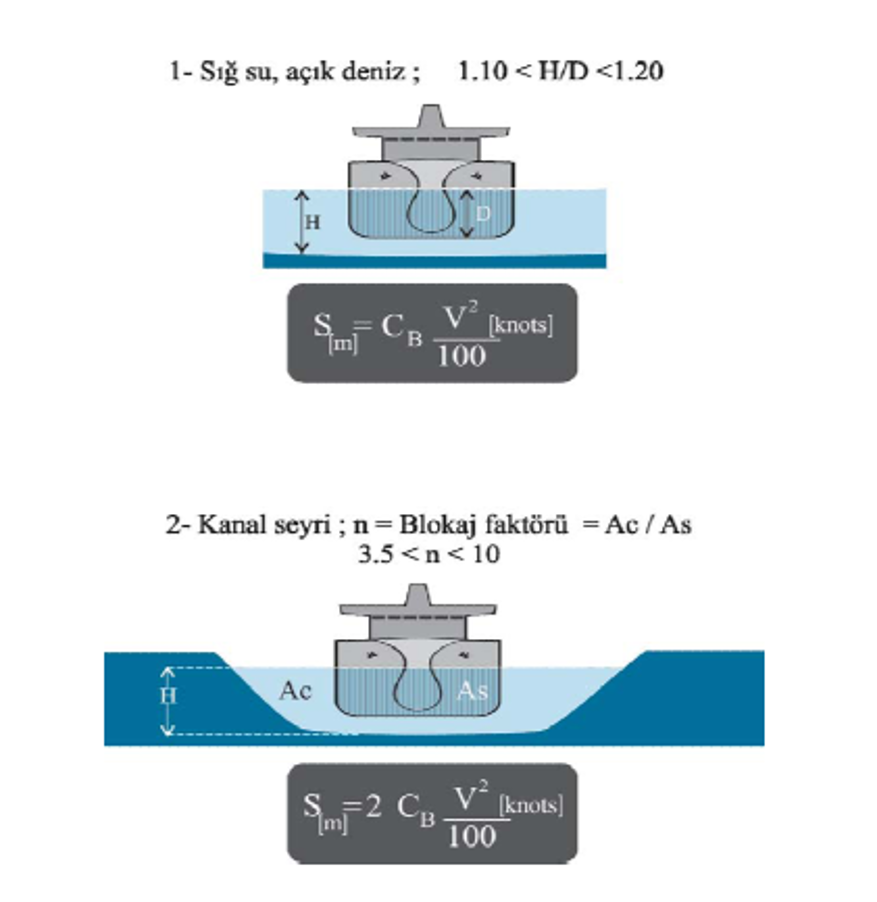
Figure 3: Brass Formula
If the squat effect is to be kept at the limit during maneuvers, it is absolutely necessary to control the speed first.
Gradually increasing the speed is also very important for controlling the squat effect. For example, when a vessel is navigating in shallow waters and transitions from a very slow speed to full speed, the engine RPM and speed will increase with a high acceleration, resulting in a squat effect that exceeds expectations. The squat value reached with high acceleration while transitioning from a very slow speed to full speed will be greater than the squat value that occurs when the vessel reaches full speed and gains stability.
Therefore, it is beneficial to make speed increases gradually whenever conditions allow. If the vessel is to be transitioned from a very slow speed to full speed, it is advisable to give commands for slow speed, half speed, and finally full speed in sequence and with some waiting in between.
In a trial conducted on a modern container ship, it was observed that the squat effect rose to 1.22 meters during the speed increase when the ship's engines were directly transitioned from very slow speed to half speed. When the ship gained stability at half speed, the squat effect decreased to 61 cm. The graph in Figure 4 shows how many meters of squat effect the vessel will be exposed to at different vessel slenderness ratios based on speed while navigating in shallow water and in a channel under open sea conditions. If the figure is examined, it can be seen that a vessel with a slenderness ratio of 0.80 will sink 80 cm at a speed of 10 knots in open sea shallow water conditions, and when the speed increases to 12 knots, the squat amount will rise to 1.1 meters.
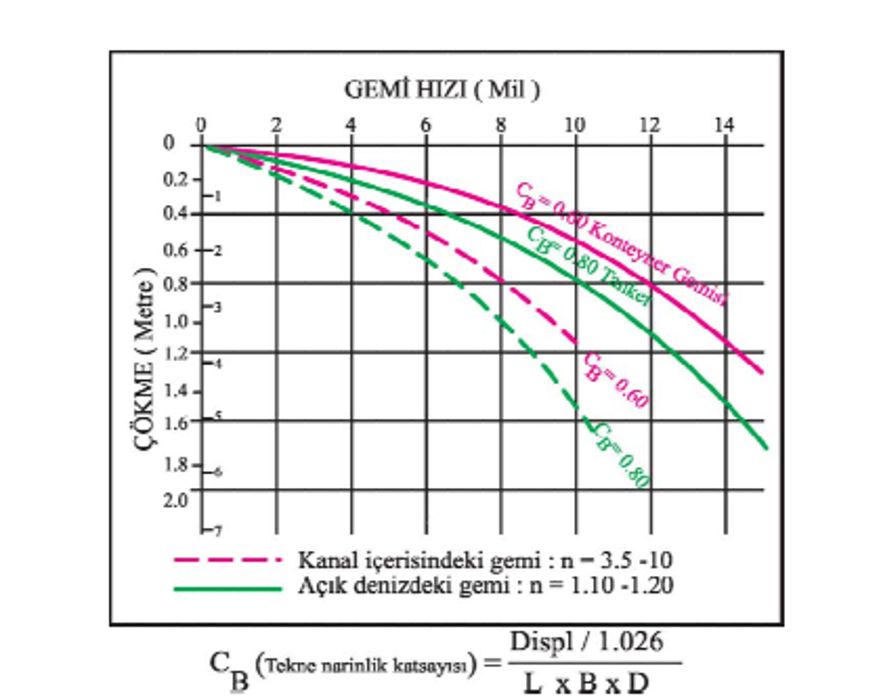
Figure 4: Amount of squat according to the vessel's slenderness ratio and speed
Let’s provide two well-known real-life examples of how the squat effect plays an effective role in maritime accidents and in overcoming certain limitations positively:
Grounding of the Queen Elizabeth 2 Transatlantic in New York Channel
The Queen Elizabeth 2 passenger ship, measuring 293.5 meters in length, 32 meters in width, and weighing 66,450.63 Gross Tonnage, experienced a strong vibration and grounded twice (touched the bottom) at approximately 21:58 LT on August 7, 1992, while navigating under the guidance of a pilot to dock at New York Harbor, 2.2 miles south-southwest of Cuttyhunk Island Lighthouse.
At that time, the ship's forward draft was 10.16 meters, and the aft draft was 9.85 meters. The chart indicated a water depth of 11.88 meters at the location where the grounding occurred. As a result of the grounding, it was found that the No. 14 and 15 freshwater tanks near the keel line were damaged and took on water, and the partially filled No. 10 fuel tank and No. 8 and 9 ballast tanks were also filled with water.
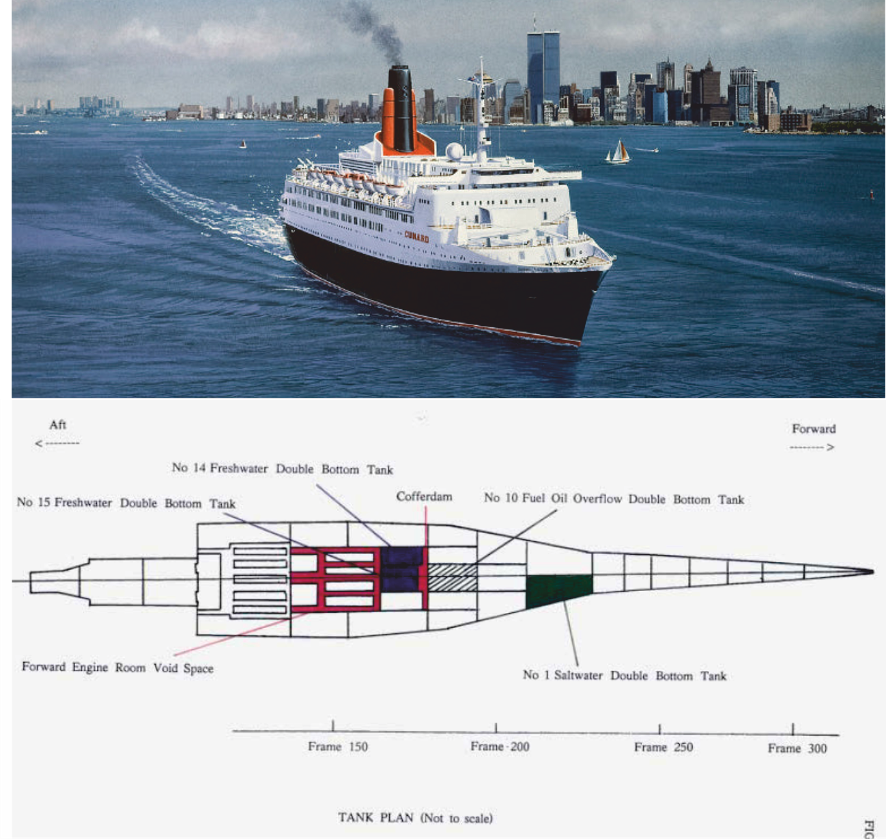
Figure 5: Damaged tanks of the Queen Elizabeth 2 passenger ship after grounding
As it continues to be the case today; there was no written document or information available to the ship's captain regarding how the squat effect would affect the ship based on its underwater shape and other fundamental characteristics. In the absence of this information, the captain consulted with the pilot and planned the navigation, thinking that the ship would experience a squat effect of about 30-45 cm, which would increase the draft and trim the stern.
During the time of the incident, it was estimated that there would be a safety margin of 2.44 - 2.74 meters between the ship and the seabed, considering a positive tidal effect of about 60 cm to be added to the chart datum depth and the squat effect, which would increase the ship's average draft by 30-45 cm according to the captain's own calculations. However, this was not the case, and the ship grounded, sustaining serious damage.
Although an Admiralty publication, Mariner’s Handbook, mentions in the relevant section that the squat effect could be about 10% of the ship's draft when vessels are traveling at 10 knots and that the ship would tend to trim by the stern, the vessel in question was traveling at over 20 knots at the time of the incident, and therefore was subjected to a squat effect greater than expected.
As mentioned in the explanations above; it is a factor that must always be considered that the squat effect increases in direct proportion to the square of the speed.
Passage of the MS Oasis of The Seas Passenger Ship through the Great Belt
On November 1, 2009, the passage of the 360-meter long, 47-meter wide, and 9.30-meter draft passenger ship named MS Oasis of The Seas, one of the largest passenger ships of its time, under the bridge (Storebælt Bridge) in the Great Belt Strait posed a significant risk.
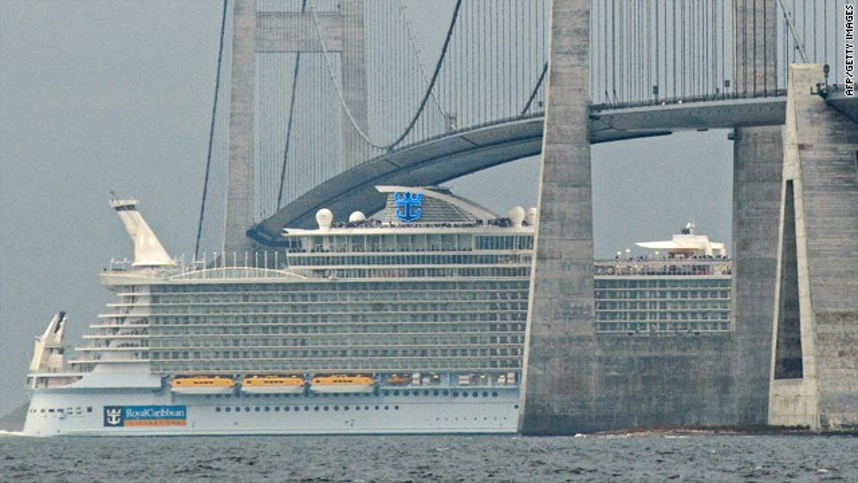
Figure 6: Passage of the Oasis Of The Seas passenger ship under the Storebælt Bridge
Even when all the foldable chimneys were lowered, there would only be a gap of about 30 cm between the bridge and the ship. Therefore, the authorities calculated that if the ship passed under the bridge at a speed over 20 knots, this gap would increase by another 30 cm, taking into account the effect of the collapse.
After the preparations were made and measures regarding ship traffic in the area were taken, the ship managed to pass under the bridge with a gap of 60 cm as previously calculated, at a speed over 20 knots.
Respectfully,
Capt. Alpertunga Anıker
Source: www.denizhaber.com