

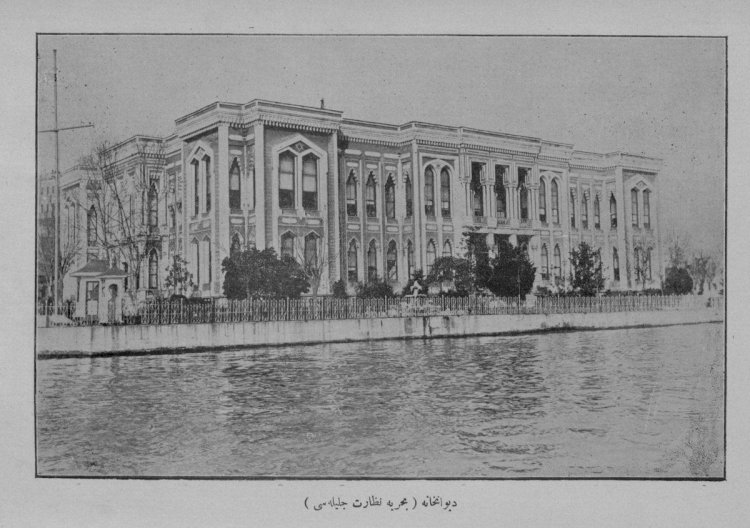
On the afternoon of January 28, 2020, the historic Divanhane (Ministry of Navy) Police Station building, constructed by Sultan Abdulaziz in 1868, located in Kasımpaşa Square, was demolished as part of a road expansion project under the control of the Ministry of Transport and Infrastructure.
The demolition was carried out in accordance with the decision numbered 7132, dated February 8, 2019, by the Istanbul Regional Board for the Protection of Cultural Heritage No. II. According to the same decision, the historic building was to be reconstructed in accordance with its original form at another location. The building in question was located in the courtyard of the Divanhane, which was recognized as a first group immovable cultural asset by the Protection Board Decision No. 7680 dated April 24, 1996, and had long served as the entrance of the historic Divanhane known as Lumbarağzı. It was recognized as a second group immovable cultural asset on April 11, 2007. Despite the approval of restoration and restitution projects on May 2, 2007, it was decided to relocate and reconstruct the building after the Haliçport project was transferred to the private sector on March 26, 2015. The demolition only began six years later under intense public pressure. The police station had also made significant contributions to the struggle in Istanbul during the Kuvay-ı Milliye resistance.
As a sailor deeply connected to the navy with my heart and soul, this demolition decision, along with other developments in the Haliç region, the flagship of our naval history, has profoundly hurt me, many sailors, and our sensitive citizens. Let me explain the reasons. The Ottoman Empire could not transfer a single ship to the Republic Navy, yet it left behind a very rich historical heritage dating back to 1455. The focal point of this heritage is the Haliç, the Tersane-i Amire, and its surroundings. Every heritage destroyed in this region means a loss of memory.
KASIMPAŞA'S NAVAL HERITAGE IS BEING DESTROYED
At the center of the Haliç maritime heritage are Kasımpaşa, the Divanhane, and the shipyards. The Divanhane, which dates back to the 17th century and has seen its fifth iteration today, hosted the highest command center of our navy, the Ministry of Navy, from 1876 to 1923. It was also used as the North Sea Command building from 1961 to 2007. Later, it underwent a major restoration. The building was vacated. The restoration was to be covered under the Kasımpaşa Protocol agreed upon between the Istanbul Metropolitan Municipality and the Navy, in exchange for the land transferred by the Naval Forces in the Taşkızak and Haliç Region to the Metropolitan Municipality. However, despite the 14 years that have passed, no action has been taken. This magnificent building has been left to decay since 2007. (Let us remind you, according to the 2006 protocol, the building must be returned to the Naval Forces after restoration. It can never be transferred to any other institution, organization, or individual.) This building, where the 1876 Shipyard Conference, one of the most significant turning points in Ottoman history, was held, which led to the declaration of the First Constitutional Era, and where naval battles affecting the fate of the Ottoman navy were managed, is virtually abandoned to its fate. Structural collapses and irreversible damages have begun to occur in the building. Nearby buildings related to this historical heritage are also affected by similar grief. The 153-year-old police station building (later used as a courthouse and prosecutor's office), which forms the entrance of this magnificent building I mentioned at the beginning of my writing, can be demolished. Beyond being severed from our historical naval heritage, it is also physically uprooted from its birthplace.
THE NAVY PRINTING HOUSE AND THE NAVAL NON-COMMISSIONED OFFICER TRAINING SCHOOL HAVE ALSO BEEN SEVERED FROM THE NAVAL FORCES
The same fate befell the building that served as the Navy Printing House during the Ottoman period, located across from the police station, which was transferred to the Military Court in 2020, even though there was no demolition decision. The building was transferred to the Fatih District Governorship. A similar fate occurred at the historical Non-Commissioned Officer Training School Command building, part of the Beylerbeyi Palace complex, which was also transferred to the Ministry of Transport in 2017.
The responsibility of preserving the historical buildings acquired by the Naval Forces and other force commands for future generations represents the continuity of state tradition. In developed maritime countries, such fait accompli decisions are not easily made. Even in countries like Germany and Japan, which were defeated and humiliated in war, the occupying victorious states respected the maritime traditions of these nations and did not touch their cultural heritage and historical buildings or ships. Today, the battleship Mikasa is preserved as a museum in Japan. In Germany, many buildings and ships that participated in World War I and II are preserved as museums in Kiel and Flensburg. I don't even mention the US and the UK. In these countries, any alteration to a building related to 153 years of naval history would make headlines in the newspapers, let alone demolition. For example, the heart of the British Royal Navy beats in Portsmouth. The flagship HMS Victory, where Admiral Nelson lost his life in the Battle of Trafalgar (1805), and the first product of the industrial revolution, HMS Warrior, are museum ships located here. The British government cannot even make the slightest alteration, let alone build a five-star hotel, shopping mall, or new church in this area. They know very well that the British people and the Royal Navy would never allow such a thing.
HALİÇ MARITIME HERITAGE IS 566 YEARS OLD
Now, let’s come to our article's title regarding our maritime heritage in Haliç. The 566-year-old maritime heritage that has been lived and is still being lived in the Haliç region makes the historical value of this area unparalleled. Those who wander the shores and neighborhoods of Haliç, especially Kasımpaşa, know. Here, most street names bear either maritime terms or the names of famous Turkish sailors. Similarly, you will find traces of maritime culture in the mosques, fountains, and monuments in the region. Many of them have traditional naval anchors on one side. This region was the heart of the navy and Turkish naval power in the Black Sea, Aegean, and Mediterranean from 1455 until 1928, when the Gölcük shipyard and naval base were established. Even after Gölcük, the North Sea Command and Taşkızak Shipyard Command were the representatives of the navy here. The navy and Kasımpaşa are intertwined.
Since December 11, 1454, the sound of Turkish hammers has been heard in the docks along the shores of Haliç. 566 years is a significant heritage for a state striving for maritime development. Shipbuilding on the northern shores of Haliç began with Fatih Sultan Mehmet. The shipyard expanded to its current boundaries during the reign of Yavuz Sultan Selim. During this period, the Haliç shipyard extended to Kağıthane, encompassing the shores of Camialtı, Taşkızak, and Hasköy. In 1557, there were 123 docks between Galata and Kağıthane in Haliç. In the winters, 250 galleys were pulled ashore for maintenance. The first galleon in the shipyard was built in 1648. After the Çeşme raid in 1770, Captain of the Navy Cezayirli Gazi Hasan Pasha, who greatly contributed to the recovery of the navy, built a large galleon barracks where the personnel of the navy galleons, who were dispersed in winter, could stay permanently, giving the Ottoman navy operational capability in both summer and winter for the first time. (This barracks is still used as the headquarters and support units command building of the North Sea Command.) With the establishment of the Mühendishane-i Bahri Hümayun, which laid the foundation for today’s Naval War College and Technical University in Kasımpaşa starting from 1773, this area completely transformed into a maritime center. During the reign of Sultan III. Selim, the first stone (dry) dock was built in the shipyard in 1799. During the reign of Sultan II. Mahmut, the second stone dock was completed in 1825, and the first wooden steamship was completed in 1837.
Sultan Abdulaziz, who reigned from 1861 to 1876, was a maritime enthusiast and a lover of the navy. During his time, the first stone dock built in 1799 was enlarged. The shipyard completed its first steel and steamship in 1874. Since II. Abdulhamid preferred to reduce and even destroy the navy, neither the shipyard developed nor were new ships built. Meanwhile, in 1886, only two Nordenfelt-class submarines were assembled at the Taşkızak shipyard. However, after the first actual torpedo firing, Sultan, fearing for the secrecy of these ships, sent the two submarines to İzmit. They were never called back. The Tersane-i Amire was divided into three separate administrations during the İttihat ve Terakki period in 1913. Hasköy was transferred to Şirket-i Hayriye (City Lines); Taşkızak (Valide Kızağı) to the Navy, and others to the Osmaniye Maritime Construction Company. The Haliç region experienced its most painful period in history during the armistice, i.e., the occupation period. It turned into a cemetery for ships and shipyards.
After the War of Independence, the Istanbul region was demilitarized due to the Treaty of Lausanne, and some of the military facilities at the Taşkızak shipyard were transferred to the newly established Gölcük Shipyard. In 1936, after the Montreux Convention, when Istanbul regained its former status, the Navy continued to develop the Taşkızak Shipyard. Other shipyards also remained in the service of various public institutions and organizations such as Seyri Sefain, Şirket-i Hayriye, Factories and Docks Directorate, Maritime Lines, Maritime Bank, etc. Meanwhile, in the early 1990s, the Naval Forces began searching for a new shipyard. After the 1999 Marmara earthquake, when the surface shipbuilding ways of the Gölcük Shipyard were destroyed, the Pendik (Istanbul) Shipyard was transferred to the Naval Forces, and the Taşkızak Shipyard was closed and moved to this shipyard. Thus, in 2000, the Navy completely removed its warship repair/construction presence from the Kasımpaşa region. Later, with the wave of privatization, the Hasköy and Camialtı Shipyards were also closed.
THE LAST FORTRESS OF OUR HISTORICAL HERITAGE: HALİÇ SHIPYARD
Today, thankfully, the sounds of hammers continue at the Haliç Shipyard. Under the leadership of Sinem Dedetaş, the first female director of the General Directorate of City Lines AŞ, our shipyard is achieving success after success. Since she took office in 2019, the silent docks are now repairing the ships of the city lines. New projects are being brought to life. Shipbuilding must continue at the Haliç Shipyard, which still holds the status of the oldest active shipyard in the world. In this state, the shipyard deserves UNESCO protection. Today, there are 28 sites worldwide that hold the status of UNESCO's Industrial Archaeology heritage. Among these sites, the closest to the Haliç Shipyard area are the Venice Shipyard and the Liverpool Maritime Trade City. Even if today the land-sovereign establishment does not understand, when individuals and institutions that recognize the importance of maritime and maritime cultural accumulation emerge in the future, the value of the uninterrupted sound of hammers in Haliç for 566 years and ship production will be better understood. There are thousands of shopping malls, marinas, and luxury hotels around the world, but there is no shipyard that has built ships for 566 years. It is a pity not to see this reality. Therefore, I invite everyone who has a heart for the sea, the blue homeland, and maritime in Turkey to support the survival, breathing, and continued ship production of the Haliç Shipyard. In this context, I invite you to support the Haliç Solidarity, the Maritime and Shipyard Personnel Association, and the Architectural Restoration and Cultural Heritage Protection Association, which strive for the active protection of the shipyard.
In the Haliç Region, the Aynalıkavak Palace, later transformed into a kasr in the 17th century; the Divanhane building, which is still standing today as the fifth iteration; the old building known as the Naval Hospital, built by Cezayirli Gazi Hasan Pasha; and the historical buildings and stone docks at the Haliç, Camialtı, and Taşkızak shipyards are representatives of the past today. However, today, except for the Cezayirli Gazi Hasan Pasha Mansion, Aynalıkavak Kasrı, and Haliç Shipyard, the values I mentioned are in a deplorable state that is not at all suitable for their historical heritage. A community becomes a nation by being aware of its shared historical heritage and protecting it. We must pass on our 566-year maritime heritage, which extends from our history into the future, to future generations. Let us not forget that civilization begins at sea and on the shore. The 566-year maritime heritage and tradition in the world's most valuable geography should not be destroyed for profit, nor should the 153-year heritage be recklessly wasted for the sake of a road. Our Naval Forces must be aware of their responsibility to pass on the historical heritage entrusted to them institutionally from past generations to future generations. We can build a new warship in four years, but the historical heritage that is destroyed is lost forever. It cannot be replaced.
The psychosocial damage caused by the historical heritage that the Naval Forces have unfortunately lost or are at risk of losing (the historical buildings in the Taşkızak area, the Divanhane Building, the Kasımpaşa Navy Printing House, the Naval Hospital, the Divanhane Police Station, the Beylerbeyi Non-Commissioned Officer Training School) is significant. Similar losses should not occur. In the most developed democracies, where civilian control over military power is at its highest, military historical heritage is protected jealously. Civil authority does not say, "I am the national will; I can do whatever I want." History and culture are not sacrificed for profit or the interests of dominant powers. Historical heritage represents the continuity of the state. Governments and administrators come and go. The state is eternal.
Source: www.denizhaber.co