

Dr. Jan Schmidt's unparalleled documentary studies
Opium trade from Anatolia to Indonesia
Author: Osman Öndeş
The unease created by the successive drug epidemic investigations and arrests today brings to the agenda the centuries-old story of opium exports from İzmir to world markets.
Regarding research on "Afyon-Opium," Dr. Jan Schmidt was an academic beyond all admiration and respect, particularly for his documentary studies titled "From Anatolia to Indonesia - Opium Trade and The Dutch Community of İzmir, 1820-1940." This work, which examines the subject of "Opium," was published in 1998 by the Nederlands Historisch-Archaeologisch Instituut in Istanbul and represents a level of seriousness and scientific rigor that is unique in its field.
Dr. Joannes (Jan) Schmidt passed away on August 11, 2025. Upon his passing, Dr. Petra de Bruijn, a lecturer in Ottoman Linguistics at Leiden University, described his life story as follows:
"We wish strength and consolation to his wife, friends, and family. Jan Schmidt will be remembered as one of the most productive and knowledgeable scholars in the field of Ottoman codicology and history."
"Jan Schmidt was born in 1951 in Arnhem, Netherlands. Between 1969 and 1985, he studied History and Middle Eastern Languages and Culture intermittently at Leiden University. In 1992, he completed his doctorate with a new interpretation of the Künhü l-aḫbâr (1590s). He became a lecturer in Turkish and Ottoman studies at Manchester University in England before returning to his alma mater. From 1998 to 2007, he worked as a cataloging expert at the University Library on various projects funded by the NWO (Dutch Research Council). Additionally, he served as a lecturer in Turkish in the Department of Middle Eastern Studies from 2004 to 2016. After retiring in 2016, he maintained his connection as a guest researcher with the Leiden University Library (2017–2019) and the department (2019–2020). Notably, his four-volume work, Catalogue of Turkish Manuscripts in the Library of Leiden University and Other Collections in the Netherlands (2000–2012), is a testament to his meticulous and generous research on Ottoman-Turkish manuscripts. The project, initiated by Prof. Jan Just Witkam, former curator of the Leiden University Oriental Manuscripts collection, involved renewing the Latin catalog that had been in use for over a century. Jan Schmidt not only brought the catalog up to date but also described the manuscripts in much greater detail and depth."
Dr. Jan Schmidt's documentary work, "From Anatolia to Indonesia - Opium Trade and The Dutch Community of İzmir, 1820-1940," is a source for many accolades regarding research on the subject of Opium. The 2009 price for this English-language work was 59.50 Euro, and it is located at the address: “Nederlands Instituut Voor Het Nabije Oosten Witte Singel 25, Postbus 9515, 2300 Ra. Leiden, The Netherlands.”
Dutch Levantines Settled in İzmir
While examining the activities of Dutch Levantines settled in İzmir as shipping agents, Jan Schmidt also conducted studies on the Van Lennep and Dutilh families, parts of which I published in my work titled "History of Ship Owners and Agents." I have felt deep happiness in knowing Hendrik Dutilh, the last generation representative of the Dutilh family to reach our time, and in conversing with him on various occasions. Although Jacop (Jan) Schmidt van Lennep appears at the forefront as an opium exporter from İzmir, deep research reveals that names such as Baltazzi, Alfred Keun, Wissing, and Dutilh also occupied very significant ranks.
The primary reason Dutch merchants chose the İzmir-Aegean region for opium cultivation was the boundless privileges granted to them by the Capitulations. Consequently, the Ottoman Empire was made a victim of the opium scourge. Thus, the sources of the opium market were Karahisar, Konya, Gediz, Akhisar, Çal, Alaşehir, Balıkesir, Uşak, Kula, and Çeşme.
This work, based on an extensive bibliography including works by esteemed Turkish academics such as Turhan Baytop, Seyfettin Gürsel, Reşat Kasaba, Uygur Kocabaşoğlu, Hüsnü Sarım, Kamran Şerif, Afet İnan, Ayhan Songar, and Turgay A. Üner, provides an answer to the catastrophe of associating the opium scourge with the Turks and the escape from this disaster, starting on page 170 with the line: “More shocking to the foreign residents in the Empire was the abolition of the Capitulations on September 7, 1914.”
Initially, the essence of opium shipments from Anatolia to Indonesia was to habituate the population of colonial Indonesia to opium. This subject reaches the core of the enforcement efforts through the specific roles of Levantines in İzmir as shipping agents.
The Industrial Revolution contributed significantly to the colonial process becoming increasingly effective and, consequently, to the expansion of the opium trade. This process was further strengthened by the communication revolution arising from the invention of new techniques and their global application. The most important elements of this development were railroads, the telegraph, and steamship transportation. The Levant was greatly affected by these inventions, and İzmir became the primary export port for the development of the opium trade, especially in the second half of the century.
The imperial decree ordering the construction of a railway between İzmir, Manisa, Kasaba, Uşak, and Afyon Karahisar—all of which were important opium centers—made Levantine merchants and shipping agents even more effective. This was because Karahisar produced two-thirds of Anatolian opium, and the transport time to İzmir would drop from twenty to twenty-five days to just eighteen hours. Anatolian railways had a massive impact on agricultural production and contributed to the doubling of exports by sea from İzmir between 1863 and 1883. (Source: Jan Schmidt)
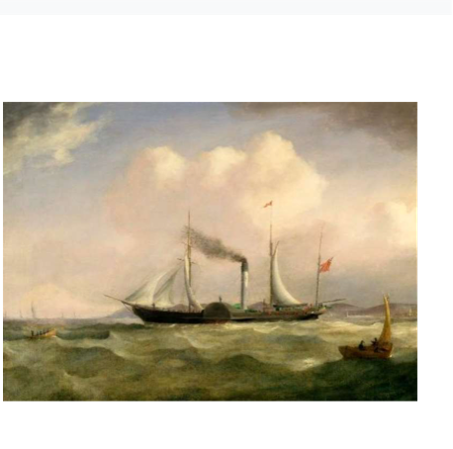
The first passenger/cargo paddle steamer to transport opium: "Tagus". Source: P&O Archives.
The first regular steamship service between İzmir and Istanbul was established in 1835, operated by two British vessels and one Austrian vessel. It was possible to reach either destination twice a week in six days; in contrast, sailing ships sometimes required up to a month. In 1840, the British Peninsular & Oriental Steam Navigation Company (P&O) launched a regular service between England and Egypt. Simultaneously, the company established passenger and cargo services connecting London with Malta, Athens (Piraeus), İzmir, Istanbul, Beirut, and Jaffa.
The appeal of the Istanbul line grew significantly as the import volume of Istanbul merchants alone approached £1.2 million, with an export volume of £1 million in the years 1842 and 1843.
The first opium transported by steamship was shipped aboard the P&O Liner "Tagus," which was built in 1837.
The first 40 chests of opium were sent from İzmir to Batavia (Jakarta) by A.J. Johnson & Co. on behalf of the Trading Co. On January 4, 1847, under the command of Captain Wilson, an overseas shipment of opium was carried out from İzmir via the P&O paddle-wheel cargo/passenger steamer "Achilles."
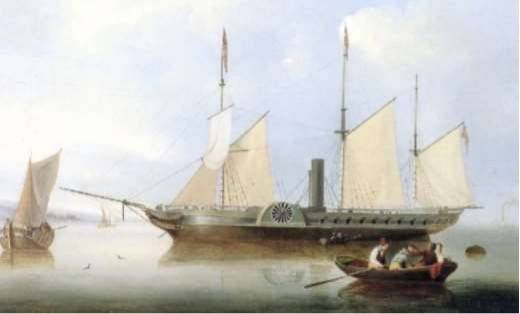
The paddle-wheel cargo/passenger steamer "Achilles," one of the vessels conducting opium voyages to the Port of İzmir. Source: P&O Archives
From 1852 onwards, opium shipments began to be carried out every fifteen days by P&O vessels to Singapore and Australia on behalf of the East India Company. During this period, some cargo was also sent to Batavia via overland routes. The paddle-steamer "Achilles," built in 1838 with a gross tonnage of 992 GRT, was purchased by De J&G Burns in 1845. (Source: The Ships Lists)
In early 1853, Jacop Van Lennep's nephews reported that P&O could take opium cargo directly to Batavia without discharging in Singapore. They were greatly impressed by the iron-hulled P&O paddle steamer "Pottinger," built in 1846 and enlarged in 1849. First appearing in March 1850, this steamer was the largest ever seen in the Levant. He toured the ship in September and found it magnificent. It had completed the journey from Southampton to Istanbul and back multiple times in just ten days and a few hours.
The passenger paddle steamer "Pottinger" joined the P&O fleet in 1846, built at William Fairbairn & Sons' Millwall shipyard. It was 1,300 GRT, 890 NRT, with a total length of 68.25m (224.0 ft), a width including paddle boxes of 18.59m (61.0 ft), and a draft of 5.330m (17.6 ft).
Its steam engine, manufactured by Ravenhill & Co Works Blackwall, produced a maximum power of 450 IHP, with a top cruising speed of 10 knots. It could accommodate 90 first-class passengers and had a cargo capacity of 325 cubic meters. I am noting these details to remind us that there were no Turkish-flagged merchant ships in those years.
One of the first British-flagged steamers to make voyages to İzmir was the "Ottoman," which loaded 11 chests/crates of opium for Liverpool on behalf of some Greek merchants on January 28, 1848.
The "Ottoman," built at C. Mitchell & Co. Low Walker yard (Hull No. 394), was 2,283 GRT, 1,492 NRT, and its main steam engine produced a maximum of 283 NHP. Its first owner was the Moss Steam Ship Co. Ltd. from Glasgow. On January 3, 1911, it suffered an engine failure while sailing from Alexandria to Ipswich and was towed to Spithead by the Hamilton. On March 5, 1912, its engine failed again; after its cargo was transferred to another ship, it was abandoned and subsequently scrapped at Forth Shipbroking Co. in Bo’ness. (Source: Tyne Built Ships & Shipbuilding).
The paddle steamer "Bosphorus" also departed İzmir on January 1, 1850, loaded with 21 cases of opium. Due to opium exports, the Port of İzmir became a leading destination for British P&O, Dutch NHM, and other shipping companies. Regular steamship services between İzmir and Liverpool began with the British Screw Steam Company, loading from İzmir on the 15th and 16th of every month. However, P&O steamers carried more opium cargo to US ports. Jacop Van Lennep wrote that they loaded whatever cargo was available onto the paddle steamers.
The list of ships calling at the Port of İzmir includes sailing ships, paddle-wheel sailing steamers, and in later years, screw steamers such as: Hendrica Elisabeth, Jonge Maria, Boreas, Twee Gebroeders, Meeuw, Achipel, Herstelling, Anna Rebecca, Anna Pawlowna, Snelheid, Amstel, Jansen, Ariadne, Briseis, Courier, Jarjen Brower, Jan Jacob, Fortuna, Pottinger, Jupiter, Clara Zoe, Geertruida, Madras, Haddington, City of London, Euxine, Rajah, Sultan, Austria, Saxon, Conte Dandolo, Vrouw Maria, Nijverheid, Carolina, Militiades, Jews, Sevea, Singapore, Hesperus, Alarm, Zeeneeuw, Eendragt, and Queen. Detailed records exist for opium exports from İzmir belonging to merchants such as Jacop Van Lennep, Dutilh, Lochner & Co., Salamon di Heym Lewi, Raphael di Haim Levi, Wissing, Hoeting & Co., Dul P. van Veen & Sons, Pagy & Buess, P. Pasquali, and others. (Source: Joannes Schmidt, Clyde and Tyne Built Ships & Shipbuilding).
Despite their emergence, screw steamers were initially at the early stages of technology. Pistons, which were insufficient against high pressure, would occasionally break or malfunction. Opium merchants feared their cargo would be affected by the sea. However, fierce competition among shipping companies led to a continuous drop in freight rates. In 1852, another shipping company besides P&O began operating higher-speed vessels between the Levant and Chinese ports. While P&O ships had a maximum speed of 8.5 knots, this company’s ships reached 10.5 knots.
In May of that year, the first iron-hulled screw steam cargo/passenger ship of Cunard Ship Co. Ltd., the "British Queen," made a voyage to İzmir. This company held the rights for a postal agreement between Liverpool and İzmir. While one voyage per month was made to İzmir in 1851, P&O owned 16 paddle-wheel passenger/cargo steamers by 1853, just before the outbreak of the Crimean War. By 1855, Cunard Line had acquired 5 screw steam cargo/passenger ships.
Jacop van Lennep lamented that the Netherlands lagged behind British shipping companies. During this process, the Trading Company continued to ship more opium via British vessels. Conversely, the last 140 cases of opium loaded onto a Dutch-flagged sailing ship, the "Boreas," were sent from İzmir to the ports of Vlaardingen and Rotterdam on February 21, 1848, under Captain C. Van Gelderen. The freight rates for these ships were lower than steamships, but their voyage durations were much longer. (Source: Joannes Schmidt).
In early May 1854, P&O and Cunard ships suspended their voyages due to troop shipments to Istanbul. During this period, the "British Queen" continued to load opium from İzmir, albeit with some interruptions. Thus, 852 full cases and 909 half cases of opium were loaded from İzmir, with China as the final destination.
In 1851, the Ottoman Hayriye Company entered service, and in 1853, the Egyptian Aziziye Company began voyages to Istanbul and İzmir. Additionally, ships from Société Hellenique de Navigation a Vapeur and Compagnie Grecque et Oriental carried opium cargo from İzmir to British and Dutch ports. Later, steamers under Belgian, Italian, Spanish, US, and German flags joined these routes. Before 1870, Dutch ships constituted the majority in İzmir.
In 1857, the Royal Netherlands Steamship Company (KNSM) began voyages to Marseille and Genoa with five ships. The first Dutch-flagged paddle-wheel sailing passenger/cargo steamer, the "Nederlander" (built in 1823), made a voyage to the Port of İzmir in 1866.
The main product exported from İzmir by Jacop van Lennep on behalf of the Trading Company was always opium. While opium export was the primary business for the Dutilh family—the other Dutch family in İzmir—it occupied a smaller share of Van Lennep’s total commercial activities.
In November 1870, Alfred Lavino was commissioned to ship 125 chests of opium via a KNSM steamer arriving in İzmir through the Lavino Trading Company. Richard van Lennep noted in his memoirs that this marked the beginning of more intensive commercial relations between the Netherlands and the Ottoman Empire.
The steamer "Rhone," built in 1856 by Scott & Co. in Greenock with 848 tonnage, called from Istanbul and arrived in İzmir later that month under Captain Wilko Wilkens. Alfred Lavino exported 75 chests of opium on this steamer. The Rhone then loaded 9 more cases and carried a total of 84 cases of opium to Rotterdam via Çeşme and Malta.
The Rhone was a three-masted, iron-hulled screw steamer. It was built at Scott & Co.’s Cartsdyke East yard in Greenock (Hull No. 32). It was 600 DWT, and its main steam engine, manufactured at A. & J. Nelson’s Hyde Park Foundry in Glasgow, produced 160 NHP. In 1864, it was sold to Rotterdam-based Geritt & Co. In 1865, KNSM of Amsterdam purchased it. On December 9, 1870, while sailing from İzmir to Amsterdam with a cargo of raisins, it succumbed to a severe storm and ran aground near Tunis. Twenty-five people, including passengers, drowned. Only one boatswain survived. (Source: Tyne Built Ships & Shipbuilding).
The passenger/cargo paddle steamer "Tagus." Source: P&O Collection.
The "Tagus," which made the first opium voyage to İzmir, continued its service from 1837 to 1864. During this period, it served in the fleets of: Richard Bourne & Partners; Willcox & Anderson; Peninsular Steam Navigation Company; and P&O Steam Navigation Company. The first owner of this paddle-wheel passenger/cargo steamer was "Richard Bourne & Partners" from Dublin.
In 1843, P&O purchased it and assigned it to the Alexandria route. In 1843, it made its first Southampton/Istanbul voyage. On its second voyage, it called at Gibraltar, Malta, Piraeus, İzmir, Mytilene, Dardanelles, Samsun, Sinope, and Trebizond.
In 1847, the Tagus was chartered on behalf of the Ottoman State to transport military units from Istanbul to Thessaloniki and later from Istanbul to Trebizond. In 1848, it collided with an Ottoman frigate and returned to England for repairs.
Jacob van Lennep, considered a resident of Seydiköy, passed away in İzmir on February 1, 1855, and was buried in the cemetery in Seydiköy. Eulalie Catherine van Lennep, sister of Henry John van Lennep, was born in İzmir, Turkey in 1822 and passed away in İzmir-Seydiköy in 1909.
Source: www.denizhaber.com