

Attila İlhan’s first novel, Sokaktaki Adam (Man on the street) published in 1953, reads like the deep emotional turbulence found in his poetry, now woven into a novelistic form. Together with Zenciler Birbirine Benzemez and Kurtlar Sofrası, it completes a trilogy that is further steeped in mystery by rumors claiming İlhan wrote it at the youthful age of eighteen—or perhaps twenty-three. Feeling the fierce winds of adolescence rush through him, İlhan anchors his sentences upon the deserted and shadowy shores of life, draping a fog over his characters’ consciousness. Adapted into film in 1995 by his former wife, Biket İlhan, this novel sheds light—both upon its era and the author’s own inner climate—in myriad ways.
In these pages, readers are plunged into a tale carried by the salt and wind of the sea, only to wander through dark alleys and slick backstreets. At the heart of the novel stands Kamarot Hasan, a man who “knows very well what he does not want, yet can never quite grasp what he does.” His closest friend, Kamarot Yakub, equally adventurous but perhaps simpler at heart, believes taking a shortcut to riches is easier than grinding through hardship. And so he finds himself caught in the midst of a fur-smuggling scheme. From this point onward, the spark of illicit trade ignites the storyline: aboard this vessel, hopes stretching from the Black Sea to the Aegean, from the East to the West, clash with the chilling realities of life, as the stories of passengers, crew, and the crowds in those murky streets become inextricably intertwined.
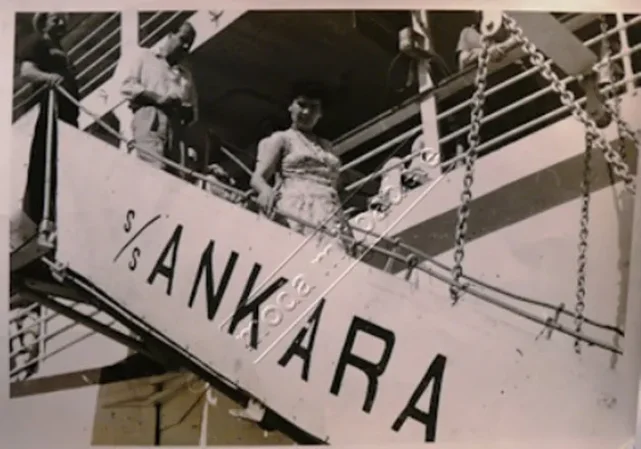
The novel’s principal setting—a steamship plying its route in the immediate aftermath of World War II—ferries both cargo and passengers, a typical vessel of its time. Back then, while the Turkish Maritime Lines reopened routes to the battered ports of the Mediterranean, ships like the S/S Adana and S/S Ankara traveled from Naples to Marseille, from Cyprus to Genoa. Everyone, in their own way, sought means of survival. Slipping contraband goods into suitcases or smuggling small items ashore was almost a second occupation for seamen of that era.
In the midst of this commotion, Attila İlhan deftly pins each character onto our lapel, breathing a fragment of his soul into every one. The novel’s introduction begins with Yakub narrating events. His candid, streetwise voice—steeped in sweat and dust—reveals an assortment of illicit goods smuggled onboard: delicate silk scarves, carton upon carton of American cigarettes. These lines capture a sense of mounting anxiety and excitement, like a sharpened scalpel incising into the narrative, as the ship draws closer to Istanbul:
“I’m not the only one getting the jitters as we approach Istanbul. The stoker, the deckhands, the bosun—like a pack of small-time grape merchants—roam back and forth. And that rascal Adil, our greaser? When we were in Naples, I said to him, ‘Why on earth do you need so many silk shawls? Did your father wrap your mother’s neck in silk shawls?’ He got mad at me. And it’s not like he bought just a handful—he bought a hundred of them… Now that we’re nearing Istanbul, everyone’s complexion turns pale.”
Amidst the deck’s commotion floats the specter of dazzling blonde passengers—a few of them so captivating that one can almost feel the crew’s collective heart skip a beat. Rose-Marie ranks among the ship’s most enigmatic figures, a woman Hasan occasionally grows close to, though her aura remains steeped in mystery. What she says points to life’s suffocating cycle, cornering the spirit from all sides. Hasan’s stories, always heavy with this fog-like mood, hint that to Rose-Marie, he might be half-mad, for:
“…Those who think only of themselves wouldn’t work as stewards on a freight ship. They wouldn’t abandon everything they have or don’t have, winding up broke and penniless as ship hands… I gave up the lie of ‘loving humanity’ a long time ago. People only wear on my nerves…”
These words betray not just Rose-Marie’s, but Hasan’s own unrest—an inner storm that will not be stilled. He approaches Meryem, then shrinks away; he seeks out Ayhan, yet veers off; he brushes past Rose-Marie’s orbit, unsure if he should remain or flee. He is the “kamarot” who chooses to be a stranger even to himself, roaming aimlessly between dead-end alleys and ceaseless voyages. Once upon a time, he was close enough to the arts to spend two years at the Fine Arts Academy, only to leave half-fulfilled, having failed to find a true sense of belonging. Perhaps it is from this lingering unease that the desire for yet another departure never really leaves him.
Despite his restless soul, Hasan cannot escape Yakub’s plan for smuggling furs. Yakub longs for money, but at the same time, he seems too carefree to be weighed down by such concerns. Although they differ profoundly, they complement each other’s missing pieces. We trail them through the mysterious, cavernous passages of the Grand Bazaar in Istanbul, in search of a certain Nubar—a furtive fur-repair man. Rumor has it, however, that Nubar has disappeared, possibly arrested. Leon, who might have taken Nubar’s place, is consumed by his own plot to flee to Palestine, going so far as to feign ignorance of both Hasan and Yakub to avoid legal trouble. The growing enigma heightens the tension and despair within the story.
At this juncture, we encounter Hasan’s interior monologue. From his perspective, there seems no other choice than to conclude this smuggling scheme—trapped in an endless loop—by forging a new, albeit murky, alliance. Enter Meryem: Leon’s mistress and a prostitute, she agrees to help move the furs. She will receive the contraband and hand over the money. Hasan goes along with the plan but senses in her another potent allure. In meeting Meryem, some fresh storm stirs in Hasan’s mind and heart.
All the while, Hasan’s spirit remains in a perpetual swirl of rebellion and yearning. He yearns to become the “sokaktaki adam,” the man of the street. Yet it’s more than a mere wish; it’s a colossal identity crisis. Through Hasan’s voice, Attila İlhan paints a striking portrait of that “man on the street” on another level of the narrative:
“I am the Man on the Street. Wandering here and there, I catch your attention. Perhaps you have hated me, or maybe you’ve liked me once or twice. One night, long after everyone’s asleep, a person passes by whistling in the street—I am that person…”
This man of the street sometimes quietly sides with the government; sometimes, he’s the cry of the opposition. He might vanish wordlessly into the darkness of the alleys. He defies a single identity or a single cause, too complex to be captured by one label. With every breath Hasan takes, Attila İlhan awakens that fiery presence of “the man on the street” who dwells within us all.
When the ship’s crew sets foot in Istanbul, their first night ashore provides one of the novel’s most striking moments. There is a custom for single sailors, conveyed by Yakub’s familiar drawl:
“— Where do single seamen spend their first night?
— You already know.
— Where exactly?
— There.
— Number twelve. With Melâhat. Yakub’s Melâhat at number twelve…”
Such lines mirror the lives of those cast outside social norms, evoking the bittersweet flight from everyday dread. A swirl of motives converge: the promise of money from smuggled fur, Hasan’s unresolved loneliness, Yakub’s simple pleasures, Meryem’s subterranean existence, Leon’s desperate fight for survival. All revolve in the same orbit.
Eventually, the narrative baton shifts to various characters, each telling fragments of the past and the future—through confessions, through their own streams of consciousness. We discover Yakub’s unassuming nature (though he remains fearless about pocketing a share of every deal), Ahmet’s calculating outlook (a man solely driven by profit), and Leon’s treachery (exposing everyone for his own salvation). Hasan stands in the midst of these swirling voices, torn between Meryem and Ayhan, burdened with a soul that’s grown numb. At last, Attila İlhan seals Hasan’s fate dramatically. Hasan, dying from a street brawl, utters his final words to the person by his side:
“These sidewalks are sticky, foul. All around us, onlookers’ shoes shuffle by. I hold his hand. Life has already drained away…
Finally:
— Tell her, he whispers, tell her I’m gone!
— All right, I say, which one?
— Phone her, say I’ve died.
— You’re not dying…, I want to say, Hasan!
— Fool! he snaps. Promise me you’ll call.
— All right, I say, but which one?
Suddenly, he shudders. His head falls back.”
These lines, laced with the somber stillness and inescapable darkness that frequent İlhan’s poetry, descend upon the novel’s atmosphere. As Hasan asks, “Which one?”—Meryem, Ayhan, or maybe Rose-Marie?—the question resonates in the reader’s mind; even as the book closes, his internal struggle remains. And so, too, does that query echo in all our lives: “Which one must I call?”
Meanwhile, İlhan doesn’t merely focus on personal crises or private sorrows. Through the “man on the street,” he comments on the country’s political and societal upheavals, using a brisk, unflinching voice:
“Sometimes I’m loyal to the government, sometimes I’m against it; one moment I’m a reactionary, the next a communist—and the police storm my home. …The coup arrests me, they drag me away. But bread never gets cheaper…”
In his stark depictions of poverty and helplessness, Attila İlhan illuminates social realities not by a camera’s lens, but with a flicker of light shining from the deepest recesses of the heart. Such passages steer the novel beyond mere intrigue or romance; they paint the tumult of Turkish politics, religious disputes, poverty, and despair in razor-sharp strokes.
Throughout Sokaktaki Adam, the perspective shifts from Hasan to Yakub, and from Ahmet to other secondary characters. Each recounts the events as though positioning the protagonists under interrogation. Indeed, we eventually realize that after Hasan’s death, the authorities thoroughly probe every link in this smuggling chain and the suspicious goings-on around it. Their recollections, their backward-glancing judgments, unveil how profoundly the “man on the street” motif embodies a questing spirit. Yakub’s guileless delight, Ahmet’s cold rationale, Leon’s duplicity, Meryem’s isolation, Ayhan’s disappointment, and Hasan’s silent wail—perhaps echoing Attila İlhan’s own anguish—all merge, forming a spiritual map as boundless as the sea, as brooding as the Istanbul night.
Reading this novel, one senses seeds of the poetry and prose İlhan would later pen. Sokaktaki Adam may well stand as his first grand experiment in dissecting the human psyche layer by layer. Its every sentence reverberates with the noise of individuals grappling for their identity and purpose. Some chase after money through illicit trade; others hunger for love or liberty. But they all share the relentless grip of that cold reality called “unhappiness,” descending upon them at the most unexpected times.
Ultimately, Sokaktaki Adam, true to its name, holds a mirror to “the street” itself. In that street, one may run into another Hasan—obstinate and lost—or a Yakub, laughing at life while clinging to the nearest handhold. The back corridors of the Grand Bazaar reveal the faces of those hustling contraband from Marseille or Naples. Each character, in one way or another, wrestles with the city, the past, and their own reflection.
In every line, Attila İlhan conjures the same breezes swirling through his poetry—by turns wild, melancholic, and fiercely impassioned. Perhaps that is why Sokaktaki Adam retains a haunting freshness even now. The man on the street remains a furtive phantom that endures in every shifting age: sometimes a shadow we ignore at our feet, sometimes our own likeness staring back in a mirror.
In short, Sokaktaki Adam is the novel of “a man searching for himself,” of a spirit who “tastes life through illicit channels while hiding from every truth it holds.” Each character represents a shard of that broader mosaic, and even when the novel ends, they leave behind a lingering twinge of longing. It is a story of loneliness, despair, and yet, of stubborn perseverance. For this reason alone—despite all its twists and muddled passages—it strikes the reader’s heart, stirring emotion and compelling reflection. Because in some small way, we all pause to listen to that whistling figure in the street, suspecting it might be our own voice echoing back at us.