

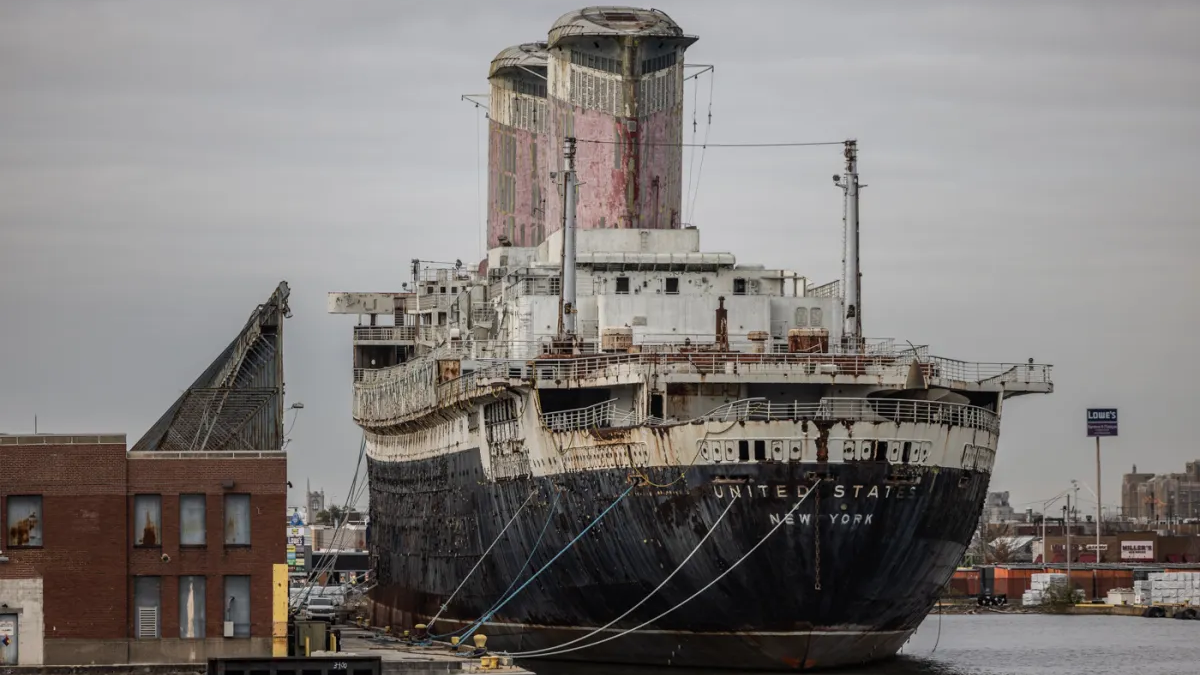
The seeds of the idea to build a cruise ship like the S.S. United States – a cruise ship capable of regular service – were sown by the U.S. Government in 1946. Until that time, the United States had relied on British ships such as the RMS Queen Mary, RMS Queen Elizabeth, and RMS Aquitania to transport American military troops to various parts of the world. Therefore, the U.S. government decided to invest in fast, luxurious ships capable of regular service that could be used for military purposes when necessary, such as the Mauretania and Lusitania, and thus the idea of the United States was born. The famous shipbuilding engineer of the time, William Francis Gibbs, was commissioned for the construction and design of the ship. With its red, white, and blue double smokestacks and delicate silhouette, the ship, measuring 300 meters (30 meters longer than the Titanic), had a capacity of 1928 passengers and 900 crew members, including 395 cabins and 14 first-class suites.
William Francis Gibbs made everything on the ship fire-resistant to protect against fire, and no wooden furniture was used on the ship except for pianos. During the trial voyages in June 1952, according to later obtained secret records, it reached a speed of 38 knots, and on its maiden voyage from New York to Le Havre on July 3, 1952, it achieved a service speed of 36 knots, earning the title of the fastest ship to cross the Atlantic. In short, the S.S. US was, in every aspect, the flagship of the United States, a source of pride. It was the most significant commercial vessel built in the U.S. and sailing under the U.S. flag. Between 1952 and 1969, the S.S. US crossed the Atlantic 800 times, but due to the introduction of jet passenger aircraft in 1958, maritime transport, even partially, ceased to be the favorite travel method for passengers, and sea tourism faced economic problems for the first time in 1960. After 1960, there were continuous financial issues with the Federal Government. In 1964, the sister ship S.S. America, which suffered a significant loss, was sold to a foreign entrepreneur, while other regular service ships of the time, France, Queen Mary, and Queen Elizabeth, were shifted to cruise services instead of regular services. Finally, in 1969, the S.S. United States was left to rust at its mooring port in Philadelphia. Changing living conditions led people to prefer fast air travel over luxurious, expensive, and comfortable journeys.
Speaking of the S.S. America, let's talk a bit about its life. The troubled life and end of the S.S. America, the first flagship of the United States, were even more tragic and shameful than that of the S.S. US. Launched in August 1939, the ship's keel was laid in 1938, and the design and construction tasks were again assigned to William Francis Gibbs. It made its maiden voyage on August 10, 1940, carrying 1202 passengers and 643 crew members from Southampton to Piraeus, and on its return to Australia via the Suez Canal, it traveled through the Pacific to Panama and Miami. During World War II, the ship was transferred to the Navy for the transportation of U.S. troops, undergoing significant modifications and equipped with some defensive weapons, increasing its passenger capacity to 7678. During this period, it transported 350,000 military personnel and prisoners of war, holding the title of the ship that carried the most military personnel during World War II. Throughout its sailing life, the ship changed ownership and names many times, including United States Lines, Greek Chandris Group, Venture Cruise Lines, again Chandris Group, followed by Intercommerce Corporation, and Silver Moon Ferries. Finally, in 1994, while being towed from Piraeus to the beaches of Phuket, Thailand, the ship broke free from its moorings and crashed into the rocks on the western shores of Fuerteventura Island in the Canary Islands, and its remains have now completely disappeared, becoming a natural reef on the seabed.
Let's return to our S.S. US. They must have learned from the tragic end of the S.S. America, as the U.S. Maritime Administration and the U.S. Government strictly prohibited the sale of the S.S. US abroad or its operation under a foreign flag. Even when Norwegian Cruise Line wanted to buy the ship in 1976 and rename it S.S. Norway, this did not happen, so they purchased the S.S. France and renamed it S.S. Norway.
In the meantime, the S.S. US also has a route to Istanbul. In 1992, while the ship was owned by American businessman Fred Mayer, it was towed from Philadelphia to Istanbul to remove the asbestos used as insulation material and to carry out improvement works in Turkish shipyards, with the hope of resuming its voyages thanks to the efforts and initiatives of the well-known Turkish and International Maritime businessman Kahraman Sadıkoğlu. However, due to the inability to obtain the necessary permits as a result of pressure from environmentalists, the efforts were in vain, and the ship was first sent to Ukraine, and when those efforts also proved fruitless, it was towed back to Philadelphia and moored at the dock on the Delaware River.
Four U.S. Presidents, jazz master Duke Ellington, poet and writer Sylvia Plath, Bob Hope, Princess Grace, Salvador Dali, Rita Hayworth, the Duke and Duchess of Windsor, and many other famous wealthy individuals were hosted on transatlantic voyages by the S.S. United States, which finally departed from Philadelphia, where it had been moored for a long time, towed by the tug Vivik #6 to the port of Mobile, Alabama. Since the final destination of the S.S. United States' last voyage would be the seabed, hundreds of people who had traveled on the ship and had memories associated with it could not hold back their tears, caught in a bittersweet moment. They were sad because the S.S. United States was embarking on this voyage to never return after being cleaned and prepared for its eternal journey in Mobile, but they were happy because it would create the world's largest artificial reef at a depth of 55 meters in the sea off Fort Walton Beach, its destination.

If you notice, the fates of the S.S. America and the S.S. US are somewhat similar, but one ended tragically while the other reached this conclusion in a safe and controlled manner with a fitting ceremony. In other words, it would dedicate the rest of its life to divers and underwater sports enthusiasts. This depth is considered quite a challenging dive for many amateur divers, but a profile 300 meters long and 55 meters high on the seabed will also provide quite an exciting viewing opportunity. The ship arrived in Mobile on March 3, 2025, and is being held here for the necessary cleaning and recovery work to be done. These processes are expected to take about a year in the U.S. Another exciting event is that in addition to the artificial reef displayed on the seabed in Okaloosa County, a museum is being built where materials and parts related to the ship will be exhibited on land, and a series of exhibitions and conferences focusing on the ship's glorious history will be organized.
Let’s briefly mention the Vivik #6 tugboat that towed the S.S. United States on this final voyage. Vivik #6 is a very important special ocean-going tugboat selected for this task. It is 43 meters long, has two locomotive engines producing a total of 5,750 HP, and is a tugboat that can be operated from two bridges with a capacity of 500 tons of fuel, 100 tons of oil, and 200 tons of ballast, having towed the largest vessel in the history of the S.S. United States.
I wish you peaceful years in your new position and new mission, Farewell S.S. United States.