
Photo: DenizHaber
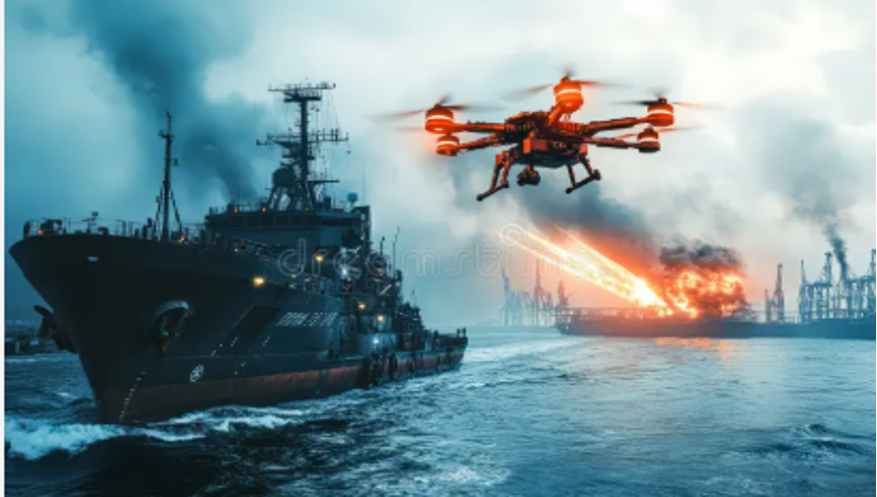
Photo: DenizHaber
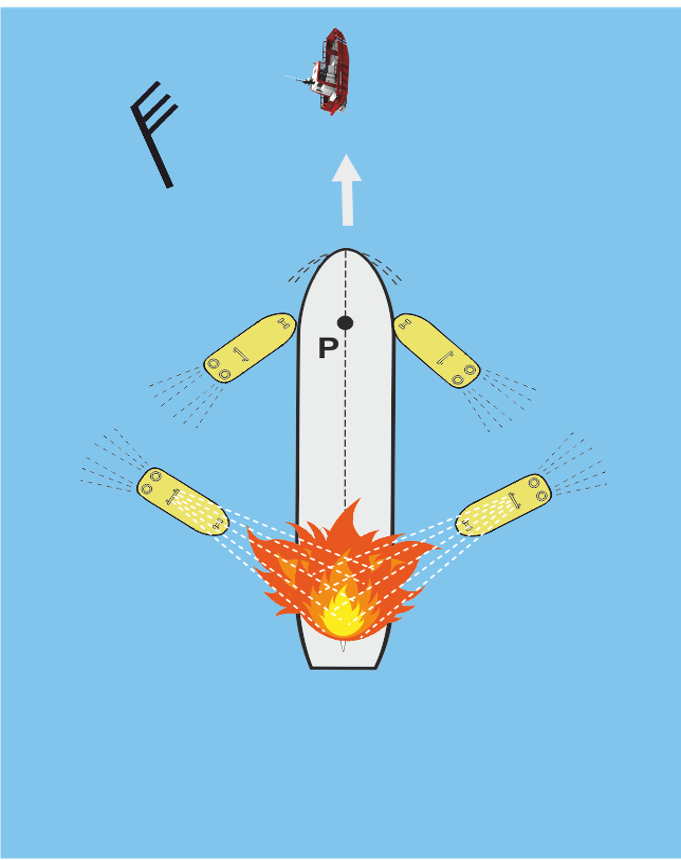
Photo: DenizHaber
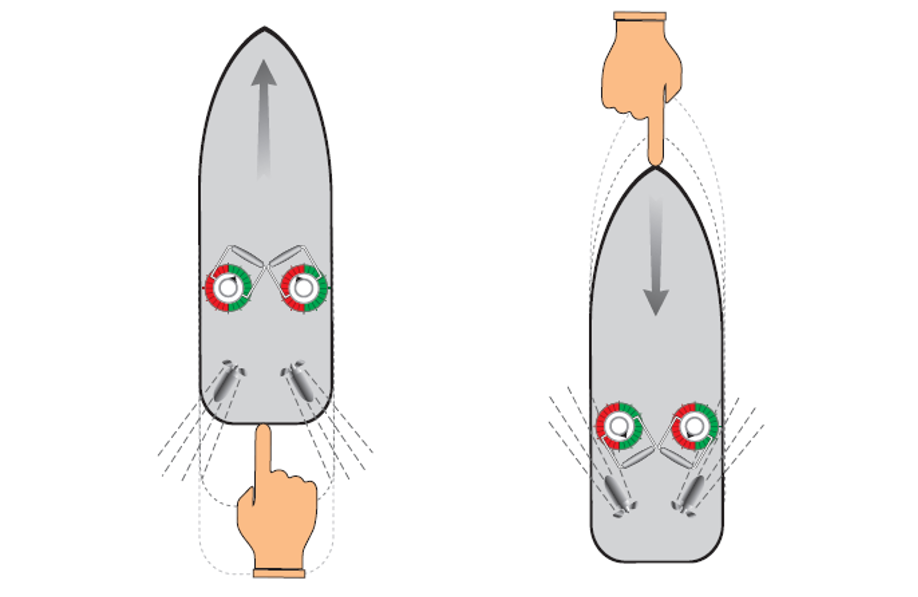
Photo: DenizHaber
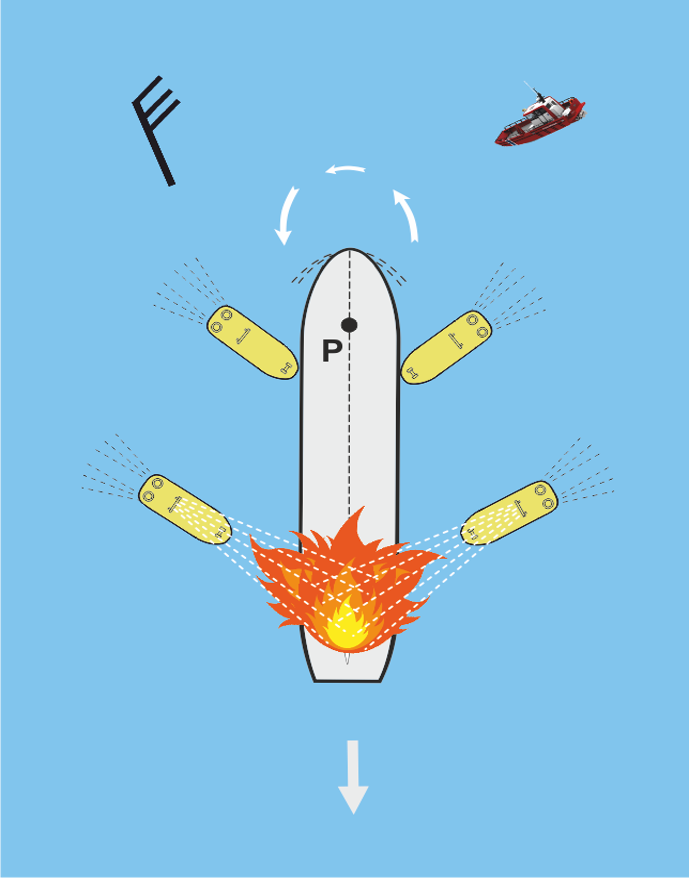
Photo: DenizHaber
The tugboats that first respond to ship fires may be those equipped with water and foam jet systems, used in port maneuvers or escort services, or they could be specialized tugs dedicated solely to fire intervention.
The different class notations these tugs receive, based on the capabilities and capacities of the equipment they use for fire intervention, are explained in the table below.
Photo: DenizHaber
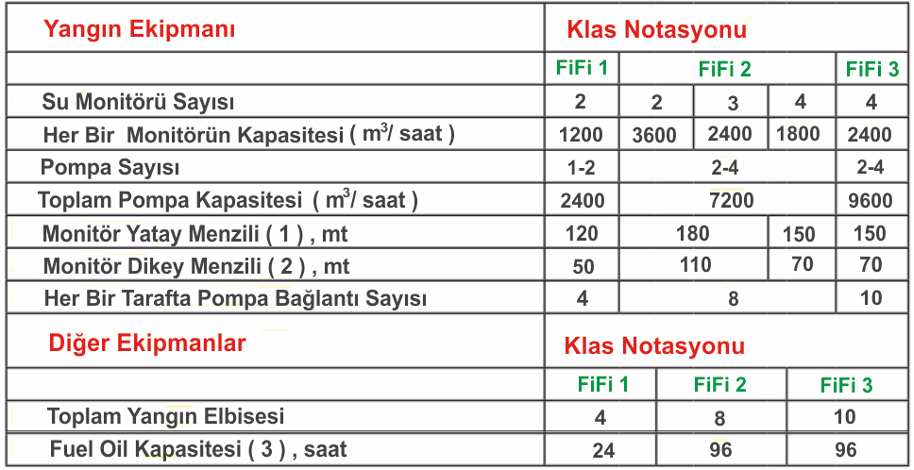
Table-1: Required equipment and capacity according to class notation
Considering these features, it will be evident that tugboats with FiFi 1 notation have insufficient water column height capacity for fire intervention on large container ships and ULCC tankers. Tugboats with FiFi 2 and FiFi 3 class notations are much more effective in intervening with larger vessels in terms of pump capacity and horizontal and vertical range.
Moreover, all tugs with fire notation are generally high-maneuverability tugs, such as ASD, Voith, and Rotor tugs. Thanks to their high maneuverability, they can be instructed to approach the distressed vessel for effective cooling based on the current situation of the fire.
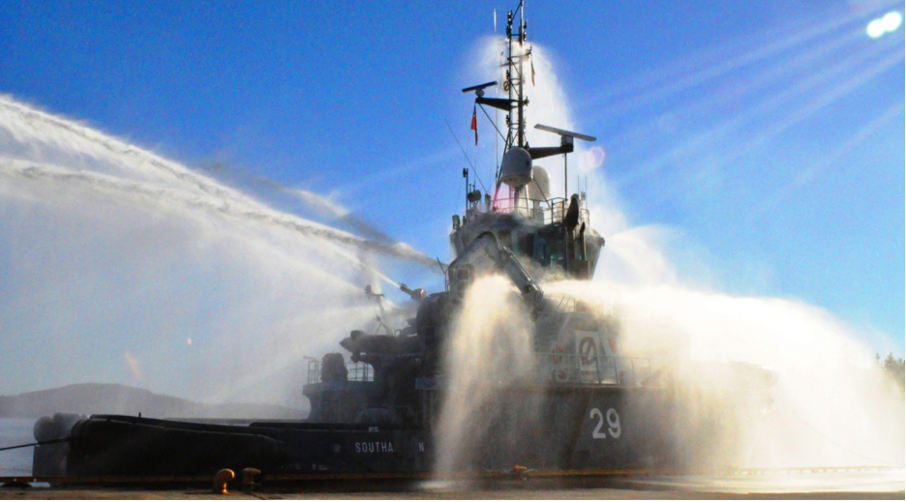
In such cases, the tugs that will make close interventions are equipped with a system that activates a water spray (water curtain) on the hull of the tug, all deck levels, and particularly in the bulwarks of the engine room, where there is a risk of explosion, to avoid being adversely affected by the heat at the accident site. Tugs used for this type of close intervention always have a contingency plan to quickly distance themselves from the accident site in case a negative and dangerous situation arises.
Figure-1: A tug operating water monitors and cooling system at full capacity
In the past, fire monitors were generally mounted above the bridge level to increase range capacity. However, it has been understood that the water mist created during fire intervention with water monitors (water monitor poisoning) significantly restricts the visibility of tug captains, adversely affecting their situational awareness. For this reason, nowadays, water monitors are generally mounted at or slightly below bridge level.
It is crucial for tug captains, chief engineers, officers, and all personnel to be trained and certified regularly according to a detailed, routine plan for intervention in various types of fires. Unfortunately, there is currently no periodic in-service training regulation for tug captains and personnel.
The fire intervention training can be shaped based on the most important issues, including but not limited to the following:
- Command and control, task distribution - Communication protocol between the ship and the distressed vessel - Communication protocol with surrounding elements such as helicopters - Cooperation with other rescue and assistance units in the vicinity - Fires to be intervened in the port - Fires to be intervened at sea - Optimum use of water and foam monitors - Optimum use of additional fire equipment - Tug maneuvers in fire situations and escape scenarios in case of danger - International assistance procedures & legal framework - Basic elements of ship stability
Particularly, basic knowledge of ship stability is crucial in rescue operations. When intervening in low GM value container ships, if the water sprayed from the monitors accumulates above the center of gravity of the distressed vessel, it can lead to negative GM, causing the ship to capsize.
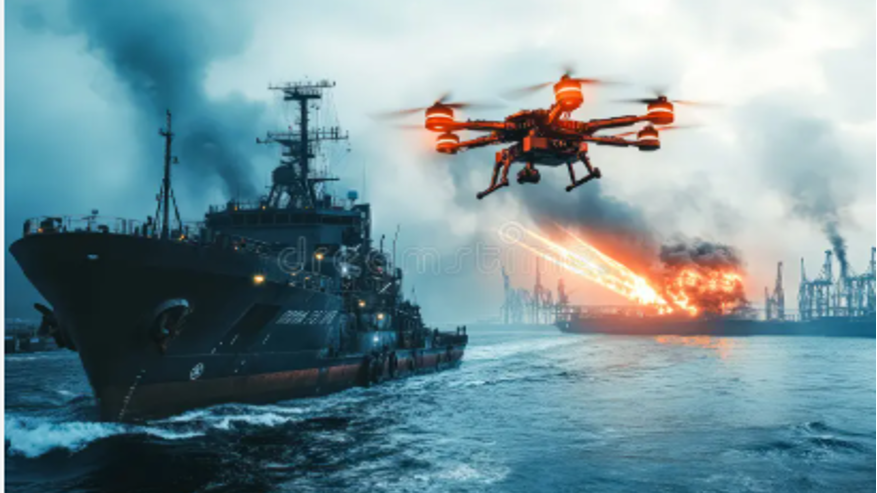
Figure-2: Use of drones in ship fires
Similarly, if the water sprayed to extinguish the fire accumulates in the ship's holds, it can gather on one side depending on the ship's list, causing the vessel to lean and lose buoyancy. Drone technologies are effectively used in directing the water sprayed by tugs to the main center of the fire. Live images reaching the command center allow experts to evaluate incoming information and guide the tugs in the most accurate manner in terms of position and intensity.
Each national administrative authority has different methods in fire coordination, but they are quite similar in principles. One of these elements is the on-scene command officer who works alongside a central command center. The on-scene officer relays the latest developments to the command center along with their recommendations. The scene, drone, meteorological data, ship traffic information, etc., are evaluated with the help of experts, allowing the coordination center to manage all units fighting the fire in the most optimal way.
As soon as information about the emergency situation is received, a general risk analysis is conducted, and when the tugs and other units that will intervene in the fire arrive at the scene, a last-minute risk analysis is performed with the most recent information. All these procedures are carried out by experienced experts in a manner that will not delay the fire intervention.
The general risk analysis roughly includes the following elements:
- The location of the burning ship (port, anchorage, canal, pilotage area, open sea conditions, etc.) - Whether there is hazardous cargo on the ship and the nature of the cargo on nearby vessels - What type of fuel the ship's engines use - The type of fire and which part of the ship the center is located in - Whether there are any casualties or injuries on board - Whether there is a risk of the ship's stability, capsizing, or sinking - What resources are necessary for fire intervention and how quickly they can arrive - Whether there is a risk of environmental pollution
The emphasis on the type of fuel used by the distressed vessel in the above items has led to the introduction of several new procedures in fire-fighting techniques today. To explain the main reason: After the 72nd meeting in 2018, the International Maritime Organization (IMO) declared its first strategic goal for reducing greenhouse gases. Following the 80th session in 2023, the same committee announced its policy on reducing greenhouse gases emitted from ships:
In line with the goal of reducing greenhouse gases from ships to zero by 2050, decisions were made to reassess developments in this direction in 2030 and 2040. In accordance with these decisions, shipowners and operators are faced with the obligation to integrate technologies and fuel types that qualify as zero greenhouse gas into their systems within a certain timeframe.
As a result of this trend, some fuel types listed below have started to be used more widely in maritime trade transportation:
- Liquefied natural gas (LNG) - Liquefied petroleum gas (LPG) - Processed vegetable oils & fatty acids
As of May 2025, the number of ships using alternative fuels is 2,224, which constitutes only 2% of the global fleet. However, 52% of the ships currently under construction are being built to use alternative fuels. Each of these ships using alternative fuel has different fire-fighting scenarios.
All these different approaches should be detailed in the written instructions published on this subject; the training programs for maritime personnel who will intervene in fires should also be expanded and detailed. Providing more detailed information on this topic exceeds the purpose and scope of this article.
Returning to our main topic, it is known that in some past ship fires, serious problems arose concerning distressed vessels that needed to be urgently moved to a safer maritime area due to high temperatures and life-threatening situations.
Figure-3: Moving the distressed vessel without tying a line
Let’s try to explain what methods can be followed in this regard using the figure provided above: It is assumed that there is no possibility of giving a tug line to the distressed vessel.
Four tugs are intervening in the vessel that has caught fire in the living quarters. The tugs at the stern are spraying water towards the fire center from a safe distance, taking the wind as much as possible behind them. The two tugs at the bow are working at an angle of approximately 45° towards the bow to move the burning vessel towards a safer area. As they both give way, the turning moments are zeroed, allowing the vessel to move forward.
A pilot boat or a marine vessel with similar characteristics is positioned at the bow to instruct the two tugs to increase or decrease their speed to ensure that the distressed vessel does not deviate from its planned route or can change its course safely. For example, at a certain stage of this maneuver, if the vessel needs to change course to starboard, the port tug is instructed to increase its speed while the starboard tug is instructed to minimize its speed without changing its engine RPM position. As a result of this maneuver, the vessel begins to turn to starboard while moving forward.
To maintain a certain course, the starboard tug is instructed to increase its engine RPM to reduce the turning speed, while the port tug is instructed to minimize its speed to maintain its position. As the vessel approaches a certain course, the engine RPM of both tugs is fixed at a certain level proportional to the preferred forward speed. Small course changes can be made while keeping the engine RPM differences of both tugs to a minimum. Essentially, this maneuver is similar to the maneuvers performed by azimuth thruster vessels when exiting a narrow area, applying steering effects through changes in engine RPM.
Figure-4: Maneuver performed by an azimuth thruster vessel with a similar setup
If the distressed vessel needs to be stopped due to an unforeseen navigation obstacle or danger during this maneuver, the tugs at the bow will take a position of 45° towards the stern and apply resistance to stop the vessel. The stopping distance of the vessel will increase or decrease inversely proportional to the engine RPM of the tugs.
Figure-5: Emergency stop maneuver with tugs
One important point to note here is that the tugs must have taken a resistance position from a point close to the pivot point (P) of the vessel moving forward. Thus, the small differences in actual engine RPM arising from the individual characteristics of the tugs do not lead to significant course deviations due to the short lever arm of the turning moment.
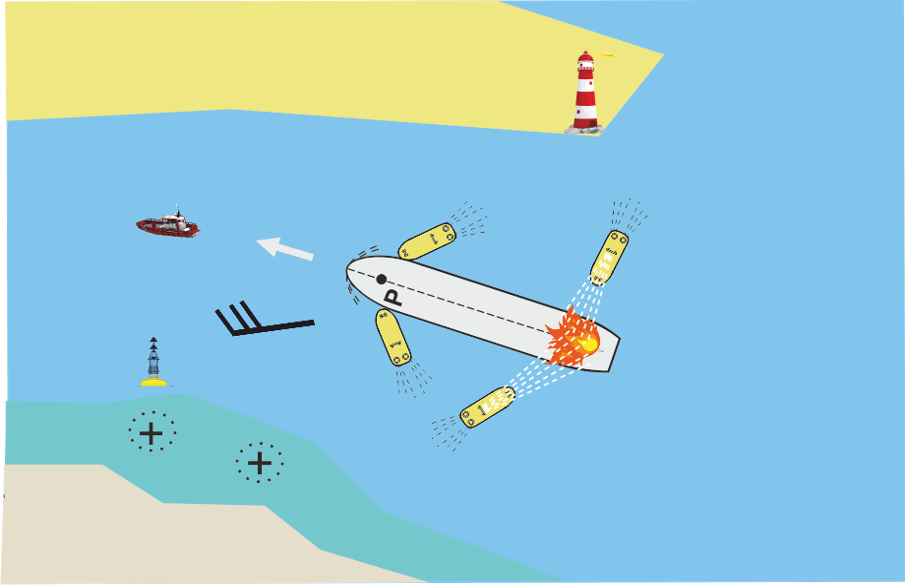
When moving the distressed vessel from a critical area to a safer area, additional precautions can be taken to minimize risk when faced with a relatively narrow waterway, obstacle, etc. For example, consider the following figure:
The distressed vessel will pass through a strait marked by a north cardinal buoy on the port side. During this time, the local wind affecting the vessel is coming from the port shoulder.
Figure-6: Safe maneuver with tugs in a narrow channel
Since the distressed vessel is moving forward, its pivot point (P) is naturally towards the bow. In this case, it is expected that the wind will exert an effect that turns the vessel towards the port side. Of course, the possibility that the wind may change direction and increase its strength near the land in such a narrow passage must also be considered.
As a precaution, the tug on the port side at the stern, which is intervening in the fire, approaches the vessel at a slightly closer angle. If there is an unexpected tendency to turn to port, the starboard tug at the stern will push from a safe point, correcting the situation without causing delay. In such a case, the tug will carry out this operation while staying as much as possible on the windward side compared to the fire center. Otherwise, the smoke, toxic gases, etc., mixed with the fire could jeopardize the safety of the tug personnel.
The possibility of the vessel turning to starboard due to an unexpected reverse current or sudden change in wind direction in the same channel should not be overlooked. If such a situation develops, the tug intervening in the fire on the port side will also assist in correcting the situation by pushing from a safe point on the port side, following a similar logic.
Keeping in mind the critical navigation areas where millions of people live, especially in the Turkish Straits, it would be appropriate to revise and update the fire intervention guidelines and instructions for ships to be more comprehensive and detailed in light of recent developments.
Regulations concerning port tugs should be reviewed in light of criteria such as the characteristics of the terminals in the area of operation, whether they include liquid cargo, tankers, natural gas, etc. Based on the risk criteria of the serviced area, it should be clearly stated in the relevant regulations or written instructions how many minimum tugs with FiFi 1, FiFi 2, or FiFi 3 notation should be present in any given area, considering not only the maneuvering capabilities or towing strengths of the tugs but also their fire-fighting features.
In Turkey, to serve as a captain on tugs under 500 GT, it is sufficient to have a limited captain's license. To serve as a captain on tugs between 500 GT and 3000 GT, one must have a near-coastal captain's license defined for this tonnage range. Although the time spent at sea to obtain a limited captain's license is considered quite sufficient, there is a significant difference in qualifications compared to practices in other countries.
The Regulation on Seafarers and Pilot Captains (2024), which governs these issues, does not treat tug captaining as a separate category, nor does it require any conditions for serving on a tug in the licenses needed to perform this job. This is particularly regarded as a significant deficiency since this aspect is not present in the relevant legislation. However, considering the nature of the service performed on tugs, the safety elements, and the inherent dangers of the job, it contains many different characteristics compared to other maritime services.
In Turkey, there is no educational module regulated by current legislation regarding the basic qualifications, characteristics, and practices of the profession for serving as a captain on tugs, whether under or over 500 GT. Given the nature and importance of the job, it would be a significant improvement to establish a training module related to tug services, supported by simulation, lasting at least one week, and make it mandatory for candidates, regardless of whether there is an examination or not.
Tug captaining is not defined with a separate emphasis in our legislation, nor is there any periodic in-service training available. As explained above, tug captaining is a very important profession that requires not only port maneuvers and escort duties but also fire-fighting training and skills. The decisions made by the IMO regarding the increasing prevalence of alternative environmentally friendly fuels have made fire types and fighting methods more detailed and intricate. It is vital that these skills be taught through periodic in-service training with new regulations included in the legislation.
Maneuvers to evacuate distressed vessels from critical areas in emergencies should be supported by simulation training and included in the official training programs and written instructions of the institutions.
Sincerely, Kpt. Alpertunga Anıker
Please pay attention to the comment writing rules below when commenting or responding to a comment. Do not make comments that violate the laws of the Republic of Turkey, or that praise crimes or criminals. Do not use profanity, slang, insults, hate speech, or incite hatred.
Source: www.denizhaber.com