

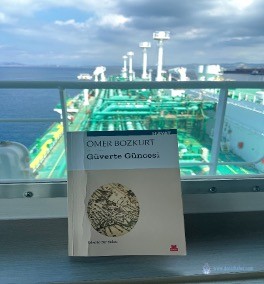


While browsing through the maritime publications of a popular book site, I came across Prof. Dr. Ömer Bozkurt's book titled “Güverte Güncesi-Şilepte Bir Yolcu” (Deck Diary - A Passenger on a Schooner) (Kırmızı Kedi Yayınevi, February 2018, Istanbul, 268 pages). The promotional description of the book, published in 2018, mentioned that it recounts the memories of a journey made by a passenger on a cargo ship in 2006. Although I enjoy reading memoirs written about maritime experiences, this was the first time I encountered this particular book. When I examined the book's description, I was reminded of journalist Faik Sabri's book “İstanbul’dan Londra’ya şileple bir yolculuk” (A Journey from Istanbul to London by Schooner), which he created by compiling his newspaper columns about his journey from Istanbul to London by schooner in 1933. I had discovered this book through an article shared by Kpt. Uluç Hanhan. I would like to present my notes taken while reading “Güverte Güncesi-Şilepte Bir Yolcu” along with my own thoughts for the exploration of maritime and book lovers.
The title “Güverte Güncesi-Şilepte Bir Yolcu” offers a beautiful presentation of the book's content. The author, Ömer Bozkurt, who defines himself as a passenger, shares his journey aboard the cargo ship IRMA, which began in 2006 from the port of Ijmuiden in the Netherlands, lasted 26 days, included a crossing of the Atlantic Ocean, and ended at the port of Duluth in America, almost as if he were narrating his own diary to the readers. The language used by the author, who refers to himself as a passenger, and his familiarity with maritime operations, along with the details of the operations that took place on board, make the book easy to read even for those who are not sailors. While reading the book, I felt as if I were a passenger on the IRMA, as stories where I can place myself in the shoes of the main character have always intrigued me.
The crew of the 200-meter-long bulk carrier IRMA, which flies the flag of South Cyprus, is entirely Polish. As I read the book, I understood that the author's journey on the IRMA was not his first maritime experience, as he had previously traveled on two different ships. The author shares his reason for choosing to travel on the IRMA in a conversation with the ship's captain, stating in his own words (p. 199): “I did not embark on this journey to go to America, to see this or that city in America or Canada. What mattered to me was sailing in the Atlantic, followed by seeing the St. Lawrence Waterway and the Great Lakes.” The passenger's main plan was to participate in the return voyage to Europe, which was still uncertain, after discharging the cargo taken from Ijmuiden at the ports in the lakes region of Canada and America. However, due to the lack of a Canadian visa, he had to cut his journey shorter than planned and leave the ship early. Nevertheless, we can say that the passenger achieved his goal, as we can clearly understand from the emergence of this book. I believe that the author's ability to produce such a work despite the relatively short time spent on the IRMA stems from his identity as a researcher and observer.
Some anecdotes in the book that caught my attention and demonstrate the author's keen observational skills are as follows:
- He describes the intricacies of loading rolled steel at the loading port of Ijmuiden and how it is stowed in the hold.
- He meticulously depicts the seating arrangements in the galley (kitchen) and the officers' mess.
- His detailed account of how the gangway was collected by the ship's crew during departure, without skipping any steps, helped me visualize this process, which I am quite familiar with due to my work.
- He narrates the fire drills and abandon ship drills he participated in with such detail that it could serve as a drill report. He notes that the lifeboat seats were not properly secured and were intertwined with those of the adjacent seats, which prevented him from fastening them, making an important observation as an outsider regarding the ship's crew. I have had similar observations during my time working at sea; usually, those straps are left in disarray during drills, and during the next drill, crew members often check with their neighbors whether they took the strap from the adjacent seat.
- From the details shared by the passenger, we learn that compass error calculations were not performed during the duration of the voyage on the IRMA. Here, the passenger catches this oversight almost in the manner of a port state control.
- Another deficiency he observed was that after the pilot was taken on board during the St. Lawrence transit, the Hotel flag was not hoisted, and he reminded the officer on watch about this. The passenger admits that his concern was not merely about whether the flag was in place but rather that he wanted to take a photo of it being hoisted.
- The passenger participated in the anchoring maneuver at the port of Montreal and shared the details of the anchoring operation.
- Starting from the entry and berthing of the ship in the locks of the Great Lakes, the passenger also provided detailed information about the working mechanisms of the lock systems and shared maps and photos he took of these locks in the book. He likened the maneuver of bringing the ship into the lock to “threading a needle” and made beautiful comparisons by stating that the ship was moving toward the lock “at the speed of an old man dragging his feet.”
- The passenger shares beautiful historical information and notes about the exploration and history of the area being navigated. With this feature, we can also say that the book has a historical aspect. Although the passenger made detailed preparations before the voyage, he regrets not having obtained a large-scale land map due to his inability to find the names of land settlements on maritime charts and makes a self-criticism.
Other notes I took while reading the book and quotes that caught my interest are as follows:
- The passenger stayed in the armature cabin located opposite the bridge during his time on the ship. On the first day of his journey, he could not sleep well due to being unaccustomed and made this comparison (p. 68): “As if he were really on a road trip, if one lets go of oneself while sitting, the bus or truck jolts back and forth just like in a stuttering vehicle.” During navigation in shallow waters in the lakes region, the reduction in the depth of the water beneath the keel increased vibrations on the ship, waking the passenger from his sleep. He also makes this beautiful comparison (p. 193): “the ship was shivering like a high-fevered patient on watch.”
- Throughout the voyage, the passenger enjoys the sea view, rainy weather, or the sky over the ocean by taking his chair out to a sheltered spot on the decks surrounding his living quarters. I underline this striking observation he made about sailors (p. 96): “For sailors, being in this or that interesting geography of the earth is not very important. They have their daily tasks to attend to.”
- I was intrigued by the term “kutuyük gemisi” (box ship) used by the author for container ships. I had not encountered this widespread usage before.
- The passenger first sets foot on land after 14 days. He notes that this situation leads to different sensations and admits that as he steps onto the lower platform of the gangway, he feels as if he might not be able to walk. When he goes ashore at the port, he enjoys taking long walks, visiting historical sites in the area, and browsing bookstores.
- The passenger's observations regarding the adjustment of the time difference according to Greenwich Mean Time (GMT) during the voyage also caught my interest. He shares this sentence about the time adjustment made on the ship (p. 53): “In many countries, like the implementation of daylight saving time, if ultimately a discretionary application is made, the captain is also making a discretionary application on his ship for work reasons.” Reading these lines brings to mind the ongoing debate in our country regarding the abolishment of daylight saving time.
I believe the passenger made appropriate and accurate observations about human relationships and psychology on the ship. He notes that the crew on the IRMA is apprehensive of the ship's captain and adds (p. 46, 47): “This is more than just a hierarchical respect that must be shown, even if it is not felt sincerely. The crew approaches the captain with a kind of anxiety, almost fear,” and “however, the personality of the captain affects the necessary distance and the type of mutual relationships. These relationships fluctuate on a spectrum between respect stemming from functional authority on different ships and hierarchical fear.”
In such a ship environment, even if operational problems do not seem to arise, the crew is not happy, and everyone only does what is required within their duties; awareness is closed, and no one makes an effort for more. A state of tension prevails, and the crew avoids unnecessary dialogues and expressing opinions outside of work.
I also find the passenger's observations about the ship's captain important, believing that this is something that managers need to pay attention to not only on ships but in every area of professional life (p. 130, 147): “He shows his distrust of the crew at every opportunity (referring to the captain),” “I see inconsistency in the captain's behavior. He seems to change his mind quite often. As if he is in doubt,” and “but I find it contrary that he does not avoid letting this be felt by others, especially the passenger.”
From the situation the passenger faced due to the lack of a Canadian visa, we also understand that especially in a confined space like a ship, good communication among people who have to live and work together is very important. Small problems can sometimes lead to more troublesome situations if not managed well. The passenger experiences similar difficulties in this encountered situation. Although he sees his situation as unfair, he explains it with these sentences (p. 141): “It seemed like there was nothing I could do but sulk. A ship's captain (even if one could seek justice against his unjust decisions through other means) was as authoritative during the voyage as Louis XIV, who said, ‘The State is me.’”
The greatest disappointment for the passenger during the voyage, aside from the visa problem, is the moment when the spiral notebook he had tucked under his seat fell into the sea while he was taking photos. Fortunately, although not in detail, he was recording a summary of his notes on the computer by the end of the day, so it was not a total loss. This is a situation that those who write and take notes can understand very well. After a while, a connection is definitely established between your writing file and your notebook or a file on the computer. It seems proportional to the effort put in.
Throughout the flow of the book, I noted some beautiful quotes from the citations and sources provided in the margins. The ones that caught my interest the most (p. 31, 107):
“In the life of a sailor, there is an independence that comes from being away from land; human passions remain on the shore; the only love and homeland between the world left behind and the world to be reached is the ship that carries you” (Chateaubriand, Memoirs - Memories Beyond the Grave).
“At sea, time and space are intertwined more than in any other human experience. Just marking the position of the ship on the navigation chart over the course of consecutive days clearly connects time and space.” (Robert Foulke, The Sea Voyager Narrative).
The passenger also had the opportunity to observe different pilot captains during the voyage, especially in the Great Lakes region. He notes that during the piloted navigation, despite the bridge being as wide as it is, the crowd creates a sense of unease, and therefore, he continues to observe the navigation from a corner without walking around too much. I would like to share the observations he made that I have highlighted:
- In one section, we see the passenger having a pleasant conversation with a Canadian pilot captain. Here, the pilot captain mentions the difficulties of working with some ship captains and the challenges of having two people command a ship with the following words (p. 161): “Some are more skilled than you, you say take command, they do not; some interfere with everything without knowing. I do not understand this man (referring to the captain of the IRMA). He is always in a state of anxiety; he tends to see the pilot as a harmful person. Everyone feels like they are working against him.”
- In another section, the conversation the passenger has with the ship's captain is interesting. Here, the captain likens the constant changing of pilot captains during the long piloted stretch to an old-time traveler changing horses during the journey and states that the pilot shows him how to jump over which ditch, how to navigate around an obstacle, or which shallow part of the creek to cross, emphasizing that all responsibility lies with him and that his legal responsibility does not disappear by taking a pilot.
- The passenger carefully records the maneuver commands exchanged between the pilot captain and the bridge team during the entry maneuvers into the locks in the Great Lakes. What caught my attention here was the commands for 10 degrees and 12 degrees for the rudder. I have never worked in the Great Lakes before, but the 12-degree command seemed strange to me. Because in maneuvers, rudder commands are generally used in multiples of 5 degrees. I suppose this was something specific to the style of the pilot maneuvering at that moment.
- The passenger notes that the pilot captain left the ship with the pilot ladder during the departure from the loading port, and in Canada and America, the pilot captain transfer was made by lowering the gangway. Although the passenger thinks this is a special security measure for North America, the actual rule is that if the ship's freeboard distance (the vertical distance from the water level to the ship's deck level) is below 9 meters, only the pilot ladder is used, and in situations above 9 meters, the transfer operation is carried out with a combination of the pilot ladder and the gangway.
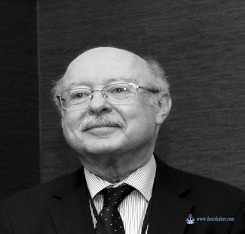
Prof. Dr. Ömer Bozkurt (www.omerbozkurt.com)
While reading the book, I postponed my deep curiosity about who the author was until I finished it. The biography on the introductory page does not provide very detailed clues about the author. The impression I formed about the author during my reading is that he is a classical music enthusiast who listens to Mozart and Bach and never parts with his notebook and camera. I also came to the conclusion that the author has a humble and modest character. We only understand that the author is a professor on page 77 during his conversation with the captain of the IRMA. The fact that the author shares photos he took during the journey but his only photo appears on page 196, at the end of the book, also increased my curiosity. After reading, when I visited the author's personal website (omerbozkurt.com), I rediscovered his passion for maritime, geography, and exploration.
Mustafa Sökükcü Pilot Captain mustafa.sokukcu@gmail.com
Source: www.denizhaber.com