

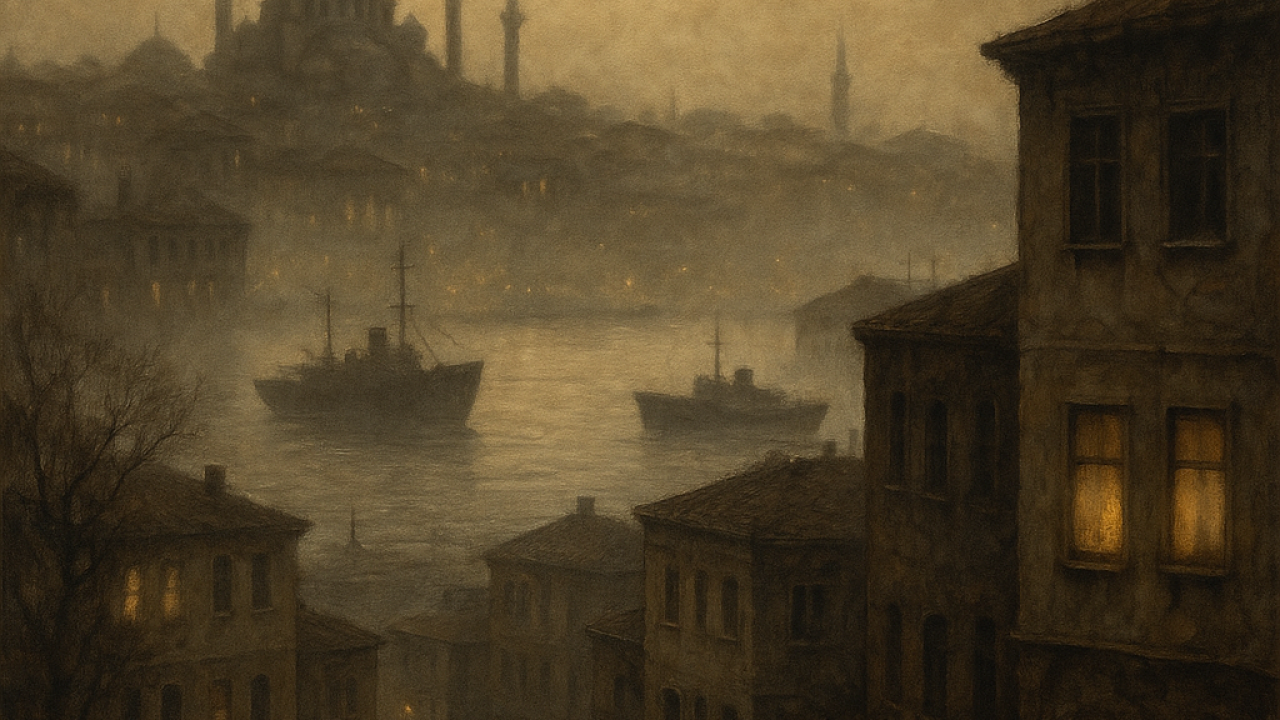
Sleep, let the moon grow, let the windows not fog You sleep, let the clouds sleep, let them not wake Let the lights not wake, let the windows not fog You sleep, let Istanbul sleep Let Karagümrük sleep, let Fatih sleep Let dreams grow on Atatürk Boulevard You sleep, let Istanbul not wake Let the ships not wake, let the windows not fog
Cibali does not wake, sleeping like a saint Hiding in the corners, eyes closed tight Lips locked, eyelashes tangled A scream disperses within its sleep Pupils dirty, shadows clingy Cibali fears its sleep will be disturbed Let the clouds sleep and grow, let them not wake Let the ships not wake, let the Golden Horn not fog
A sip of poison, Captain Selim's sleep He lost Beykoz, searching for it Under the Unkapanı Bridge in the Golden Horn Supposedly the ship is in Kadıköy, anchoring Diver İzzet has descended to the depths of his dream Pulling out a loaf of bread from twenty-five fathoms Fish have eaten İzzet's eyes But how deeply they sleep Let them sleep, you sleep, let no one wake Let Cibali not wake, let my heart not fog
Ticket clerk Şerif beats Control Şevket Breaking his glasses, cutting his brow Ink flows from Şevket's left eyebrow The windows close their eyes I am the driver, my hands are the driver I will make one more trip to Taksim The car should be pulled out from under the rain Tomorrow maybe I will fly into the sea from Tarabya Cibali sleeps like a tired prisoner, shadowy Let it sleep, let it not wake untimely Let the garages not wake, let the windows not fog
Cibali's sleep is awaited by giants, Istanbul is waiting The sleep of carpenter Serkis, the sleep of Ahmed They are sleeping like great furnaces, bustling From their jugulars, the stream of Kağıthane flows They grow in the dark with the majesty of a forest They hear the secret voices of the wind They hear its lullaby, its bitter lullaby Forty thieves enter their dreams Istanbul's bakeries enter, its restaurants Its counters enter, barber shops Clouds tear their hearts slice by slice They keep their hopes like a treasure Let them keep, let them sleep, let their hopes grow Let the moon grow, let the clouds sleep, let them not wake Let Cibali not wake, let the windows not fog
When Attila İlhan's verses found life in Ahmet Kaya's voice, it became a lament written for the soul of Istanbul. "Bitter Lullaby" is not just a song; it is the story of unfulfilled revolutions, unrealized dreams, and silently fading hopes. This lullaby is sung not to children rocked in cradles but to a city that grows weary even in its sleep.
Heraclitus said, "There is one world for the awake, and each sleeper returns to their own world." Attila İlhan, however, turns this proposition on its head: What if wakefulness is painful? What if the common world has become an unbearable burden? Then sleep becomes not an escape but a mercy.
What does the poet mean when he says, "Let Istanbul sleep"? Is it a consolation or a rebellion? Or is it a compassion veiled in pain, standing in an indescribable place between the two? Not wanting Istanbul to wake may be a way of avoiding the confrontation that awakening brings. Just like a child closing their eyes to avoid seeing their broken toy.
Cities, like people, get tired. The heaviness you feel when you wake up in the morning is also present in the concrete nerves of the city. This geography stretching from Zeyrek down to Unkapanı, from there to Galata and then to Cibali has been crushed under the weight it has carried for centuries. Every street has a story, every building has a memory. And they are all weary, all exhausted.
The repetition of "Let the windows not fog, let my heart not fog" is the most important image of the poem. Fog obstructs vision. You cannot see outside, nor can you see what is inside. It is a dual blindness. Against Descartes' proposition, "I think, therefore I am," Attila İlhan seems to say: "I am fogging up, therefore I am suffering."
How does fog form? When warm breath touches cold glass. When the warmth inside meets the cold outside. The poet's heart is like this; when the warmth of hope inside comes into contact with the cold reality outside, it fogs up, vision blurs, everything becomes vague.
On a winter morning, you want to look out the window, but the glass is fogged. You wipe the fog with your hand, for a moment you see outside, then the fog comes back, closing your view again. This is how modern man's hope is; it shines for a moment, then fades. You become enlightened for a moment, then darkness falls again.
"Let Karagümrük sleep, let Fatih sleep, let Cibali not wake..." As the neighborhoods of the city are counted one by one, it is as if a decree is read. But this is not the sultan's decree; it is the poet's lament. The name of each neighborhood is, in fact, a repository of memory, a layer of life.
There were customs in Karagümrük in the past. Those who passed through there paid something, left something behind. What remains now? Fatih, the city of conquerors, the homeland of those who conquer. But now, who is conquering what? Cibali, in the shadow of its old prison, among university buildings, is neither a conquest nor a customs; just a flowing, weary life.
These neighborhoods are the neighborhoods of Istanbul's lower class. Places where workers, small tradesmen, and poor people live. The poet does not count the aristocratic neighborhoods; he passes Nişantaşı, Bebek, Etiler. Because they are already awake, they are already aware. The real sleepers, the real non-wakers, are ordinary people.
And the poet counts these ordinary people one by one, naming them. There is Captain Selim, for instance; "his sleep is like a sip of poison," lost Beykoz, searching in the Golden Horn. Perhaps a ferry captain, but now lost his course, maybe drunk, maybe old, definitely weary. "Supposedly the ship is in Kadıköy, anchoring," says the poet. The word "supposedly" is very important; it means actually not, he is dreaming, he is seeing visions, or he is deceiving himself.
Diver İzzet is also there. He dives into the seas, "has descended to the depths of his dream, pulling out a loaf of bread from twenty-five fathoms." Twenty-five fathoms... The depth where light begins to fade, where the water gets cold, where the lungs ache. What does a person seek there? A treasure, a sunken ship's bounty? No. A loaf of bread.
This is the true portrait of labor: To plunge into darkness, to drown in order to pull out just one’s bread. The diver goes down, down, the darkness thickens, the water cools, the ears ring. Twenty-five fathoms, almost the belly of the sea. And there, at the bottom, where light never reaches, there is a loaf of bread. Nothing else. No gold, no jewels. Just bread. Because earning bread is truly this: to dive to the bottom of the sea, to plunge into darkness, to risk one's life. Every day, every day, twenty-five fathoms deep.
The line "Fish have eaten İzzet's eyes, but how deeply they sleep" is horrifying. The diver is dead, his eyes eaten by fish, yet he still sleeps. Not even death is enough to wake him. Or perhaps death is just another sleep; an eternal, unawakable sleep.
What is the poet doing here? Remembering the unsung heroes of Istanbul. The ferry captains, the divers, the porters, the workers. They all have a name: Selim, İzzet. But they are all lost, all asleep, all weary. Selim has lost his course, İzzet has gone down and cannot come back.
When he says "how deeply they sleep," there is both astonishment and pity in the poet's voice. They sleep like children, innocent, defenseless. Their lives are a nightmare; at least let their sleep be peaceful. The poet says: Let them sleep. The world has already made them suffer enough.
But the poet also sees not only the sleepers but the awake ones too. And the awake ones are even more tragic. "Ticket clerk Şerif beats Control Şevket, breaking his glasses, cutting his brow. Ink flows from Şevket's left eyebrow."
This scene narrates the ordinariness of violence. Ticket clerk Şerif, Control Şevket... They are all from the same class, sharing the same troubles. But they have fallen out with each other. Two workers, two clerks, perhaps fighting on a bus, perhaps on a ferry. Why? Who knows. Maybe a misunderstanding, maybe a small injustice, maybe just accumulated anger.
The line "Ink flows from Şevket's left eyebrow" is captivating. Not blood, but ink flows. Why? Because Şevket is perhaps a clerk, a control officer. He deals with papers, notebooks. He has read so many papers, issued so many invoices that now ink flows in his veins instead of blood. He is not even fully human; he is a bureaucratic machine.
"The windows close their eyes," says the poet. There it is! Violence happens, ink-blood flows, but no one sees, no one intervenes. Even the windows have closed their eyes. Because this violence is ordinary, daily, normal. Every day somewhere, a Şerif beats a Şevket. And life goes on.
Then we hear a driver's voice: "I am the driver, my hands are the driver. I will make one more trip to Taksim, the car should be pulled out from under the rain, tomorrow maybe I will fly into the sea from Tarabya."
This is an inner monologue of a driver. It describes his daily grind: "One more trip to Taksim, I must pull the car out from the rain." But then he adds: "Tomorrow maybe I will fly into the sea from Tarabya." That is, suicide. To leap off the roadside and fall into the sea. How much despair is hidden in such an ordinary sentence.
"My hands are the driver," he says. His hands have become so accustomed to the steering wheel that they are no longer human hands but driver hands. His identity has turned into his profession. The state of being human has been lost; only a function remains.
And finally: "Cibali sleeps like a tired prisoner, shadowy, let it sleep, let it not wake untimely, let the garages not wake, let the windows not fog."
Cibali, you remember, is the old prison neighborhood. And the poet says it sleeps like a prisoner. So even sleep is a prison here. Not a free sleep, but a forced sleep. "Let it not wake untimely," he says; because the time has not yet come. The work hour has not come. The alarm has not rung. Let it sleep. Let the garages not wake; because when the garages wake, the drivers will wake too, they will go out on trips to Taksim again, they will pull the cars out from under the rain again, they will think of flying into the sea from Tarabya again.
This section tells not only of the poverty of the lower class but also of its violence, its despair, its falling out with each other. Şerif fights with Şevket, but they are not the real enemies. The real enemy is the system that pushes them into this fight, the fatigue, the despair. The windows close their eyes because this scene has become ordinary now. The driver thinks of flying into the sea because he sees no other way out.
And the poet says to them all: Sleep. Because being awake is even more painful. Being awake means seeing Şevket's wounded brow. It means understanding Şerif's anger. It means feeling the driver's despair. Then sleeping becomes a mercy.
Socrates wandered the streets of Athens asking people questions: "What is good? What is right? What is justice?" Attila İlhan, however, asks different questions while wandering the streets of Istanbul: "Why are you sleeping? Why are you not waking? Or are you sleeping because you do not want to wake?"
The line "Let dreams grow on Atatürk Boulevard" may be the most tragic, most ironic line of the poem. Atatürk symbolizes awakening, enlightenment, revolutions. But even on the boulevard named after him, dreams no longer grow; they merely sleep, they are merely seen.
This line is also a reading of history. The early years of the Republic were the years when dreams were real, when the impossible became possible. "We created this miracle," it was said. But then what happened? Dreams could not grow, revolutions could not be completed, hopes remained unfulfilled.
Nietzsche said, "God is dead." Attila İlhan seems to say, "The revolution is dead." But declaring the death of God requires courage, declaring the death of the revolution requires even greater courage. Because the death of God is a metaphysical event, while the death of the revolution is a historical, concrete, painful reality.
Atatürk Boulevard, formerly known as Fetvahane, is a street stretching from the University to Aksaray. It was built in the early years of the Republic, symbolizing modernization. It is a wide, bright, orderly street. But what is there now? Traffic, noise, chaos. It is no longer a place where dreams grow, but a place where dreams are trampled.
The line "Let the ships not wake" brings the motif of separation. Istanbul is the city of ships. It is a witness to arrivals and departures, to longing and reunion. While Orhan Veli says, "I am listening to Istanbul with my eyes closed," he hears the ship whistles. Attila İlhan, however, wishes for the ships to sleep too.
Why should the ships not wake? Because when the ships wake, someone leaves. Someone departs. Did not Nazım leave like that, by ship? Did not Ahmet Kaya leave like that, not by ship but still, he left? In fact, we sent them off a bit; then we said, "You were all there, damn it"; but none of us said this while they were leaving; it did not suit us. When the ones who can wake us in this city are few and the ones who leave are many, the waking of the ships is not a good news but a sorrow.
Heraclitus again: "You cannot step into the same river twice." Because the river flows, it changes. But what about the Bosphorus of Istanbul? Water flows there but ships go. Water returns but people do not return. Those who leave go away never to return.
Lullabies are meant to soothe. But "Bitter Lullaby" does not soothe; it hurts. Just like a mother singing a lullaby to her dead child. The child does not sleep; he is dead. But the mother still sings. Perhaps in hopes of waking him, perhaps hoping for a miracle.
Schopenhauer compared life to a pendulum: It swings between pain and boredom. We suffer when we cannot obtain what we desire, and we feel boredom when we do. Is there salvation? Yes, Schopenhauer says: Art, and especially music. Because music is the echo of the will itself.
"Bitter Lullaby" is such a music. It pretends to soothe the pain of life but actually deepens it. It pretends to relieve boredom but actually brings awareness. As Schopenhauer said, music does not free us from pain; it makes us dance with it.
What is a lullaby like? It repeats, repeats, repeats. "Let it sleep, let it not wake, let it not fog..." Repetition is hypnotic. It lulls you into a deep sleep. But in this sleep, you do not dream; there is only darkness, only silence.
"This song has been called a lament for unfulfilled revolutions." A correct observation. But which revolutions? The French Revolution, the Russian Revolution, or our own revolutions?
Revolution is a promise of change. The old order will be destroyed, the new order will be established. But what if the revolution cannot be completed? What if it remains half-finished? Then what happens? Neither the old order remains nor is the new order established. A limbo state forms. Is Turkey not in such a limbo? Neither fully traditional nor fully modern, neither fully East nor fully West, neither fully republic nor fully democracy.
Gramsci said, "The old is dying, the new cannot be born; in this interregnum, a great variety of morbid phenomena appear." Attila İlhan's Istanbul is a city of such an interregnum. The old Istanbul has died, the new Istanbul has not been born. There is a city where monstrosities roam.
Making a revolution means awakening. Awakening the people, awakening consciousness, awakening awareness. But the poet says the opposite: Let them sleep. Why? Because the revolution has already failed. Trying to awaken is in vain. So let them at least sleep comfortably, let them not suffer.
Is this poem nostalgic? Yes and no. Yes, because it refers to the past, saying "Let dreams grow on Atatürk Boulevard." No, because it does not beautify the past; it mourns it for being lost.
Nostalgia is a sweet pain. You miss the past but do not suffer. Melancholy is deeper, darker. You think of the past and fall into despair. "Bitter Lullaby" is more melancholic than nostalgic.
Baudelaire said, "Sadness is my light." For Attila İlhan, sadness is a light too. But this light does not illuminate; it only sharpens the shadows. When the windows are foggy, the light tries to enter but the fog breaks, scatters, and blurs it.
Imagine walking by the sea on an autumn evening. It has grown dark, a cold wind blows. Ships move in the distance, seagulls cry nearby. There is a void, a ache inside you. You do not know what you want. You cannot find what you want. This is melancholy. And "Bitter Lullaby" is the song of this melancholy.
It is a paradox: You sing a lullaby so that the child will be quiet. But this lullaby is like a
Source: www.denizhaber.com