

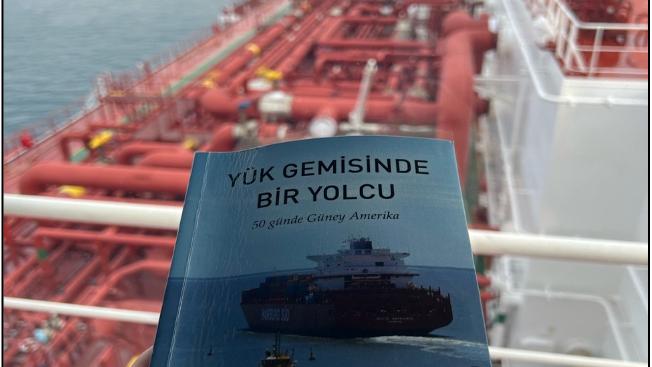
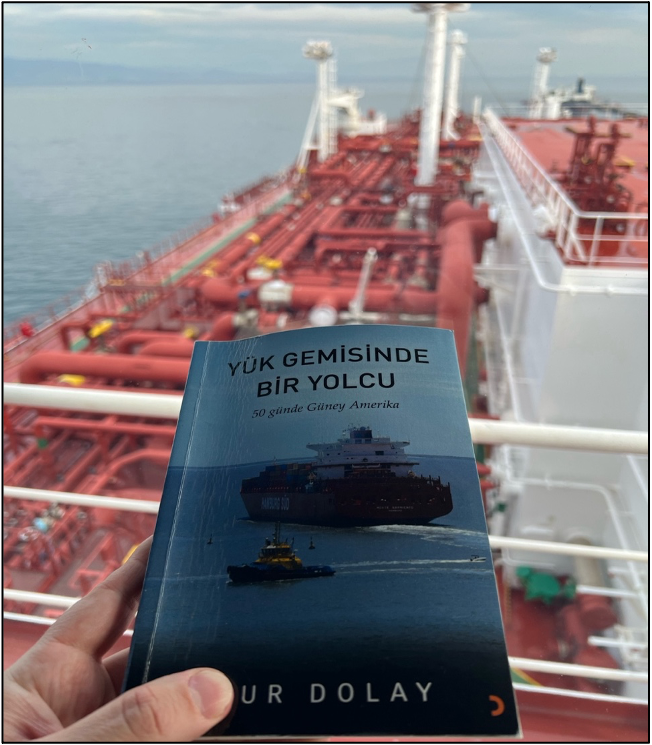
Reading the observations of people from different professions regarding their journeys on cargo ships and viewing the maritime profession from a different perspective has always intrigued me. While researching stories of life at sea on the internet, I stumbled upon the book titled “A Passenger on a Cargo Ship - 50 Days in South America” by journalist, writer, sociologist, and traveler Nur Dolay (Cinius Publications, January 2024, Istanbul, 247 pages). The cover photo featuring a container ship and a tugboat immediately caught my attention, perhaps due to selective perception. After reading the description, I added it to my order list without hesitation, and once it arrived, I read it with great interest in a short period. The author comments on her 50-day journey on a cargo ship chronologically under 48 different headings and sections, while also addressing topics such as the capitalist system, colonialism, and the climate crisis, delivering beautiful messages. In this piece, I will share my review and thoughts on the book.
The author dedicates her book to all maritime workers, indicating that she is not entirely foreign to the maritime sector and has also traveled on passenger ships. Her passion for the sea began in her childhood, during which she dreamed of becoming a ship captain and sailing the world's oceans. This journey on a container ship is her first trip made on a cargo vessel. The author participated in the preparation of the marine-themed documentary program “Thalassa” (meaning “sea” in Greek) aired on a French television channel, and during this process, she joined pilot captains in the transit of oil tankers through the Istanbul Strait for the documentary titled “Danger in the Strait.” Within the book, we can see a summary of the author’s previous diverse and remarkable experiences in the maritime sector (especially in Chapter 4).
The ship hosting the journey is a 214-meter container and car carrier operated by an Italian shipowner. According to the author, the cargo ship appears quite neglected due to its last voyages before being sent for scrapping, and several mechanical failures occur during the journey. The journey, which starts from the port of Hamburg in Germany and lasts for 50 days, visits various ports in Europe, Africa, and America, concluding at the port of Montevideo in Uruguay. The planned duration of the trip was initially projected to be 30-35 days; however, the addition of new stopover ports, delays at African ports, and prolonged waits at some ports during the Christmas-New Year period extended the author's stay on the ship. Accompanied by her husband Jean-Louis and their minibus, which they named “Sputnik,” the author’s main goal is to have a family vacation by reuniting with their daughter, who lives in Los Angeles, at the port where they will disembark. The ability to take their trusty car with them on such a journey on a cargo ship is a significant factor in their choice. The author notes that when the vehicle is on board, it is considered the passenger's luggage, allowing them to disembark with fewer customs formalities at the arrival port. At the beginning of the book, there is a map showing the route the ship followed and the ports it visited.
The crew of the cargo ship consists of Bulgarian officers, while the crew is Filipino. Besides the author and her husband, there are seven other passengers from different nationalities and backgrounds on board with their cars. While reading the author's interesting observations about both the ship's personnel and the other passengers, we cannot say she has a favorable view of the ship's captain and officers. In fact, in one section, she compares the officer personnel to “grumpy salespeople who scold customers in shops.” The captain and other officers are noted to always walk around the ship in shorts, t-shirts, and flip-flops, avoiding interaction with passengers and even being careful not to smile, which the author mentions several times throughout the book. She states that she understands a maneuver is about to happen when the captain changes his clothes and puts on shoes. She suspects that the captain and officers see themselves as “a burdensome load that must be endured.”
The author seems to regard the steward Manolo as a standout among the crew. Steward Manolo is the personnel who provides all kinds of information to passengers, finds solutions to their problems, and even conducts familiarization training on the ship. The author notes that every piece of news from Manolo is as accurate as if it had come from the captain's mouth, dubbing it “kitchen news.” From the details provided, we see that Manolo is a kitchen staff member who takes care of his personal grooming and clothing and enjoys his job. Perhaps we can assume that he is currently continuing his duties as a chef. The fact that both the captain and Manolo give speeches to the staff and passengers during the Christmas celebration evening showcases Manolo's respect in the eyes of the crew. The author cannot help but agree with the observation that “Filipinos have gained a reputation for being hardworking, obedient, and cheerful, doing every task assigned without complaint.”
Among the passengers, the most memorable and unique character is “Alex,” who has trouble with his keys. Throughout the journey, he experiences misfortunes such as a clogged shower drain in his cabin, accidentally throwing his cabin key into the sea, being trapped in the garage for three hours due to the garage door locking while he was getting into his car, and losing the registration of his vehicle on the day he was to disembark.
From the insights gleaned from the book, we can say that the author possesses a curious and free spirit. She has a nature that enjoys minimal living and tranquility. She does not like being in crowded places such as shopping malls and fast-food chains. She is inclined to learn foreign languages, dislikes idleness, and is a person who uses her time efficiently to the extent that she rarely gets bored. She is focused on living every moment to the fullest. Her participation in karaoke with the Filipino staff during the Christmas celebrations and their dancing together is a beautiful example of this. The author describes this Christmas celebration on the ship as one of the happiest Christmases of her life.
The author’s humanistic and maternal approach in her conversations with Filipino sailors is clearly reflected in the anecdotes within the book:
We can discern from the author’s notes that the ship's captain does not exhibit a polite and considerate attitude towards either the passengers or his own crew. The captain's avoidance of engaging in dialogue with passengers and even withholding a smile when they encounter each other leaves a negative impression on the passengers, who are seeing a ship captain for the first time, regarding all ship captains in general.
Passengers can only observe their surroundings from the outside by walking around the living area, meaning they can only do so from the bridge wing. Perhaps the presence of multiple passengers on this particular ship has contributed to this approach, but I still think it would have been possible for passengers to spend some limited time on the bridge during the voyage (i.e., when no maneuvering is taking place).
Despite passengers being required to sign a company dress code policy upon boarding, the author mentions several times that the captain and officers do not adhere to this policy. For instance, on the evening of the Christmas celebration, their participation in shorts, t-shirts, and flip-flops seems strange to the author, who states that she cannot imagine any Turkish captain celebrating in such attire on a holiday. As the author points out, the captain's behavior and attitude towards third parties who have joined the ship from outside are crucial as they serve as an example for the other personnel on board.
The author's only pleasant memory regarding the ship's captain seems to be the surprise cake prepared for him on his birthday and a small treat given by the captain. This birthday celebrated on the ship becomes one of the unforgettable birthdays for the author.
Despite all the negative experiences the author has had with the ship's captain, the expectation of searching for the captain with her eyes as she disembarks and perhaps seeing him wave from a distance unfortunately remains unfulfilled.
Throughout the journey, the author has positive dialogues and impressions with the pilot captains:
- At the port of Dakar, when the Senegalese pilot captain went out to the wing for fresh air, he approached the passengers observing the surroundings with binoculars with a friendly demeanor and provided tourist information about Dakar, making the author feel, in her own words, as if they were no longer on the ship for a moment.
- In the dining room at the port of Rio De La Plata in Argentina, the author engages in a conversation with a pilot captain who is sitting alone, exemplifying Turkish hospitality, and upon learning that the passenger is Turkish, the pilot captain requests Turkish coffee from him.
- While they were photographing a close encounter with another ship moving in the opposite direction in the narrow waterway at the port of Parana in Argentina, the pilot captain engages in conversation with the passengers while out on the wing. While the pilot captain is taking a breather here, he also shares some information about ship traffic with the passengers, and the author appreciates the pilot captain's generous willingness to share information. The same pilot captain also comes to the ship for the departure from the port of Parana and engages in conversation with the passenger again. He even writes down the address of his parents' house in Uruguay, where he spends his holidays, on a piece of paper and tells the passenger that he can stay with them whenever he wants. Since it is the author's birthday that day, she considers this a lovely birthday gift from the Argentine pilot captain.
When reading the author's positive comments about the pilot captains, I am reminded of the late Captain Altay Altuğ's words: “A pilot captain is the first and most important representative of a country at sea.”
The sections I have highlighted and the notes I have taken from the book are as follows:
- The author argues that while major pandemics may pose the greatest threat to old sailors, the significant health issue for modern sailors is the inactivity caused by automation. She notes that there are no longer sailors climbing masts or hauling heavy loads while shoveling coal under steam boilers, and even the steering is automated.
- The author connects the ship's age and poor living conditions with the crew being from an old Eastern Bloc country, predicting that personnel in the West would not accept working under such conditions on such a dilapidated ship.
- The author faces difficulties in reaching suitable places for meals and internet communication in the ports where she can disembark. The prolonged journey and uncertainty create a sense of weariness for the author, making her feel as if she is in a prison. She expresses her longing for walking, swimming, mingling with crowds, seeing different people, and talking. By empathizing with the sailors who are away from their loved ones and countries for long contract periods, she highlights the challenging conditions they must endure and how they are forced to live somewhat disconnected from the world.
- I cannot help but agree with the author's observation regarding her intense interest in maritime vehicles and ships: “Recently, it is hardly possible to see any ships that are aesthetically designed and built according to aerodynamic rules. Each is constructed with the utmost concern for how many containers or cars it can carry. There is no longer a specific general shipbuilding technique.” The author also touches on the different and interesting names given to ships, noting that some names are entirely unsuitable for a ship.
- One of the author's observations regarding the meals on board is that every meal begins with soup, the dishes are generally plentiful and varied, and the crew members are very hungry and eat quickly. Additionally, from the author's observations, we understand that the provisions on this transoceanic ship are planned inadequately, without considering the long and uncertain voyage schedule. We must not overlook the author's remark that “the huge company calculates how to buy a few kilos of fruit a couple of cents cheaper and makes those on board subsist on withered apples and dried-out oranges for a month.”
- When land first appears after crossing the Atlantic Ocean, the author feels a strange fear and the suppressed desire to return to land, a feeling that can only be described by those who have been at sea for a long time. She fears that she may not be able to hold on to land again.
- After departing from the port of Vitoria in Brazil, the author poses a question to the Bulgarian captain of the ship: “Which is more difficult, passing through the Bosphorus or Vitoria?” I would like to share the captain's response verbatim: “Passing through the Bosphorus is much more difficult. In Vitoria, first of all, it is mandatory to take a pilot captain. There is none in the Bosphorus. Companies do not want to spend money on pilot captains; they just say you can pass through. But there is two-way traffic there, and the area is filled with all sorts of boats, especially near Galata. There are currents flowing in opposite directions both above and below in the Bosphorus. On top of that, there are 90-degree turns. Passing through the Bosphorus is the most stressful and challenging.” From this, we can once again emphasize the importance of mandatory piloting for the safety of the Turkish Straits. We can also mention that some shipowner companies pressure captains into passing without a pilot or leave them with no choice. The author touches on this issue at the end of the chapter, criticizing that the documentary they prepared for the program “Thalassa,” titled “Danger in the Strait,” was not sufficiently utilized in lobbying efforts regarding safety in the Turkish Straits.
The author concludes her book without emphasizing her thought that it is impossible to understand the state of mind, feelings, and thoughts of these people with just a single relatively short journey.
I would like to conclude my writing with this quote from the book: “Why did Christopher Columbus, who could have comfortably remained captain between Genoa and other familiar Mediterranean ports, set sail into the unknown? It was a passion, a curiosity that pushed him. A curiosity stronger than his fear.”
Photo: DenizHaber

Photo: DenizHaber
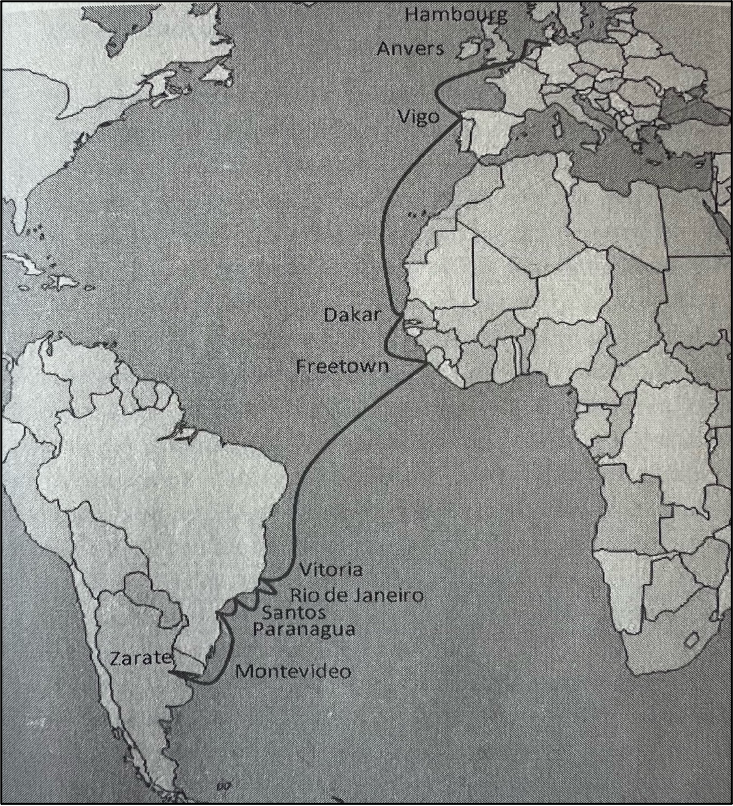
Photo: DenizHaber
Source: www.denizhaber.com