

“Bollard Pull” is a term frequently used to describe the pulling power of tugs in recent years. This term, which is in English, is translated into Turkish as "Pull Force", "Pull Force" or "Hook Force".
The hook power or pulling force of a tug is essentially proportional to its power in BHP (Break Horse Power); so we can calculate the hook force of a tugboat with small deviations for which we know the BHP force. However, there are other factors that affect hook strength. These are the propeller type of the tug, whether the propeller is nozzle (with sleeve) or without nozzle (without sleeve), the boat's slenderness, draft and trim are the most obvious.
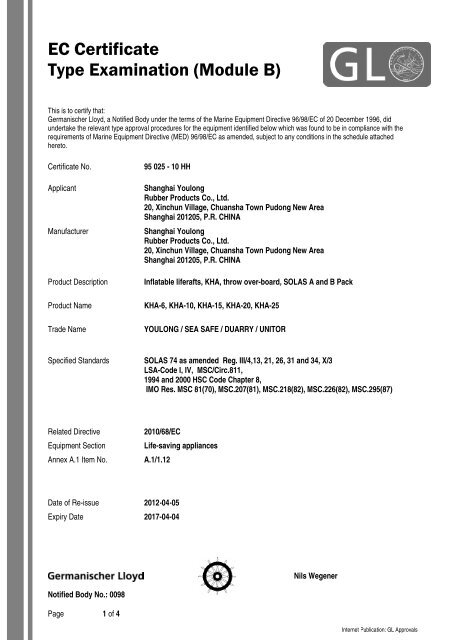
Bollard Pull Test Certificate (Germanischer Lloyd)
How to measure bollard pull? There are two methods for this: the first is measured by connecting to the measuring device in the real environment, the second is measured in the virtual environment. The reason why it is called "Bollard Pull" is because of the actual ambient measurement. As it can be understood from its literal translation (Bollard=Baba, Pull=Towing), the maximum pulling force that the tugboat can apply with the propeller power is calculated, which is attached to a rope (with hook or bollard) attached to a fixed bollard at the quay.
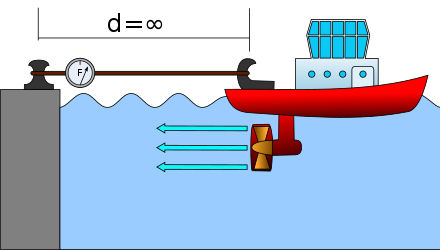
The marine environment in which this test is performed is important for accurate results. The area where the test is carried out must be free of waves, currents and at least 20 meters of water depth. Again, the length of the rope used in this test is also important in order to get accurate results.
Bollard Pull measurement unit is "TON".
Bollard Pull defines the towing capacity of a tug when there is no road on it.
The perception on this subject is often wrong. When the phrase "a tugboat with a pulling force of 40 tons" is said, it is assumed that the tugboat will apply this force in any situation, for example, while traveling at a certain speed. However, the hook force of a tug moving at its maximum speed drops to zero; because in this case, the tugboat in question spends all its propeller power to move through the water.
As we will indicate with a formula below, as the speed increases, the bollard pull value decreases proportionally.
For this reason, we need to know that the hook force of a tugboat that will interfere with a tanker moving at 10 knots in the Bosphorus will be close to zero if this speed does not decrease.
(There are exceptional cases where this example I gave is not valid due to different resistance factors: except the use of the tugboat, where the tanker is tethered from the stern to brake. This is a special case where the hydrostatic resistance of the tug is also included in the hook force. But the same is not the case if the tugboat is leaning from the side, for example, on a tanker traveling at 10 knots, because in this case the tug will use the propeller power more to move through the water.)
So how should we read the given "Bollard Pull" of a tug?
The Bollard Pull is essentially a useful metric to tell you how useful a tug can be when towing a stationary ship or object. It is especially useful to know the bollard pull value when towing a sitting ship in rescue aid activities or lifting the ship from the pier in port operations.
Bollard pull is usually calculated by the class society that classifies the tug by testing in a "real" environment (testing can also be done in virtual environment). This test is done when the tug is first built, but the bollard pull test needs to be done again later (Overhaul) when large machinery repairs or maintenance is done on the tug. The tugboat owners who have this test have a document showing the bollard pull value.
Bollard pull value, like horsepower, is a sought-after value for marketing a tugboat. For this reason, it is a value whose value and effectiveness can be exaggerated from time to time by the manufacturers. However, there is a simple method for calculating the bollard pull value. Let's examine this simple method first:
The difference between the nozzle (with sleeve) propeller and the propeller without nozzle (without sleeve)
In terms of pulling power, the propeller systems (nozzle propeller) placed in a sleeve have a 20%-30% advantage over the propellers without nozzles. For this reason, the calculation method for subtracting the pulling force from horsepower, which we mentioned above, is done separately according to the propeller systems with and without nozzles.
According to this;
In a tugboat with a conventional, nozzleless propeller system, dividing the horsepower in BHP by 100 gives the tug's pulling power (Bollard Pull) in tons.
In a tugboat with a nozzle (sleeve) propeller system, dividing the horsepower in BHP by 85 gives the pulling power (Bollard Pull) of the tug in tons.
For example; The engine power of the tugboat named TDİ Kızkulesi, which has a nozzle system Schottel propeller and serves in İzmir Port, is 4200 BHP. When we divide 4200 by 85, we get 49.4. Indeed, the tested BP value of the TDI Maiden's Tower tug is 50 tons.
Voith-Schneider is in a different classification.
Another example; We find the BP value of the Rescue 6 tugboat with Voith-Schneider propeller system with 5300 BHP engine power by the same method, dividing it by 85, as 62.3 tons. The measured value is 65 tons. (It should be taken into account that there may be a margin of deviation of 5% in this calculation.)
(The Voith-Schneider propeller type, as can be seen in the left picture, is a different system. In this system, which consists of propeller blades rotating on a vertical axis and placed vertically, it is possible to push in almost any direction without the need for a rudder.)
Another powerful tugboat of our country, the TDI Zübeyde Main Tug with Z-Drive propeller system, has a 5500 BHP engine power; When divided by 85, the value is 64.7. The tested bollard pull value of this tug is 65 tons.
In summary, we can say that every 100 horsepower value corresponds to a pulling force varying between 1 and 1.5 tons in tugboats. It is possible to obtain approximate bollard pull values using this method for tugs that have not undergone the bollard pull test.
Detailed Method for "Bollard Pull" Account(1)
Above, I mentioned the simple method of calculating the Bollard Pull value. This formula is a bit more complex, but there is one that gives lower error margins than tugboat types. I'm including those formulas below:
Without Sleeve (No Nozzle) -Fixed Pitch Tugboat:
BHPx0.9x110/100=Bollard Pull(t)
Sleeve (Nozzle)-Fixed Pitch Tugboat:
BHPx0.9x120/100=Bollard Pull(t)
Without Sleeve (No Nozzle) -Variable Pitch Tugboat:
BHPx0.9x125/100=Bollard Pull(t)
Sleeve (Nozzle)-Variable Pitch Tugboat:
BHPx0.9x140/100=Bollard Pull(t)
Bollard pull test in ideal conditions. Note that the propeller is nozzle type. (Figure is from Wikipedia)
Bollard Pull is mostly valid in Europe
While the bollard pull value is generally included in the literature in Europe and major tugboat companies offer test certificates, tugboat companies in America or companies providing support to offshore oil units in the world generally do not need to have the bollard pull value tested and reported. Those who report this value usually report the value they obtained as a result of the calculation we mentioned above, not as a result of a test. In these regions we mentioned, the horsepower value of the tugboat is a more respected form of evaluation.
For convenience, the Bollard pull is not the only or most useful measurement method for describing a tug's towing capacity.
Except for sitting, in all other situations where a tug is needed, the purpose of the tug is to move its tow, tow or push in a certain direction. As we mentioned in the example of the tugboat interfering with the tanker advancing in the Bosphorus at the beginning of our article, a significant part of the pulling power of a tugboat pushing or pulling a ship despite the road on it is spent on the boat resistance of the tugboat itself, and some of it goes to the resistance of the tow rope. It is possible to improve the Bollard pull value according to the impeller and nozzle designs. However, when you do this, this time it will be necessary to sacrifice the pulling force to be applied to the towing rope in case of towing. Such a design will also negatively affect the free forward speed and fuel consumption values. For this reason, when designing tugboats, propeller and nozzle systems adjusted for towing are preferred instead of being attracted to bollard pulls and designing accordingly.
Tugs are generally built to serve at speeds between 4 knots and 8 knots.
Tugboats with nozzle type propeller system have an advantage of 20-30% compared to conventional systems, as can be understood from the calculation methods above, in terms of bollard pull value. Today, tugboats are mostly manufactured with nozzle propeller system. In these tugboats, the pulling force (Bollard Pull) can be high due to the advantage of the nozzle propeller, but this is a disadvantage in terms of service speed and fuel consumption of the tugboat.
If the first priority for a tugboat going to the rescue aid is to reach the accident site quickly, then the nozzle propeller system may be a disadvantage.
Simulation Method
Above, we talked about the applied method of calculating the bollard pull value. In this method, the maximum force that can be applied is calculated by connecting the tugboat to a fixed point with a rope connected to the measuring device.
This calculation can be done in the real environment as well as in the virtual environment.
Bollard pull can be calculated in the simulation environment through a computer program by loading the features of the tugboat. However, only large shipyards can do this, since simulation is a relatively more expensive form of measurement compared to the applied method.
In addition, the simulation method has the flexibility to calculate the pulling force that the tugboat can apply in different usage areas. However, it should be known that there may be a margin of error in the numerical method in the computer environment, depending on the loading details of the criteria.
It is best to use the applied method and the numerical (simulation) method integrated in determining the bollard pull value, if conditions allow.
Bollard Pull-Speed Relationship
There is a direct relationship between the bolt pull of a tug and the speed of the tug. Bollard pull, as we mentioned above, is the pulling power that the tug can apply at maximum propeller speed while on the zero road.
In cases where some of the propeller power of the tugboat is spent moving the tug through the water, the hook power also decreases linearly. We can formulate it as follows:
"0" Speed -100% Propeller Speed = 100% Bollard Pull
Max Speed-Max 100% Propeller Speed = "0" Bollard Pull
There are other factors besides speed that negatively affect hook strength. These can be caused by the tug itself or by environmental conditions. To name a few:
Whether the surface of the tugboat bottom is smooth.
Effect of sea conditions such as tugboat making bow and stern, being affected by waves
Machine cooling problems caused by high seawater temperature.
The factors mentioned above should also be taken into account when calculating the hook strength that will be required in an operation.
Another factor to consider is that the hook force of the tug cannot remain at the specified value for long. When calculating the hook force (Bollard Pull), the highest value is the value obtained immediately after the start of the test. Because the propeller cavitation and rotten water effect that will appear after the first minutes will cause the applied pulling force to decrease. Therefore, as can be seen in the Bollard Pull Document by Germanischer lloyd, cited above, both values are specified, "Maximum hook Force" and "Continuous hook Force". Continuous hook force is the value obtained 10 minutes after the start of the test and usually corresponds to a value of 90% of the maximum hook force.
In real conditions, some power loss due to the heating problem of the tugboat machine should be calculated and the pulling power calculation to be used in the operation should be arranged accordingly.
How much hook strength do I need?
Calculating how much hook power is needed in an operation is not an easy process. Many variables need to be considered. Moreover; Important criteria are the points at which force will be applied by the ship or object to be towed, the weather and sea conditions in the operation area, the hydrodynamic and aerodynamic resistance of the towed vessel or floating object to the tow rope. Factors such as sea condition, wind strength and direction, surface size of the windward area of the ship or object, speed of the ship or floating object are taken into account in the calculation.
Experienced pilots in port operations can easily predict how many tugboats and how much hook power will be needed based on the type of vessel to be towed, the displacement tonnage and hydrodynamic characteristics, taking into account the weather conditions. This is a practical and effective method. But there are also complex formulas for calculating how much hook force will be needed. In addition, there is a simple formula for making this calculation that is not complicated but still gives near-accurate results. We will focus on this simple formula here.
Accordingly, the hook force that will be required to pull a tow with a displacement of 10,000 tons is:
(10.000x60/100.000)+40= 46 tons. (For information: Displacement tons, named after "Displacement", in short, is the weight that can be found to weigh a ship on the scale.)
This is a rough calculation and should be considered as the minimum hook force required. Environmental conditions and the factors mentioned above may require an addition to this account.
This formula cannot be used where less than 40 tons of hook force is required. So, we will focus on another simple formula to use in these situations, this time the BHP formula:
BHP = D 2/3 . v² / 120
D = Reserve's displacement tone
v= pulling speed
If we apply this calculation to our example above; and if we accept the towing speed as 8 knots;
We find BHP=10.000x2/3x8²/120=3555 BHP.
If we convert this value to hook power;
3555/85= 41.83 Tons of hook force required.
In the previous example, the required hook force was 46 tons. The difference here was due to the fact that we also took into account the speed factor.
BHP calculation gives more accurate results than hook force calculation since it also takes into account the speed factor. In any case, it should be acted by making both calculations and knowing that both are for the purpose of giving an opinion, accepting that the real value will emerge in the evaluation of the experts.
---------------------------------------------------------------------
(1) Capt. P. Zahalka, Association of Hanseatic Marine Underwriters