ZIM launches ZX3 service, offering 12-day transit from Shanghai to LA, focusing on reliability amid declining freight rates.
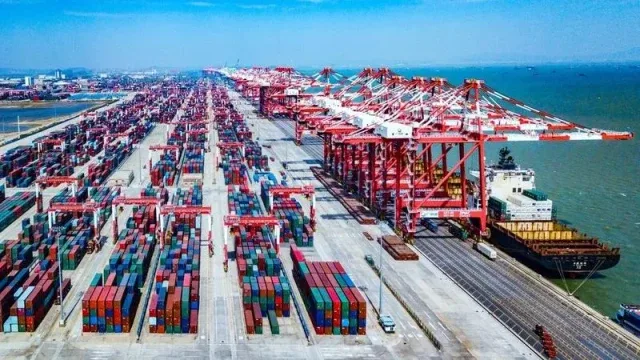
As trans-Pacific freight rates continue to soften, liner carriers are intensifying their investment in transit-time performance. On 30 October, ZIM announced the launch of ZX3, a new service linking Shanghai and Xiamen directly with Los Angeles.
Operated exclusively by ZIM, ZX3 is scheduled to commence operations in December 2026, with a port rotation of Xiamen - Shanghai - Los Angeles - Xiamen. Against a backdrop of declining rates and contracting cargo volumes, ZIM has elected not to compete on price alone, but instead to position transit certainty and speed as its core value proposition, targeting cargo segments prepared to pay a premium for delivery reliability.
According to ZIM's announcement, ZX3 carries the following transit commitments: 12 days direct from Shanghai to Los Angeles, and 15 days from Xiamen to Los Angeles - a performance the carrier describes as 'best in market.' Four operational mechanisms underpin these commitments. First, direct berth access at origin: both Shanghai and Xiamen are direct port calls, with vessels berthing immediately upon arrival. Second, dedicated terminal resources at Los Angeles: vessels call at WBCT, supported by a ZIM-exclusive yard and dedicated gate lanes. Third, Monday arrival with same-day availability: cargo is discharged directly onto ZIM proprietary chassis, with no appointment required and no queuing. Fourth, rapid inland rail connectivity, with onward connections to New York, Chicago, Memphis, Dallas, and Kansas City. With ZX3 integrated into ZIM's existing express network alongside ZEX and ZX2, the carrier's total weekly express sailings from China and Vietnam will reach seven departures.
According to the Drewry World Container Index assessed on 29 October, the Shanghai-Los Angeles rate stood at USD 7,514 per 40-foot equivalent unit, representing a week-on-week decline of six percent from USD 8,007 the prior week. The Shanghai-New York rate registered USD 9,631, down five percent. The same report cited a National Retail Federation forecast projecting an eleven percent month-on-month decline in US seaborne import volumes in November. The decision to launch a transit-time and reliability product - rather than a low-rate offering - during this period of rate softening and volume contraction reflects ZIM's assessment of its target cargo base. The service is not positioned to capture price-sensitive freight; rather, it targets shipments for which '12 days' and 'immediate availability upon arrival' justify a rate premium, typically including cross-border e-commerce, seasonal replenishment cargoes, and categories with firm delivery deadlines.
At the operational level, the speed advantage of ZX3 derives primarily from the compression of waiting time at both ends of the voyage - guaranteed berth availability at origin, dedicated yard and chassis infrastructure at destination, and appointment-free gate access - rather than from an increase in vessel sailing speed. For freight forwarders, the value of these arrangements extends beyond days saved; it lies in the reduction of uncertainty inherent in the transport chain. In a declining rate environment, transit reliability may hold greater appeal for high-value cargo than price reduction alone. It should nonetheless be noted that the express commitment pertains to port-to-port transit time, not door-to-door delivery.
Data compiled by The Dwell from daily two-port rail reports indicates that, as of 26 October, approximately 35,700 import containers at Los Angeles and Long Beach were awaiting rail placement, with 41.4 percent of boxes at Los Angeles having waited more than nine days for rail cars. For shipments destined for inland points, the realization of ZX3's speed advantage is contingent on the rail segment, not on the Los Angeles terminal segment. A 12-day transit to Los Angeles represents the carrier's commitment to the port; a 12-day transit to a customer's warehouse is not an equivalent proposition.
Freight forwarders are advised to incorporate rail dwell times, equipment availability, and inland transfer costs into their comprehensive quotations before presenting ZX3 transit times to inland shippers, and to avoid substituting port-side transit performance for end-to-end delivery expectations. For time-sensitive cargo, it is advisable to confirm chassis and rail connection arrangements in advance, utilizing ZIM's dedicated yard and chassis resources to minimize delay risk between the destination terminal and inland delivery points.