The International Maritime Pilots’ Association explains why pilots avoid inertia reel fall arresters, citing dynamic risks and unreliable onboard conditions.
Introduction The International Maritime Pilots’ Association (IMPA) has issued a new position paper outlining its reasons for recommending that maritime pilots not use fall arresters—also known as inertia reel systems—when boarding and disembarking vessels. Common in the construction industry, these devices rely on seat belt-like reels to stop sudden falls. Yet, IMPA warns that the dynamic nature of ship-to-ship or ship-to-ladder transfers presents a unique set of challenges that could make such systems hazardous rather than helpful.
The Mechanics of Inertia Reels Inertia reels operate on a principle similar to automotive seat belts: when a user moves slowly, the line unwinds freely; when movement is abrupt, the reel locks. IMPA’s paper notes that while this technology is well-known, even the construction sector—where fall arresters are widely deployed—continues to experience a poor safety record. Transferring the same technology to the far less predictable maritime environment, the association argues, introduces added complexity and potential for misuse.
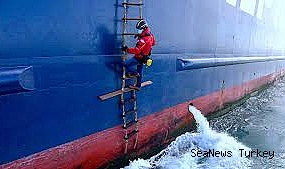
Dynamic Boarding Conditions One of the primary issues IMPA highlights is the inherently unstable setting in which pilots work. When a pilot transfer boat approaches the side of a moving vessel, both crafts can be rising, falling, or rolling at different rates, sometimes by several meters. If a pilot were attached to an inertia reel, sudden changes in relative positions could trigger the reel to lock unexpectedly. For example, if the pilot boat descends into a trough of a wave while the pilot stands on a ladder, the reel might jerk the pilot upward violently, creating a new fall or injury hazard.
Challenges During Boarding and Disembarking The moment of transition from pilot ladder to pilot boat (and vice versa) is typically a carefully timed maneuver. Pilots often jump or step quickly, taking advantage of the boat’s relative motion. With a fall arrester tether, however, the pilot would be restricted from making such agile movements. IMPA warns that the reel cannot differentiate a planned leap from a genuine fall. The risk is that the pilot might be violently yanked mid-transfer. Moreover, attaching the reel’s hook to the ship requires securing it to a robust fixture—something not guaranteed on many vessels, as pilot ladders are often rigged in suboptimal or even non-compliant ways.
Technical and Regulatory Concerns IMPA cites the 2012 amendments to SOLAS Chapter V, where mechanical pilot hoists were disapproved due to their inability to function reliably and safely. The association draws a parallel here, suggesting that an inertia reel system introduces a similarly mechanical, moving part that depends on careful maintenance and correct usage. Further, pilots point out that the device would belong to the ship, which means it would rely on the ship’s crew for storage, inspection, and upkeep. Yet, past experiences show that even the “simplest piece of kit,” the rope ladder, is not always maintained properly.
Real-World Constraints Another practical matter is that around 20% of ships reportedly fail to provide even the most basic, regulation-compliant pilot ladder. If these vessels struggle with routine ladder upkeep, IMPA questions whether they could responsibly maintain an additional fall protection system with more complex mechanisms. Additionally, the potential for hooking the reel’s line to an unsuitable anchor point—like handrails, ventilators, or manifolds—poses a significant risk. Pilots have observed ladders tied to these structures in non-compliant ways, undermining any additional device’s promised safety benefits.
Experience Versus New Technology IMPA underscores that many seasoned pilots have encountered hazards stemming from poor pilot ladder arrangements. Adding a reel system could introduce another layer of unpredictability. The device itself may become a hazard if not correctly handled, potentially pulling a pilot upwards or sideways at the worst possible moment. In contrast, an often simpler, proven method is to use a well-maintained pilot ladder and rely on skilled coordination between the pilot, the pilot boat crew, and the ship’s personnel.
Conclusion While fall arresters are widely used in construction to mitigate falls from height, IMPA insists that maritime pilot transfers are a distinct operational scenario with unique challenges. According to the association, the best path to improved pilot safety lies in enforcing existing ladder standards and ensuring that both the ship’s crew and pilot boat teams collaborate effectively. Far from dismissing new technologies out of hand, IMPA’s stance underscores the need for caution, emphasizing real-world conditions over theoretical benefits. Whether further research or advanced device designs might one day change the equation remains an open question. For now, IMPA advises that conventional methods, carried out correctly, remain the safest approach for pilot transfers.