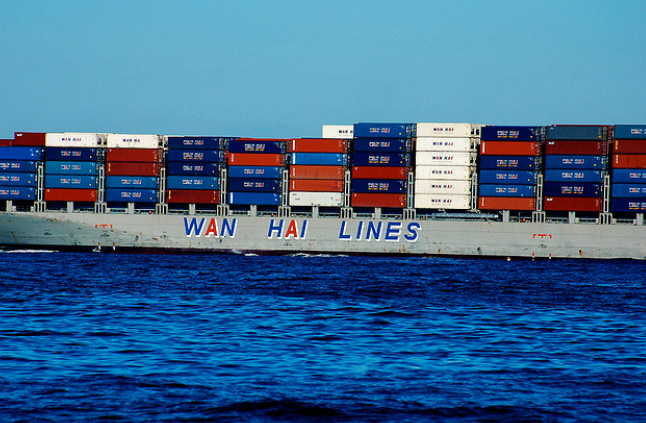
Wan Hai's return to trans-Pacific services has made the Asia-US East Coast its top revenue source, confirming strategic foresight and fleet growth.
Wan Hai Lines' strategic decision to re-enter trans-Pacific services in 2020 has translated into substantial operating returns, with Chairman Chen Po-ting confirming that the Asia-US East Coast lane now stands as the carrier's single largest revenue contributor. The progression from market re-entry to core revenue pillar reflects both the foresight of the company's route selection and the compounding effect of disciplined fleet expansion and capacity deployment.
As reported by shipping media, Chen noted that the 2020 return to the trans-Pacific market represents a successful strategic decision. From 2020 through the third quarter of 2026, Wan Hai recorded a cumulative net profit of approximately NT$300 billion, equivalent to roughly US$9.11 billion. While the company posted a net loss of NT$5.8 billion during the market correction of 2023, the overall operating performance since the pandemic period remains considerable. In the early stages of the pandemic, certain major shareholders expressed concern over the risks associated with large-scale investment should market conditions normalize. Wan Hai responded by adopting a phased investment approach - monitoring market developments while incrementally expanding the fleet - establishing the operational foundation required to compete effectively on trans-Pacific corridors.
To strengthen its competitiveness on deep-sea lanes, Wan Hai pursued a sustained program of fleet growth through the acquisition of secondhand tonnage and the ordering of large containerships. Total fleet capacity now stands at 627,456 TEU, representing an increase of more than 132% from pre-pandemic levels and ranking second among the world's 12 largest container liner operators by capacity growth. Notably, Wan Hai is the only major liner company globally to operate exclusively on an owner-operated basis, without chartering in external vessels. This structure affords the company full control over vessel deployment and capacity allocation, while also requiring commensurate investment in ship acquisition and asset management. Under its current order book, Wan Hai is scheduled to take delivery of 11 newbuildings in 2027 - comprising 10 vessels of 16,000 TEU and one of 8,700 TEU - with the incremental capacity earmarked to serve US East Coast, US West Coast, South America, Middle East, India, and intra-Asia routes.
Against a backdrop of rising global newbuilding orders and market concern over potential capacity oversupply in the coming year, Chen argued that the competitive dynamics of the container shipping industry have fundamentally changed since the pandemic. The sector is transitioning away from oligopolistic competition toward a more structured market environment, and freight rates are no longer determined solely by supply and demand. Geopolitical developments, climate-related factors, port congestion, and logistics bottlenecks each exert meaningful influence on effective capacity and operational efficiency. Chen further cautioned against the assumption that current rate levels should revert to historical norms; as requirements related to green energy, environmental protection, and labor rights continue to intensify, the operating cost base for shipping companies rises accordingly. The implication is significant: even as additional newbuildings are delivered and nominal capacity increases, the conversion into effective transport capacity will not necessarily follow in direct proportion.
From its 2020 re-entry into the trans-Pacific market to the emergence of the Asia-US East Coast lane as its largest revenue source, Wan Hai's fleet expansion and network development have established a durable operational foundation. The delivery of 11 newbuildings in 2027 will further strengthen the company's deep-sea transport capability and support service development across the US East and West Coasts, South America, the Middle East, India, and Asia. Wan Hai's trajectory makes clear that competitive advantage among liner operators rests not on fleet scale alone, but on the quality of route selection, capacity configuration, and market strategy. As global supply chains continue to recalibrate, the Asia-North America trade lane remains a critical arena of competition among major carriers, and Wan Hai is reinforcing its position in the global container shipping market through sustained fleet investment and network optimization.