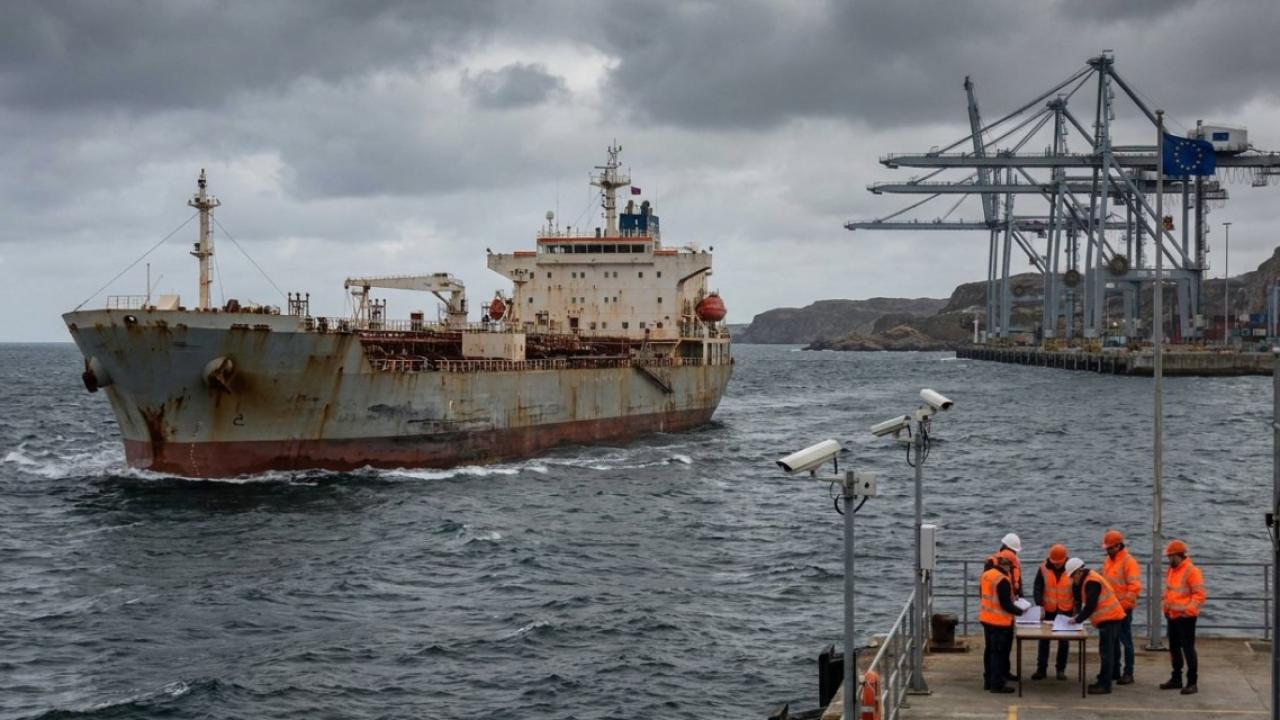
President Trump lifts the maritime blockade, allowing stranded ships in the Gulf to return home amid ongoing tensions with Iran.
U.S. President Donald Trump announced on Friday via his social media account that he would lift the maritime blockade imposed by the U.S. by outlining the conditions for a ceasefire agreement. Without sharing any timeline regarding the process, Trump stated that the ships stranded in the region could now begin their 'return home' process.
According to a report by Bloomberg, approximately one-quarter of the large oil tankers stranded in the Persian Gulf since the onset of conflicts with Iran have managed to leave the region. Based on AIS signals and other maritime data, it is estimated that out of 109 supertankers trapped in the Gulf, 29 have either exited the area or received passage permission from Iran.
However, ship traffic in the Strait of Hormuz is still progressing slowly. Experts indicate that concerns about being stranded in the region for an extended period are influencing the decision of ships to set sail again.
In a joint statement released on Friday, the International Energy Agency (IEA), the International Monetary Fund (IMF), the World Bank Group, and the World Trade Organization (WTO) warned that the current crisis could have lasting economic consequences. The organizations noted that the rapid depletion of global oil stocks, along with ongoing disruptions, could have widespread effects on food and other critical supply chains.
Shortly before Trump's announcement, the U.S. Central Command (CENTCOM) released its daily activity report. The report indicated that the routes of a total of 115 commercial vessels had been altered to prevent entry and exit to Iranian ports. While no details were provided regarding the four vessels that were previously reported as disabled, it was stated that the operation is ongoing and the number of vessels whose routes have been changed is increasing daily.
In his post, Trump stated, 'Due to our incredible and unprecedented maritime blockade, the ships stranded in the strait can now begin their return home process thanks to this blockade being lifted. Say hello to your wives, husbands, parents, and families.'
The U.S. President noted that the lifting of the blockade is part of efforts to fully reopen the Strait of Hormuz. Trump asserted that Iran must open the strait to ship traffic in both directions without any restrictions, stating that the U.S. has neutralized a large portion of the mines in the region, and Iran must immediately clear or destroy the remaining mines.
Among the fundamental conditions put forth by Trump is that Iran must not possess nuclear weapons under any circumstances. He also argued that the enriched uranium, which he claimed is located deep within facilities bombed by the U.S. last year, must be extracted and destroyed. Trump claimed that only the U.S. and China have the technical capacity to carry out this operation, stating that the International Atomic Energy Agency (IAEA) would also be involved in the process. However, he did not provide any assessment regarding the future of Iran's uranium enrichment activities.
Trump did not provide a clear timeline for the process. He announced that he would move to the White House Situation Room to consult with his advisors and then make a 'final decision.' However, according to reports in the U.S. media, Trump left without announcing any decision after a meeting that lasted about two hours.
As for Iran, no official statement has yet been made regarding the conditions proposed by Trump. Hours earlier, a military advisor to Iran's Supreme Leader, Muktaba Khamenei, warned that Iran would respond if the U.S. maritime blockade 'extends beyond a reasonable time.'
Experts agree that Iran's oil exports have largely come to a standstill. In an assessment published by TankerTrackers.com on Wednesday, it was stated, 'Due to the blockade imposed by the U.S. Navy, approximately 60 million barrels of Iranian crude oil are blocked. This means Tehran cannot access about $6 billion in oil revenue.'
The Iranian administration has repeatedly emphasized that any potential agreement must also include the withdrawal of U.S. forces from the region. It is reported that the U.S. currently has about 20 warships in the region to enforce the blockade announced by Trump in mid-April and to maintain control over the eastern entrance of the Strait of Hormuz.
Source: SeaNews Türkiye